Best Tactical Watches of 2026

Rugged watches rarely fail the way the marketing suggests. They fail at a car door, in a hotel shower, or on a wrist that measures 6.5 inches when the spec sheet assumed 8. I've owned tactical-style watches that fogged up after a swim and others so bulky I quietly stopped wearing them — the worse outcome, honestly. The ones that stay on my wrist let me read the time at 3 a.m. without blinding myself, slide under a jacket cuff, and still run a stopwatch and survive a pool two years in. We just spent six months with 12 of them to find out which deserve that.

The backlight turns out to be the feature you use most and the one listings describe least; a watch that's blinding in a dark tent or too dim to find a keyhole is a watch you'll stop reaching for. Case size matters nearly as much, since a 50mm watch and a 39mm watch are different propositions on the same wrist. Below are the ones that held up, from plain digital beaters to a solar-charging smartwatch.

1

Best Overall

Garmin Instinct 2X Solar Tactical

92 /100
LBD Score Outstanding

Key details

Weight
2.36 oz
Battery
Up to 40 days, solar-assisted
Standard
MIL-STD-810
Water Resistance
100 m
View on Amazon

The flashlight decided it for us. Garmin sets an LED into the top of the case with several brightness levels and a strobe, and it is the sort of light that finds a dropped key in a dark footwell without dragging a phone out. Everything else in the tactical brief is there too: a fiber-reinforced polymer case built to U.S. military standard 810 for thermal, shock and water resistance, a 100 m water rating, and multi-band GPS with ABC sensors and TracBack routing that retraces the path you came in on.

Battery life is the second thing you notice. Garmin rates it at up to 40 days in smartwatch mode, and the Power Glass lens adds to that, with three hours of direct sun a day given as the figure for staying off the charger indefinitely. That changes how you pack as much as how you charge: on a long weekend the cable stayed home, and we never thought about it again.

The sensors are where the money goes, and where the watch rewards a bit of setup. Altimeter, barometer and compass sit behind the same handful of buttons, and we spent an evening rearranging the watch face so sunrise and sunset show on the main screen, data you ignore in the city and check constantly above treeline. The interface is not obvious on day one, but the three screens you actually use become habit inside a week.

Pros

  • Built-in LED flashlight with strobe modes
  • Up to 40 days of battery, extended by solar
  • MIL-STD-810 rated for shock, heat and water
  • Multi-band GPS, ABC sensors and TracBack routing

Cons

  • The most expensive watch in this guide
  • 50 mm case and 67 g suit larger wrists
Our verdict

For duty, backcountry navigation, or anyone who wants a flashlight and weeks of battery on the wrist, this is the tactical watch we recommend first.

Check Latest Price
2

Best Value

Casio G-Shock DW9052

95 /100
LBD Score Outstanding

Key details

Battery
2-year battery
Stopwatch
1/100 sec
Shock Resistance
Shock resistant
Water Resistance
200 m
View on Amazon

Only a few watches here carry a 200 m rating, and this is the least expensive of them. For that you get shock resistance, a 1/100-second stopwatch, a countdown timer, dual time, multiple alarms and a two-year battery, the full standard-issue kit with no charger and no app.

What we appreciate most is how little it asks of you. There is no charging routine and no firmware update; the time is simply there when you look. It has gone in the pool, been knocked against door frames and come away with nothing worse than a scuff on the resin, which is exactly the job this watch was built for.

The catch is the alarm. It is polite rather than insistent, so we do not count on it to wake us; set a phone for that and keep this for the time, the stopwatch and the countdown. Beyond that there is very little to object to at this price.

Pros

  • 200 m water resistance at the lowest price here
  • Shock-resistant case that takes knocks
  • Stopwatch, countdown timer, dual time, multi-alarm
  • Two-year battery with no charging routine

Cons

  • Small digits read slowly at a glance
Our verdict

The least expensive way to get a genuine 200 m rating and real shock resistance, and the watch we reach for when we do not want to think about one.

Check Latest Price
3

Best Lightweight

Timex Expedition Camper 39mm

89 /100
LBD Score Excellent

Key details

Weight
1.12 oz
Display
Analog, luminous hands
Case Size
39 mm
Case Material
Resin
View on Amazon

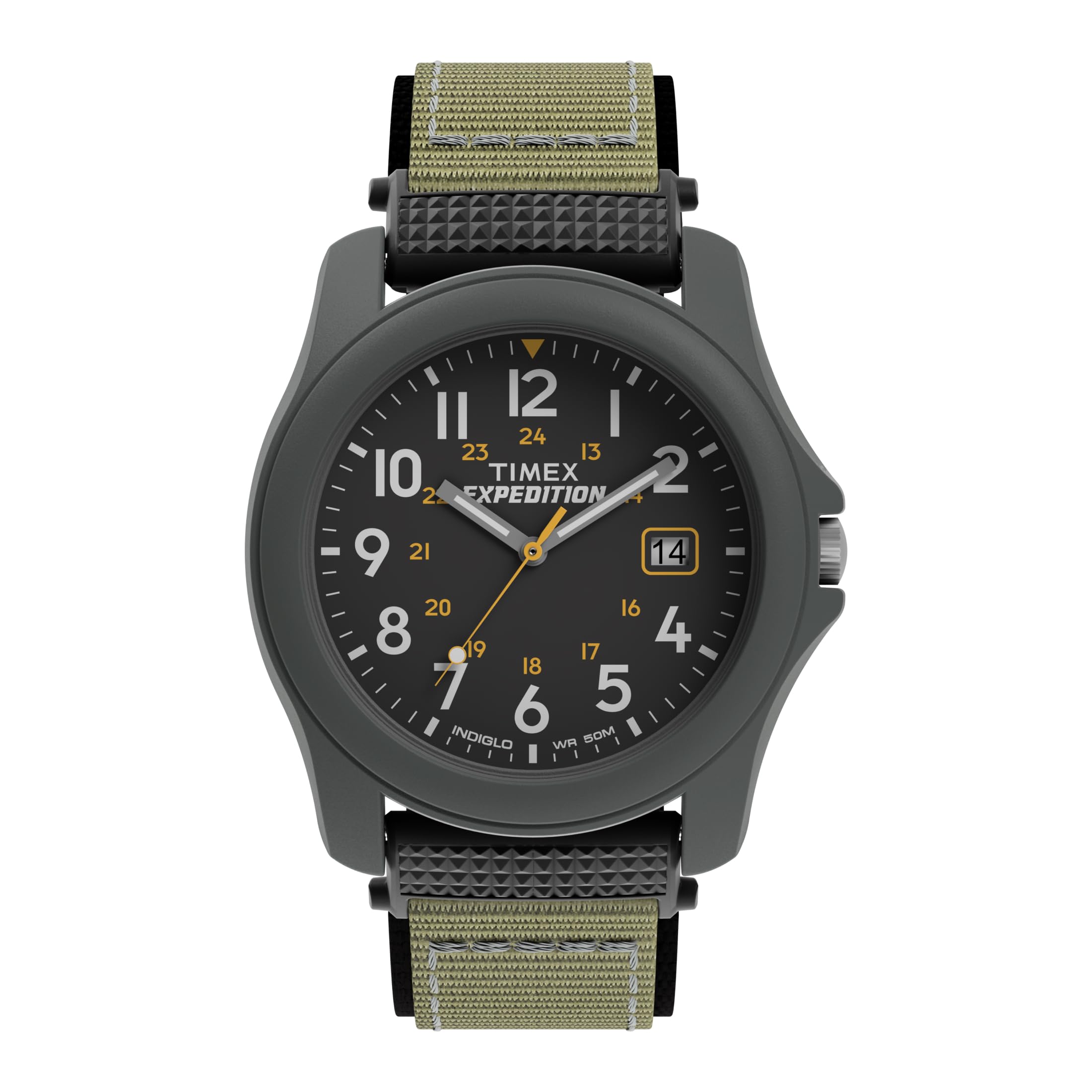
At 1.12 ounces, the Camper barely registers. It is the lightest watch here, and the one that disappears under a cuff, inside a glove, or against a wrist you are using all day.

The dial is why we keep it in rotation. Full numerals, a 24-hour inner track, luminous hands and a 39 mm resin case that sits flat; in daylight the time reads in about half a second, and Timex's Indiglo lights the whole face rather than a corner of it. That pairing is what makes it a better companion than the fussier watches here for a run, a hike or a night in a tent.

The strap runs long, which is worth knowing if your wrist is on the narrow side, since you will be punching an extra hole or swapping the band. Otherwise there is very little to fuss over, and nothing to charge.

Pros

  • Lightest watch in this guide at 1.12 ounces
  • Full-numeral dial that reads at a glance
  • Indiglo lights the whole dial
  • 24-hour track alongside standard numerals

Cons

  • No depth rating, so rain and splashes only
  • No stopwatch, timer or alarm
Our verdict

The watch we put on when we want to forget we are wearing one: light, instantly legible, and the simplest good field watch in this guide.

Check Latest Price
4

Best Analog-Digital

Casio G-Shock GA100-1A1

93 /100
LBD Score Outstanding

Key details

Weight
2.5 oz
Display
Analog-digital
Resistance
Shock and magnetic resistant
Water Resistance
200 m
View on Amazon

Hands are the underrated half of a tactical watch. A glance gives you the time from the analog face without pressing a button or waiting for an LCD to catch the light, and the digital window underneath covers the rest.

Magnetic resistance is the spec we are glad to see and the one most shoppers skip past. It is what keeps the watch honest next to a speaker, a radio or a vehicle dash, the sort of equipment a duty day is full of. Around that sits a 200 m water rating and a case that has taken hits without showing them, which is why this one stays in rotation for shift work and yard work alike.

Setting it takes an evening of patience. The hands and the digital display are set separately, and getting them to agree is the fiddliest part of owning this watch; once they are synced you will not touch it again except at daylight saving.

Pros

  • Analog hands plus a digital window
  • Rated shock and magnetic resistant
  • 200 m water resistance
  • Large face that reads from arm's length

Cons

  • Backlight barely lights the face at night
Our verdict

We recommend it for anyone who thinks in hands rather than digits: analog at a glance, a digital window for detail, and 200 m of water resistance around both.

Check Latest Price
5

Watch-Wrecking Jobs

FANMIS Digital Sport Watch

89 /100
LBD Score Excellent

Key details

Backlight
Switchable color LED
Functions
Alarm, stopwatch, date
Water Resistance
Daily water resistance
View on Amazon

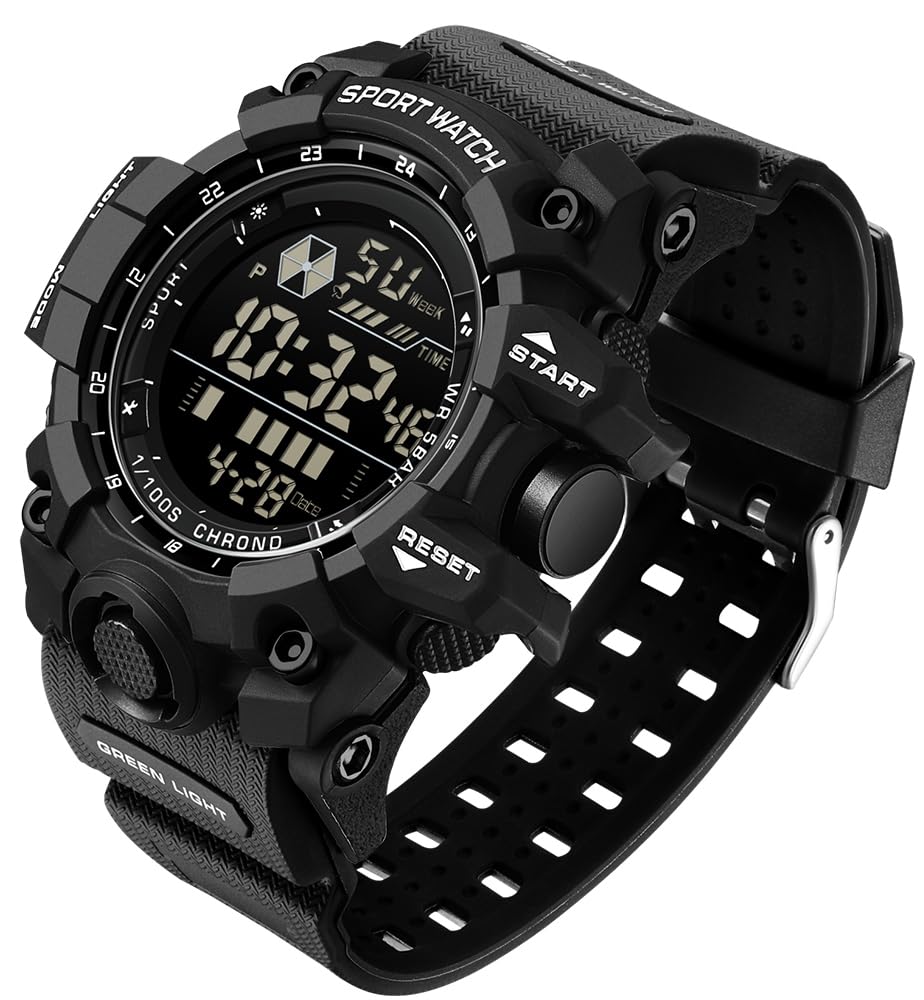
It gets mistaken for a G-Shock, and at arm's length we understand why: the chunky bezel, the resin case, the wide digital display. Then you press the light and the screen cycles through blue, red, orange, purple and green, which is not a trick any G-Shock has.

Setup is a five-minute job and the instructions are readable, which is not always the case in this price bracket. Time, date, alarm and stopwatch, arranged in a menu you can navigate without the manual after the first day. The strap is long enough for a large wrist, and the case wears big without being clumsy.

What it is, honestly, is a watch for the jobs you would not bring a nice watch to. Concrete, paint, a fence line, a muddy walk to a stand; the sort of day where a scratch is the least of it. At the bottom of the market, this is the one we point people toward.

Pros

  • Switchable blue, red, orange, purple and green backlight
  • Five-minute setup with usable instructions
  • G-Shock styling for very little money

Cons

  • Band is the first part to give out
  • Case is bigger than the photos suggest
Our verdict

A big G-Shock-shaped watch with a color-cycling backlight for very little money, and our pick when the watch is the thing most likely to get wrecked.

Check Latest Price
6

Toolbox Spare

KXAITO 6256 Digital Watch

90 /100
LBD Score Outstanding

Key details

Strap
Silicone
Functions
Alarm, stopwatch, date
Water Resistance
Waterproof
View on Amazon

There is a particular freedom in a watch that costs almost nothing. You wear it for the plumbing job, the painting, the muddy hike, and you never once think about whether it will survive.

What surprised us is how much it does: time, date, alarm, stopwatch and a light, all set in a minute or two. It handles plumbing work and worse without complaint, and the silicone strap stays exactly where you put it, which is more than we can say for some bands at several times the money.

It is not a watch you will pass down, and it is not the one for open water. What it is, is the watch that lives in the glovebox or the toolbox and works when you need it, and at the bottom of the price range that is a genuinely useful thing to own.

Pros

  • Cheap enough to keep as a spare
  • Takes a beating in workshop conditions
  • Time, date, alarm, stopwatch and light
  • Silicone strap stays put

Cons

  • Display needs the light in low light
  • Numerals run small for the case size
Our verdict

The cheapest watch here, and the one we point to when the watch itself is likely to get lost, borrowed or destroyed.

Check Latest Price

How We Tested the Best Tactical Watches

We started by pulling together more than 50 watches marketed for outdoor, military, or tactical use, then cut anything without a stated water-resistance rating, a working light, or a case size we could confirm. That left 12, ranging from simple digital watches to a solar-assisted smartwatch. Each one went onto a real wrist for six months — commutes, gym sessions, camping weekends, yard work — and came back with notes.

Every watch got worn in a pool or shower and run under a faucet, then checked for fogging under the crystal and moisture at the case back. We knocked them against door frames and dropped them from waist height onto tile to see whether the crystal and bezel scuffed. Backlights were judged in a pitch-dark room and in daylight, with notes on how much glow spilled and whether we could read the dial without wrecking our night vision; watches with luminous hands got checked after 30 minutes in the dark.

Size and ease of use were the quieter tests. We measured each case across the wrist, watched for strap overhang and buttons that pressed themselves when the wrist bent, and noted whether the watch snagged a jacket cuff. We set the time, date, and alarms on each one without opening the manual and timed how long it took; we also noted which buttons needed a fingernail.

Appearance got graded on the wrist rather than in product photos — strap quality, finish, and whether the case looked scuffed by week two — and at the end we weighed what each watch actually did against what it asked for it. Functionality was mostly a matter of whether the stopwatch, alarms, and dual-time settings were quick to reach or buried three presses deep.

How to Choose a Tactical Watch

Start with the water rating

A 200 m rating is the number to look for if you swim, work on a boat, or get rained on for a living. It is a static pressure test rather than a diving depth, so 200 m means you can swim and snorkel with the watch on, 50 m covers rain and handwashing, and an unrated watch should come off before you get in. Here, the DW9052 and the GA100 both carry 200 m, the Garmin is rated to 100 m, and the Camper publishes no depth rating at all.

We would decide this before anything else, because no other feature makes up for a watch you have to take off. If your days are dry and indoors, the cheaper rating is fine and the money is better spent on legibility.

The display decides how much you will like it

Two watches with identical functions can feel a decade apart because of their screens. A dark negative LCD, with light digits on a black background, looks sharp in product photos and turns into a mirror in direct sun. Backlights vary just as widely: some light the whole dial evenly, others fire one LED from the bottom edge and leave the top half of the face in shadow.

Look for hands and numerals that carry lume as well as a light, and favor a full-dial electroluminescent panel over a single LED. The Timex Camper's Indiglo is the good version of this at a low price, and it is the reason that watch reads as easily at night as it does at noon.

Toughness claims are not equal

Shock resistant is a marketing phrase; MIL-STD-810 is a test standard covering thermal extremes, shock and water immersion. The Garmin is the only watch in this group built to it. Where no standard is stated, judge the design instead: a crystal set below a raised bezel, a resin case rather than polished steel, and pushers that sit protected all do more for survival than an adjective does.

Mud resistance and low-temperature ratings are worth paying for if you work outside in winter or in dirt, and neither is standard across this set.

Battery: decide how often you want to open the case

Every battery change is also a reseal, and a gasket that does not sit properly is how water gets into a watch that used to be fine. A two-year cell keeps the watch cheap and simple to run; a long-life lithium or a solar-assisted rechargeable keeps the case closed for years at a time. The Garmin takes the rechargeable route and pairs a 40-day battery with a solar lens that tops it up in daylight.

Our rule: if you hate charging things, buy a cell. If you want sensors and navigation, accept the cable and the routine that comes with it.

Size, weight and the strap that fails first

Cases in this group run from a 39 mm resin field watch to a 50 mm polymer smartwatch, and the difference shows up in a shirt cuff, in a glove, and in how often you catch your wrist on a doorframe. Weight matters more than diameter for all-day wear; anything near 70 g announces itself by the end of a shift.

The strap is where most of these watches die. Resin and silicone bands split long before a movement gives trouble, so check that the band attaches with standard spring bars and can be replaced with any strap you like rather than a molded part from the maker.

Frequently Asked Questions

Final Verdict

The Garmin Instinct 2X Solar Tactical is the one we recommend when a watch has to do more than tell time. Navigation, a flashlight and weeks between charges are capabilities nothing else in this guide offers, and they are worth the premium if you actually go where they matter.

If you only need the time, 200 m of water resistance and a case that survives concrete, the Casio DW9052 does that job for a fraction of the money and is the watch that lives in our bag. Buy the Garmin for capability; buy the Casio for the days you would rather not care.