Best Studio Microphones of 2026

A microphone has one job: capture the voice or instrument in front of it and ignore everything else — the laptop fan, the radiator, the dog two doors down. That second half of the job is where most first purchases go wrong, and it's why two mics with near-identical specs can sound completely different in the same untreated bedroom. My own first condenser was so sensitive I could follow my downstairs neighbor's television plot through my headphones.

The decision usually comes down to two forks: USB or XLR, and dynamic or condenser. USB mics are plug-and-play and forgiving of a bad room, while XLR mics need an interface but leave you a path to upgrade later. Dynamics shrug off background noise but demand more gain, and condensers capture detail you didn't know you were making. Over the past six months we've run 14 microphones through the same sessions — voiceover, singing, acoustic guitar, a drum kit, and plenty of late-night streaming — to find the ones that actually earn a spot on the desk.

1

Best Overall

Audio-Technica AT2035

94 /100
LBD Score Outstanding

Key details

Capsule Type
Condenser
Connectivity
XLR
Polar Pattern
Cardioid
Included Mount
Shock mount
View on Amazon

The AT2035 arrives with the accessory that usually costs extra: a custom shock mount. That is the first sign this is a studio tool rather than a desktop gadget. It is a large-diaphragm cardioid condenser with an XLR output, a switchable 80 Hz high-pass filter, and a 10 dB pad. The pad matters if you record a loud guitar amp or a hard-hitting drummer; the filter cleans up rumble from a desk or floor.

We think it is the most sensible first serious studio mic in this group because it covers vocals and instruments without asking you to work around a narrow specialty. The low self-noise and cardioid pattern make it easy to place for a single voice, and the shock mount keeps stand thumps from traveling into the take. Compared with the SM7B, it gives you more detail on acoustic guitar and room sound, which is either the point or the problem depending on your space.

The trade-off is that it is XLR-only, so it needs an interface with phantom power. That is the normal cost of moving beyond a USB mic, and the AT2035 leaves room for a basic interface in the budget. We also appreciate that the body is metal and the mount is a proper shock design rather than a clip. That matters when you are recording at a desk and every keyboard tap has a path into the mic.

For a first serious condenser, the complete package is the quiet advantage: you can put it on a stand, add phantom power, and start learning placement without chasing accessories. That is a better use of a studio budget than a mic with more switches and a flimsier mount.

Pros

  • Included shock mount adds isolation
  • Low self-noise keeps vocal takes clean
  • Pad and high-pass filter handle loud sources
  • Strong value for a serious condenser

Cons

  • No XLR cable included
Our verdict

We recommend the AT2035 as the best overall studio mic here for a home recordist who owns an interface and wants one condenser that handles vocals, acoustic instruments, and loud sources.

Check Latest Price
2

Best for Untreated Rooms

Shure SM7B

96 /100
LBD Score Outstanding

Key details

Capsule Type
Dynamic
Connectivity
XLR
Polar Pattern
Cardioid
Recommended Gain
60 dB
View on Amazon

The SM7B asks for gain before it gives you anything. Shure recommends at least 60 dB, and that number is the difference between a smooth broadcast voice and a thin, noisy signal. If your interface has a clean, high-gain preamp, the mic rewards it; if it does not, budget for an inline preamp or a better interface.

What you get in return is one of the best close-voice mics here. The cardioid dynamic capsule and air-suspension shock isolation are built to ignore the room, and the internal pop filtering and detachable windscreen tame plosives without extra accessories. We found it especially easy to keep a voice consistent because the mic does not ask you to work the distance as precisely as a sensitive condenser.

We keep coming back to it for spoken word, podcasts, and close vocals in rooms that are not treated. On acoustic guitar or a detailed instrument track, it is not the most revealing choice; the AT2035 or SM57 will show more of the string and body. The SM7B is a specialist, and that is why we like it.

The all-metal body feels like it will survive a desk knock, and the yoke mount makes it easy to angle. It is expensive, but the cost is not only the mic: the gain requirement is part of the purchase. If you have the preamp, it is the one we reach for when the room is the problem.

Pros

  • Excellent room rejection for close voice
  • Warm broadcast-style vocal tone
  • Rugged all-metal build with shock isolation

Cons

  • Premium price for a vocal specialist
Our verdict

We recommend the SM7B for close vocals and podcasting in untreated rooms, provided you have a clean interface with enough gain to drive it.

Check Latest Price
3

Best for Instruments

Shure SM57

96 /100
LBD Score Outstanding

Key details

Capsule Type
Dynamic
Connectivity
XLR
Polar Pattern
Cardioid
Frequency Response
40 Hz–15 kHz
View on Amazon

The SM57 is the other Shure dynamic we kept reaching for, but it is a different tool: where the SM7B flatters a close voice, the SM57 is built to sit inches from a snare, a guitar cab, or a horn. Its contoured presence boost makes attack and detail cut through a mix, and the cardioid pattern keeps bleed under control when you are close-miking.

We like it most on guitar amps. Put it near the grille and it captures the bite and body without needing a lot of setup. It also handles high sound pressure levels, so a loud drummer or a brass section is not a problem. The all-metal body and swivel stand adapter make it easy to move between rooms, and the small size helps in tight spots.

For vocals, it can work, but it is not the forgiving choice. You need to stay close, use a pop filter, and accept a mid-forward sound that favors intelligibility over air. That is why we see it as an instrument mic first and a utility mic second.

The SM57 is not the mic we choose for a warm lead vocal, but it is the one we keep on hand for everything else. If you record amps or drums, it earns its place before a lot of pricier mics.

Pros

  • Excellent on amps, drums, and horns
  • Presence boost cuts through a mix
  • Rugged all-metal body travels well

Cons

  • No XLR cable included
Our verdict

We recommend the SM57 as the instrument-first dynamic in this group, especially for guitar amps, drums, and horns, with close vocals as a secondary job.

Check Latest Price
4

Best USB All-Rounder

Blue Yeti

93 /100
LBD Score Outstanding

Key details

Capsule Type
Three-capsule array
Connectivity
USB
Polar Patterns
Cardioid, omni, bidirectional, stereo
Onboard Controls
Headphone volume, pattern, mute, gain
View on Amazon

If you do not own an audio interface, the Yeti is the mic that gets you recording tonight. It is a USB condenser with a three-capsule array, four pickup patterns, and onboard controls for headphone volume, pattern, mute, and gain. The headphone jack gives you zero-latency monitoring, which is a bigger deal than it sounds when you are trying to stay on pitch.

The patterns do real work. Cardioid is the default for one voice; bidirectional is useful for a two-person interview; omni picks up a group around a table; stereo gives you a wider ambient capture. The pattern dial is on the mic, so you can change the setup without opening software.

The caveat is sensitivity. A condenser like this hears the room, the keyboard, and the fan, so close-miking and a quiet corner matter. The desktop stand is also bulky and transmits some handling noise, which is why a boom arm or shock mount is a sensible next purchase. Those are normal USB-mic trade-offs, not deal-breakers.

We think the pattern dial is what keeps the Yeti useful after the first recording: you can switch from a solo voice to a two-person interview without moving the mic or opening software. For a USB mic, that flexibility is the real reason to choose it over a cheaper single-pattern model.

Pros

  • Four pickup patterns in one mic
  • USB plug-and-play with onboard controls
  • Headphone monitoring for zero-latency tracking
  • Solid metal build for the money

Cons

  • USB-only; no XLR upgrade path
Our verdict

We recommend the Yeti as the best USB all-rounder for a home recordist who wants four patterns and plug-and-play recording without an interface.

Check Latest Price
5

Best Budget Dynamic

RØDE PodMic

96 /100
LBD Score Outstanding

Key details

Included
Internal pop filter and shock mount
Capsule Type
Dynamic
Connectivity
XLR
Polar Pattern
Cardioid
View on Amazon

We think the PodMic is the value pick among the dynamic broadcast mics here, and it feels like a much more expensive microphone. The body is all metal, the internal pop filter and shock mounting are built in, and the integrated swing mount makes it easy to angle on a desk or boom arm. It is XLR-only, so it is not a USB shortcut.

We like it for podcasting and close voice because the dynamic capsule is tuned for speech and rejects some room noise. The internal pop filter means you can skip an external one for most close work, and the shock mount helps with desk thumps. It is a low-output mic, though, so a basic interface can run out of clean gain; plan for a preamp with headroom.

The weight is the other practical detail. At 937 grams, it needs a solid boom arm or stand, and a lightweight arm will sag. That is a fair trade for the metal build, but it is worth checking before you buy. We also found the sound is more broadcast than airy; it flatters speech and makes close vocals sound present.

If you already have an interface and want a durable dynamic for talking, the PodMic is a strong value. It is not the mic we choose for acoustic instruments, but it is one we are happy to leave set up for daily voice work.

Pros

  • Internal pop filter and shock mount
  • All-metal build feels purpose-built
  • Clear broadcast voice tone

Cons

  • Heavy for lightweight boom arms
Our verdict

We recommend the PodMic as the best budget dynamic for podcasting and close voice, as long as your interface has enough clean gain and your stand can handle its weight.

Check Latest Price
6

Best Starter USB/XLR

Samson Q2U

91 /100
LBD Score Outstanding

Key details

Included
Tripod stand, clip, windscreen, cables
Capsule Type
Dynamic
Connectivity
USB-C and XLR
Polar Pattern
Cardioid
View on Amazon

The Q2U's trick is simple: it is a dynamic mic with both USB-C and XLR outputs, so you can start recording without an interface and move to one later. The box includes a tripod stand, mic clip, windscreen, USB-C cable, and XLR cable, which makes it one of the few true starter packs here.

We think it is the best starter USB/XLR mic because it removes the first purchase decision. Plug it in over USB, record a podcast or voiceover, and add an interface when you want more control. The dynamic cardioid capsule is more forgiving of room noise than a condenser, and the handheld form is easy to position close.

The capsule is still a dynamic, not a magic room filter. In a live room it picks up some surrounding noise, so close placement matters. The USB side is the simpler path; the XLR output is what lets you grow, but it needs an interface with enough gain.

For a beginner who wants one mic to learn on, the Q2U is a smarter first buy than a cheap USB condenser. It gives you a path to XLR without forcing the interface purchase on day one.

Pros

  • USB-C and XLR in one mic
  • Includes stand, clip, and cables
  • Dynamic capsule rejects some room noise

Cons

  • Headphone jack can fail over time
Our verdict

We recommend the Q2U as the best starter USB/XLR dynamic for a beginner who wants to record now and move to an interface later without buying a second mic.

Check Latest Price
7

Best Complete Kit

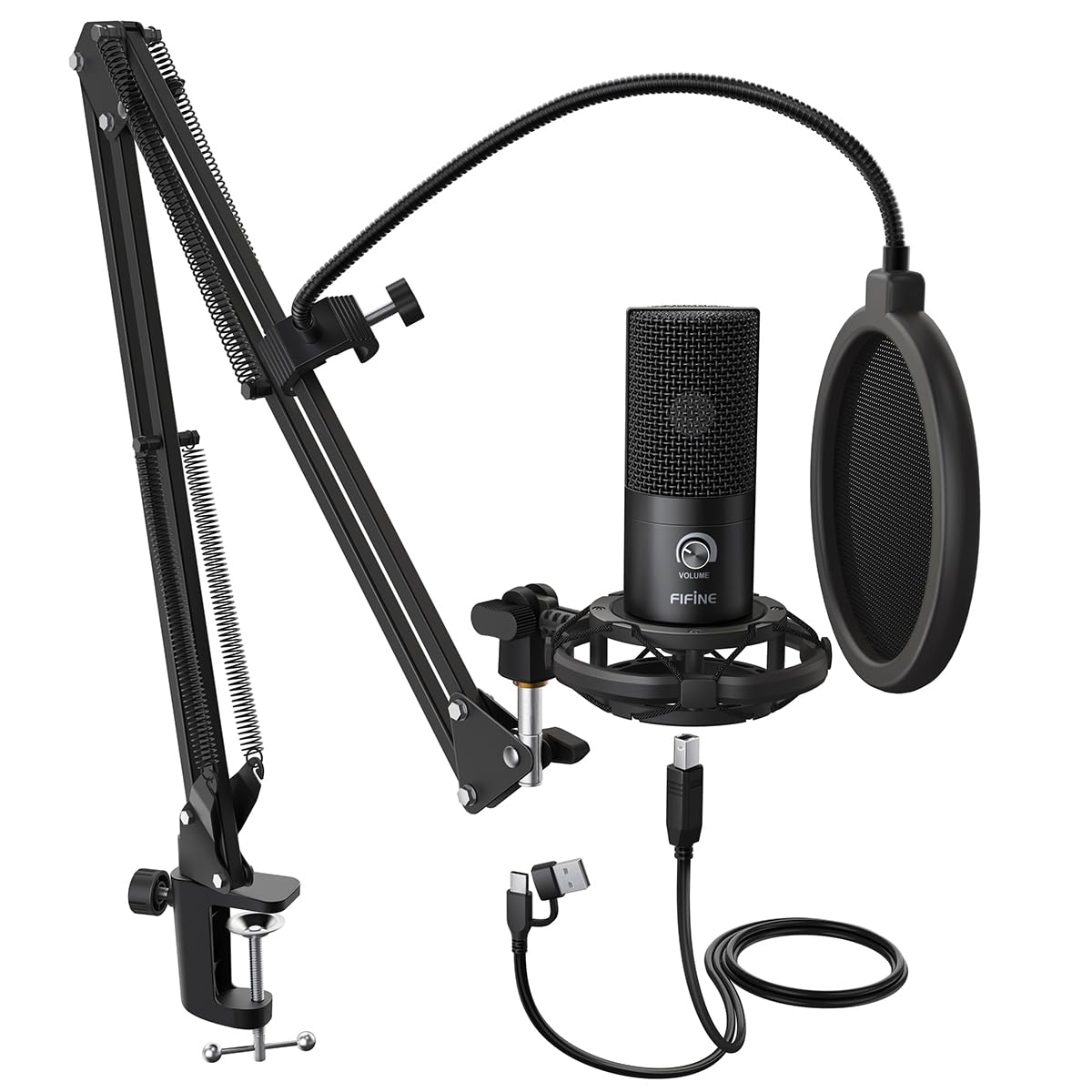
FIFINE T669

93 /100
LBD Score Outstanding

Key details

Included
Boom arm, shock mount, pop filter
Capsule Type
Condenser
Connectivity
USB
Polar Pattern
Cardioid
View on Amazon

The T669 is less a microphone than a starter studio in a box: boom arm, shock mount, pop filter, windscreen, and USB cable all arrive together. The mic itself is a USB condenser with a cardioid pattern and a gain knob, so you can plug it into a laptop and start recording without an interface.

We like it for a first desk setup because the arm gets the mic off the desk and the shock mount helps with bumps. The sound is clear enough for voiceover, podcasting, and casual music recording, and the USB connection is genuinely plug-and-play. It is not a detailed studio condenser, but it is not priced like one.

The arm and clamp are the parts that remind you of the price. They are fine for a stationary desk, but they can feel wobbly if you move the mic often, and a heavy-handed adjustment can be frustrating. We think the mic is the keeper; the mount is the upgrade path.

If you want a complete first setup and do not need XLR, the T669 is a low-risk way to start. It is the kit we hand to someone who wants to be recording in an afternoon.

Pros

  • Complete kit with arm and shock mount
  • USB plug-and-play setup
  • Clear voice for the money

Cons

  • USB-only; no XLR upgrade path
Our verdict

We recommend the T669 as the best complete budget kit for a beginner who wants a mic, boom arm, and shock mount in one plug-and-play purchase.

Check Latest Price

How We Tested the Studio Microphones

We started by rounding up the mics that come up again and again in studio and streaming threads, then filtered that pool by connection type, capsule, polar pattern, what ships in the box, and price, so the final group covered USB, XLR, and hybrid models at every budget. Fourteen made the cut, and they stayed set up on our desks for six months.

Testing happened where these mics actually live: a home desk with a laptop fan, a mechanical keyboard, and a radiator that clanks. Each one recorded the same 60-second spoken script, a sung verse, a strummed acoustic guitar, and a snare drum close up, with gain set so peaks matched across the board. We also streamed, sat through video calls, and typed mid-sentence to hear exactly what bled through.

We timed setup from unboxing to first recording and noted who needed drivers or software and who needed an interface just to be heard at all — a few gain-hungry dynamics only came alive past 60 dB. To judge noise rejection, we spoke into the front, then turned each mic 90 and 180 degrees and compared how much room and keyboard noise tagged along. For durability, we handled every body, coiled and uncoiled the cables repeatedly, and checked whether the bundled shock mount or pop filter did anything at all, since what's included changes the real value of the purchase.

How to Choose a Studio Microphone

USB or XLR: Start With Your Workflow

USB mics like the Blue Yeti and FIFINE T669 contain their own preamp and often a headphone jack, so they are the fastest route to recording. The trade-off is a closed path: you cannot swap in a better preamp later, and the mic and electronics age together. XLR mics like the AT2035, SM7B, and PodMic need an interface with a mic input; condensers also need phantom power. Budget for the cable, stand, and interface, not just the microphone. If you already own an interface, an XLR mic gives you more room to upgrade; if you do not, a USB model is the lower-friction start.

Condenser or Dynamic: Match the Mic to the Room

Condensers are more sensitive and detailed, which makes them natural for vocals, acoustic guitar, and quiet studios. That sensitivity also means they hear fans, keyboards, and reflective walls. Dynamics are less detailed but more forgiving of an untreated room, which is why the SM7B and PodMic are popular for close speech. Pick a condenser when you have a quiet space and want detail; pick a dynamic when you record close and need the room to stay out. Neither type cancels noise, so placement still matters.

Pickup Patterns and Placement

Cardioid is the default for a reason: it picks up mostly what is in front and rejects the rear, which helps with isolation. The Blue Yeti adds omni, bidirectional, and stereo patterns; omni is useful for a group around a table, bidirectional for a two-person interview, and stereo for ambient capture. For most home-studio vocals and instruments, cardioid is enough. The trap is assuming a pattern fixes a bad room; it changes what the mic hears, not how the room behaves.

Accessories, Gain, and Hidden Costs

A shock mount, pop filter, and solid stand are not optional extras once you start recording seriously. The AT2035 includes a shock mount; the FIFINE T669 includes a full arm and mount; the SM57 and several others do not include a cable. Dynamic mics also need clean gain, and the SM7B is the clearest example at a recommended 60 dB. Check your interface's gain before you buy a low-output dynamic, and check the weight of the mic before you hang it on a lightweight boom arm.

Frequently Asked Questions

Final Verdict

For most home studios, the Audio-Technica AT2035 is the one we recommend first. It is a true studio condenser with the shock mount, pad, and high-pass filter already in the box, and it handles vocals, acoustic instruments, and loud sources without becoming a one-trick mic.

If your room is untreated and you mostly record close voice, the Shure SM7B is the better buy, provided you have clean gain. If you want to skip the interface entirely, start with the Blue Yeti.