Best Studio Headphones for Mixing of 2026

Open-back headphones can make a mix feel like it's floating in front of you, but they broadcast every cymbal hit to the room. Closed-backs keep the sound in, though some make the low end feel sealed off. For mixing, the real question isn't which pair wins on a spec sheet—it's which one lets you hear the midrange clearly enough to fix a vocal and stays comfortable through the third hour.

I've been mixing on headphones for years, and my team and I spent seven months testing ten pairs across both designs. We listened for how vocals sat, how bass translated to speakers, and whether the top end turned harsh. Comfort, fit, and weight mattered as much as sound; so did build quality and whether the cable and pads could survive daily use. None of these are active noise-canceling, but the closed-backs offer enough isolation for a home studio, and these are the pairs we'd spend our own money on.

1

Best Overall

Audio-Technica ATH-M40x

93 /100
LBD Score Outstanding

Key details

Cable
Detachable
Impedance
35 ohm
Driver Size
40 mm
Frequency Range
15 Hz - 24,000 Hz
View on Amazon

The ATH-M40x is the pair in this set that Audio-Technica explicitly tunes flat, and that is the right place to start for mixing. The 40 mm drivers and closed-back cups give you a contained sound, while the 35-ohm impedance means it runs from a laptop or a basic interface without a dedicated amp. The detachable cables and 90-degree swiveling cups are practical studio details: you can replace a damaged cable and listen with one ear when you need to check a room or a take.

We kept the M40x on for balance checks because it doesn't flatter low end the way some closed-back pairs do. It won't match an open-back model for width, but the trade is isolation and less bleed into a microphone. That flat-leaning tuning is the reason it earns top pick: it gives you a stable reference without asking for extra gear. We also appreciate that the cups fold and the case keeps the spare cable with the headphones.

For a first serious mixing pair, this is the one we hand to someone who wants a neutral starting point and doesn't want to rebuild their desk around a headphone amp. It is less forgiving of a poor mix than the M50x, and that is the point. The M40x tells you what is there rather than adding excitement.

Pros

  • Flat-leaning tuning for balance checks
  • Detachable cables are easy to replace
  • Swiveling cups help one-ear monitoring
  • Closed-back cups limit bleed

Cons

  • Firm clamp on larger heads
Our verdict

We recommend the ATH-M40x as the default mixing pair here: its flat-leaning tuning, closed-back isolation, and detachable cables make it a dependable first reference without an amp.

Check Latest Price
2

Best Closed-Back All-Rounder

Audio-Technica ATH-M50x

95 /100
LBD Score Outstanding

Key details

Cable
Detachable
Impedance
38 ohm
Driver Size
45 mm
Frequency Range
20 Hz - 28,000 Hz
View on Amazon

If you want one closed-back pair for tracking, editing, and everyday listening, the ATH-M50x is the one we point to in this set. Its 45 mm drivers give it more low-end weight than the M40x, and the 38-ohm impedance keeps it easy to drive from an interface or laptop. The three detachable cables and 90-degree swiveling cups are genuinely useful: you can swap to a coiled cable at the desk or go straight when you move around.

We found the extra bass makes it a friendlier listen for long editing sessions, but it is also why we keep the M40x for balance decisions. The M50x flatters kick drums and bass guitar; that can be satisfying, and it can hide a mix that is already lean. For tracking, the closed cups and swiveling design are the bigger win. The clamp is snug, and the pads can warm up after a couple of hours, so it rewards a short break.

The M50x is the more forgiving all-rounder of the Audio-Technica pair, and that is why it stays in the set. It is not the most neutral closed-back here, and we don't pretend otherwise. If your work is mostly tracking and you want a listen that stays fun, it is the easier recommendation; if you need a cleaner balance reference, the M40x is the better tool.

Pros

  • More low-end weight than the M40x
  • Three detachable cables in the box
  • Swiveling cups for one-ear work
  • Easy to drive at 38 ohms

Cons

  • Ear pads are the first wear point
Our verdict

For a closed-back pair that handles tracking and listening, the ATH-M50x is our pick, with sturdy swiveling cups, three cables, and more low-end weight than the M40x.

Check Latest Price
3

Best for Long Sessions

beyerdynamic DT 770 Pro

93 /100
LBD Score Outstanding

Key details

Cable
3 m (9.8 ft) straight
Design
Closed-back
Ear Pads
Black velour
Impedance
80 ohm
View on Amazon

Velour ear pads are the reason the DT 770 Pro stays on through a long session. The 80-ohm version sits in a useful middle for a home studio: easy enough to drive from an interface, high enough to benefit from one. The closed cups cut leakage, and the 3 m straight cable gives you room to move at the desk.

The velour is soft and breathable, but it doesn't seal like pleather. If you need maximum isolation in a loud room, the Sennheiser HD 280 Pro is the stronger choice; the DT 770 is the more comfortable long-haul wear. The metal joints and headband feel built to take daily use. We also appreciate the black finish and purposeful feel.

We reach for the DT 770 when a session runs long and isolation still matters. It has a balanced, detailed character that makes edits easy to hear, and the velour pads keep heat down. It isn't the widest-sounding closed-back here, but it is the one we trust for hours at a desk. The 80-ohm model is the version to get for a typical interface; the higher-impedance version asks for more gain.

Pros

  • Velour pads stay comfortable for hours
  • Closed cups keep bleed down
  • Balanced detail for editing
  • 80-ohm load suits an interface

Cons

  • Fixed cable cannot be replaced
Our verdict

The DT 770 Pro is the closed-back pair we choose when comfort has to last: velour pads, an 80-ohm load that suits an interface, and a balanced sound for long edits.

Check Latest Price
4

Best Open-Back for Soundstage

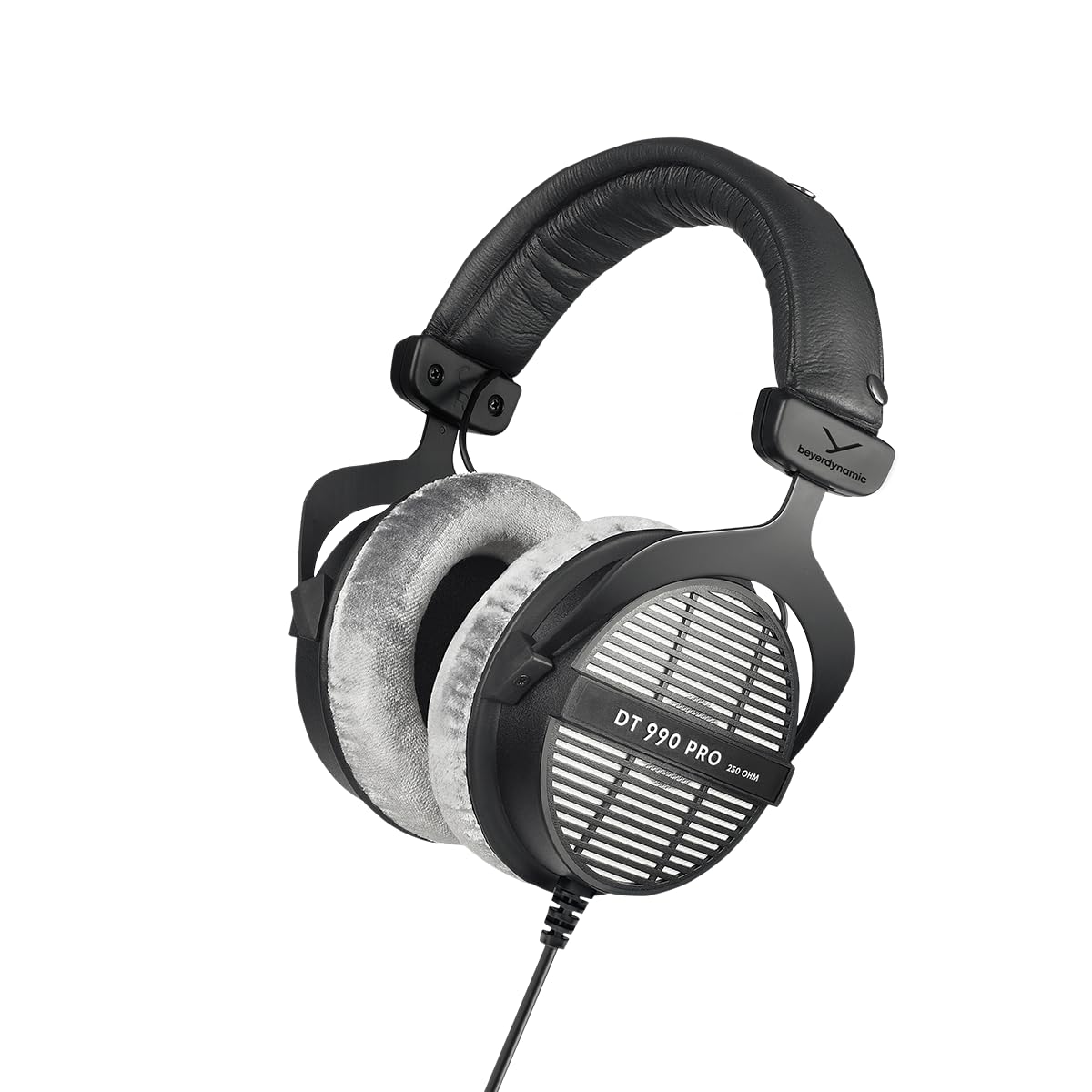
beyerdynamic DT 990 Pro

93 /100
LBD Score Outstanding

Key details

Cable
3 m coiled
Design
Open-back
Impedance
250 ohm
Frequency Range
5 Hz - 35,000 Hz
View on Amazon

The DT 990 Pro is the open-back pick here, and the 250-ohm impedance is the first thing to plan around. It needs an audio interface or headphone amp to reach useful volume; straight from a laptop or phone it will feel weak. Once driven properly, the open-back design gives a wide stereo image and a sense of depth that closed cups can't match.

We choose the DT 990 when placement and depth matter more than isolation. The open cups let you hear the room, which is helpful for checking a mix but bad for tracking vocals or working near noise. We found the velour pads comfortable and the spring-steel headband secure without a vice-like grip. The treble is lively, so bright mixes can feel forward; we keep a darker reference handy.

It is not the pair for a shared room or a noisy apartment. For a dedicated studio desk with an interface, though, it earns its place. The open-back presentation makes reverb tails and pan positions easier to judge, and the replaceable pads and headband stretch the service life. The practical limit is the amp, not the headphone.

Pros

  • Wide open-back soundstage for placement
  • Strong depth for pan checks
  • Velour pads comfortable for long sessions
  • Replaceable pads and headband

Cons

  • Fixed coiled cable is heavy at the desk
Our verdict

If your desk has an interface, the DT 990 Pro earns its place as the open-back reference here, with a wide image for pan and depth and comfort for long sessions.

Check Latest Price
5

Best Lightweight Folder

Sony MDR-7506

95 /100
LBD Score Outstanding

Key details

Cable
9.8 ft fixed
Impedance
63 ohm
Driver Size
40 mm
Frequency Range
10 Hz - 20,000 Hz
View on Amazon

The MDR-7506 folds into a compact shape and comes with a soft case, which is why it is the pair we pack for field recording or a session away from the desk. The 40 mm drivers and closed cups give a clear, mid-forward sound, and the 9.8-foot cord gives you room to move.

The closed cups and light frame make it easy to wear for a quick check, and the folded shape slips into a bag. The 63-ohm impedance is easy to drive from a laptop or interface, and the 3.5 mm plug with a 1/4-inch adapter covers most studio jacks. The gold-plated plug and sturdy strain relief are small details that suit a headphone meant to travel.

We found the Sony's mid-forward character useful for hearing edits and dialogue. It is not as wide or as smooth as the open-back DT 990, and it doesn't have the M40x's flatter balance. But it is direct, and that can be exactly what you want when you are checking a take rather than living with a mix.

The MDR-7506 is the lightweight folder we reach for when the work moves. It is clear, easy to drive, and built for a bag. It won't replace a full-size open-back for depth or a plush closed-back for a long day, but it doesn't need to. This is the pair for quick references, remote sessions, and tight desks.

Pros

  • Folds into a compact case
  • Light and easy to drive
  • Mid-forward clarity for edits

Cons

  • Cord is fixed and not detachable
  • Clamp can feel tight on larger heads
Our verdict

The MDR-7506 is the one we pack for work away from the desk: it folds, drives easily, and gives a clear mid-forward check in a closed-back design.

Check Latest Price
6

Best Isolation

Sennheiser HD 280 Pro

91 /100
LBD Score Outstanding

Key details

Cable
3.3-9.8 ft coiled
Impedance
64 ohm
Isolation
Up to 32 dB
Frequency Range
8 Hz - 25,000 Hz
View on Amazon

The HD 280 Pro is the isolation specialist in this set: Sennheiser rates it for up to 32 dB of outside-sound attenuation, and that figure is why we choose it for loud rooms, drum tracking, and any desk next to a noisy street. The closed cups create a strong seal, and the replaceable pads, headband, and cable are designed for a long service life.

The sound is warm and natural rather than flat, which suits tracking and checking but makes it a less neutral final-mix reference than the M40x. The replaceable pads, headband, and cable are the practical story: this is a headphone designed to be kept in service.

For a home studio with a loud fan, a shared room, or a singer who needs to hear a backing track without bleed, it is the most practical closed-back here. The 64-ohm impedance runs from an interface. It is a specialist, and that is the point.

Pros

  • Up to 32 dB passive isolation
  • Replaceable pads, headband, and cable
  • Warm, natural sound for tracking

Cons

  • Firm clamp can feel tight over hours
  • Coiled cable adds bulk when packed
Our verdict

Isolation is the reason to buy the HD 280 Pro: its strong seal and replaceable parts make it a practical closed-back for loud rooms and tracking.

Check Latest Price
7

Budget Monitoring

AKG K240 Studio

91 /100
LBD Score Outstanding

Key details

Cable
3 m detachable
Design
Semi-open
Impedance
55 ohm
Driver Size
30 mm
View on Amazon

The K240 Studio is the least expensive way into a semi-open studio headphone in this set, and its self-adjusting headband is the detail that makes it easy to live with. The 55-ohm impedance works from a laptop or interface, and the 3 m cable with a screw-on 1/4-inch adapter covers most home setups.

Semi-open means it leaks sound and lets some in. That makes it a poor choice for tracking a loud source or working in a shared room, but it also gives the K240 a more open, less boxed-in presentation than the closed-back picks. The 30 mm XXL transducers and Varimotion diaphragms are the technical story; the practical story is a light, comfortable fit that doesn't clamp like a vice.

We found the K240's bass solid but not especially deep, and the highs clear without much sparkle. It is a useful second reference for checking midrange and balance, not a substitute for a neutral closed-back. The self-adjusting headband is comfortable, but the ear pads are the part to watch over time.

For a first home studio on a tight budget, the K240 Studio is a sensible entry point. It is comfortable, easy to drive, and open enough to hear placement. It won't isolate, and it won't give you the last word on low end, but it gives you a workable reference for the money. We keep it as a backup and a second opinion, not as the only pair.

Pros

  • Self-adjusting headband is comfortable
  • Semi-open presentation for placement
  • Detachable 3 m cable

Cons

  • Plastic build feels less substantial
Our verdict

The K240 Studio is our budget entry into semi-open monitoring: comfortable, easy to drive, and open enough to hear placement, as long as you don't need isolation.

Check Latest Price
8

Spare Reference

Samson SR850

91 /100
LBD Score Outstanding

Key details

Design
Semi-open
Impedance
32 ohm
Driver Size
50 mm
Frequency Range
10 Hz - 30 kHz
View on Amazon

The SR850 is the budget semi-open option here: 50 mm drivers, a self-adjusting headband, and a 32-ohm load that runs from almost anything. It has a wide, crisp presentation for the money, and the semi-open cups take some of the boxiness out of the sound.

The trade is isolation and refinement. The semi-open design leaks sound both ways, so it is wrong for tracking a loud source or working in a shared room. We found the clamp light and the fit easy, and the self-adjusting headband does most of the work. The sound is bright enough to check upper-mid detail, though it won't give you the low-end control of the M40x.

We keep the SR850 as a cheap second reference, not a primary mixing pair. It is open enough to check pan and upper-mid detail, but it doesn't have the durable feel of the M40x. If you need one dependable pair for critical work, spend more; if you want a spare for quick checks and don't need isolation, it earns its place.

Pros

  • Wide, crisp sound for the price
  • Self-adjusting headband fits easily
  • Easy to drive at 32 ohms

Cons

  • Plastic frame feels less durable
Our verdict

The SR850 makes sense as a spare or first semi-open reference: wide and crisp for the money, easy to drive, and comfortable, provided you don't need isolation.

Check Latest Price

How We Tested Studio Headphones for Mixing

I built the shortlist from spec sheets, studio-forum threads, and the pairs engineers actually keep within reach, then filtered for impedance that works with a typical interface, replaceable cables or pads, and a mix of open- and closed-back designs. That left ten pairs, which we lived with for seven months. They went through afternoon mixing sessions, late-night vocal comping, and a few tracking dates where I needed to hear a click without bleeding into a mic.

Sound quality was judged by action, not vibe: I mixed the same three songs—one acoustic-heavy, one synth-dense, one drum-forward—and checked whether a vocal move I made on headphones still held up on monitors. I listened for bass that bloomed, cymbals that turned glassy, and midrange that let me hear an artist take a breath. For comfort and fit, I wore each pair for a full afternoon, noted pressure at the temples and jaw after an hour, and passed them around to a drummer and a singer with different head sizes; I also tested while wearing glasses. We weighed each pair and tracked whether the headband or earcups made us shift them.

Noise isolation got a real-world check next to a humming desktop and a noisy air vent—none of these are active noise-canceling, so passive seal was the measure. Build quality and durability came down to repeated handling: coiling and uncoiling cables, tugging at connectors, swiveling earcups, and checking pad wear after months of use. Reliability and performance meant no crackles, no loose hinges, no drivers cutting out, and no change in sound after seven months. Value for money was the last pass: did the pair solve a mixing problem without charging for features we never touched?

How to Choose Studio Headphones for Mixing

Closed-back or open-back comes first

Start with how much isolation you need. Closed-back models such as the ATH-M40x, DT 770 Pro, and HD 280 Pro keep sound in and room noise out, which makes them the practical choice for tracking vocals, working near a computer fan, or sharing a room. Open-back models such as the DT 990 Pro trade that isolation for a wider image and a more natural sense of depth. The trap is buying open-back for a shared space: everyone hears your mix, and you hear everyone else. If you need one pair for both tracking and mixing, choose closed-back first and add an open-back later.

Match impedance to your interface

Impedance is not a quality score; it is a power question. A 32- to 80-ohm headphone like the SR850, M40x, or DT 770 Pro will run from a laptop or a basic interface, while the 250-ohm DT 990 Pro needs a dedicated amp or a strong interface output to reach useful volume. The trap is assuming higher impedance means better sound. Buy for the gear you already own, and leave headroom if you plan to add an amp. If you mostly mix at a desk, an interface with a decent headphone output is the safer foundation.

Comfort is a clamp and pad question

Long sessions are decided by clamping force and pad material as much as weight. Velour pads, as on the DT 770 Pro and DT 990 Pro, stay cooler and feel softer over hours, but they seal less than pleather. A firm clamp can make a light headphone feel heavy, which is why the HD 280 Pro is a focused-work tool rather than an all-day wear for everyone. Check whether the pads are replaceable, and give any pair a long first session before a deadline. The trap is judging comfort by the spec sheet alone; head size and glasses change the answer.

Cables and spare parts decide service life

A detachable cable is the simplest insurance for a studio headphone. The M40x and M50x let you swap a damaged cable, while the Sony MDR-7506 and DT 990 Pro use fixed cables that make the whole pair vulnerable to a strain failure. Replaceable pads and headbands matter too, especially on the HD 280 Pro. The trap is treating a long coiled cable as a travel convenience; it is a desk tool. If the headphones stay at your workstation, length is useful. If they move, a detachable straight cable is easier to live with.

Frequently Asked Questions

Final Verdict

The ATH-M40x is the pair we recommend first for mixing. It gives you a flat-leaning closed-back reference, detachable cables, and easy drive from an interface, so it works as a first serious pair without extra gear. If you need more low-end weight and a friendlier listen for tracking, the ATH-M50x is the alternative. For a quiet desk with an amp, the open-back DT 990 Pro gives the widest image in this set; for loud rooms, the HD 280 Pro isolates best.