Best SFX Power Supplies of 2026

A small-form-factor build only feels small until you hear it. Squeeze a standard ATX power supply into a mini-ITX case and something has to give — usually the fan, working harder in less space, or the cable bundle, bent against a side panel. SFX supplies are sized for that reality: about 125 millimeters square and barely half the height of a full ATX unit, with the fan and heatsinks laid out for a shoebox-sized chassis.

My team and I have built with 11 of them over the past eight months, from 450-watt budget units to 1,000-watt Platinum models, in everything from a console-shaped living room case to a cramped desk build. Wattage decided surprisingly little. In a tiny case, cable length and flexibility mattered more, and so did fan behavior at idle — a unit that spins up early is audible through a mesh panel mid-game.

Every pick below ran our bench without coil whine I could hear over the case fans, and none of them made me regret the footprint. What's left is matching capacity and cable kit to the build you actually have.

1

Best Overall

Corsair SF750 (2024)

85 /100
LBD Score Excellent

Key details

Output
750 watts
Warranty
7 years
Dimensions
4.92 x 3.94 x 2.5 inches
Efficiency
80 Plus Platinum
View on Amazon

If you are building in a case that only takes SFX, the Corsair SF750 is the unit we send people to first. It is a true SFX body — 4.92 by 3.94 by 2.5 inches — holding 750W at 80 Plus Platinum efficiency, and it meets ATX 3.1 and PCIe 5.1, so a current graphics card connects without an adapter joint sitting in the middle of a 10-liter case.

The 92mm fluid-dynamic-bearing fan stops entirely below a load threshold, and through a stretch of desktop work, browsing, and video we never heard it start. It only became audible on a long sustained load, and even then it was a low rush rather than a whine. Corsair rates the capacitors to 105°C and includes the SFX-to-ATX bracket, so the same unit moves into a bigger case if your next build goes that way.

Cables are where it asks you to know your case. The Type-5 micro-fit set is cut short on purpose, which is exactly right in something like an NR200 and maddening in a mid-tower where the 24-pin has to travel around a motherboard tray. The connectors on the power supply side are Corsair's own generation, too, so you are buying into its cable ecosystem rather than reusing whatever is in your parts bin.

One number gives us pause: seven years of warranty, where Lian Li, Vetroo, and Cooler Master all offer ten on units that cost less. That is the only place Corsair's premium does not buy more, and it is worth knowing before you pay it.

Pros

  • Platinum efficiency with ATX 3.1 and PCIe 5.1 support
  • Fan stops completely at everyday loads
  • True SFX size with the ATX bracket included

Cons

  • Warranty runs seven years, not ten
Our verdict

The SFX unit we recommend by default: Platinum efficiency, ATX 3.1 support, and near-silent running for anyone building in a case that only takes SFX.

Check Latest Price
2

Best for High-Power Builds

Corsair SF1000 (2024)

85 /100
LBD Score Excellent

Key details

Output
1,000 watts
Warranty
7 years
Efficiency
80 Plus Platinum
ATX Standard
ATX 3.1, PCIe 5.1
View on Amazon

A 1000W power supply in a case that fits in a backpack sounds like overkill until you look at what people actually build: a flagship card, a high-core processor, and no room for a second power supply or a bigger one later. The SF1000 is the SF750's body with 250W more on tap and the same Platinum rating, and it is the unit we point at when the graphics card is the reason the build exists.

What impressed us most is how little it behaves like a 1000W unit. The fan parks through everyday work, and under a long gaming session it climbs to a hum you notice only because the rest of the machine is silent. Packing this much output into an SFX box without turning it into a hairdryer is the hard part, and Corsair gets it right.

The same caveats that follow every Corsair SF unit follow this one. Cables are short — fine in a purpose-built small-form-factor chassis, awkward if you are routing around a tray — and the PSU-side ends are Type-5 micro-fit, so nothing from an older Corsair set will fit. Neither is a defect; both are the cost of the form factor.

Headroom is the entire argument. If a 12V-2x6 lead is doing the heavy lifting in your build and a transient spike should not be the thing that reboots the machine, this is the unit that keeps the question closed. If your card draws through two 8-pin cables, the SF750 does the same job and leaves more of your budget for the rest of the build.

Pros

  • 1000W of Platinum power in a true SFX body
  • ATX 3.1 with PCIe 5.1 support
  • Practically inaudible in daily use

Cons

  • Headroom you only use with a flagship card
Our verdict

Buy this one when a flagship card is the whole point of the build and you want the quietest 1000W in a case that has no room for anything bigger.

Check Latest Price
3

Best Value 750W

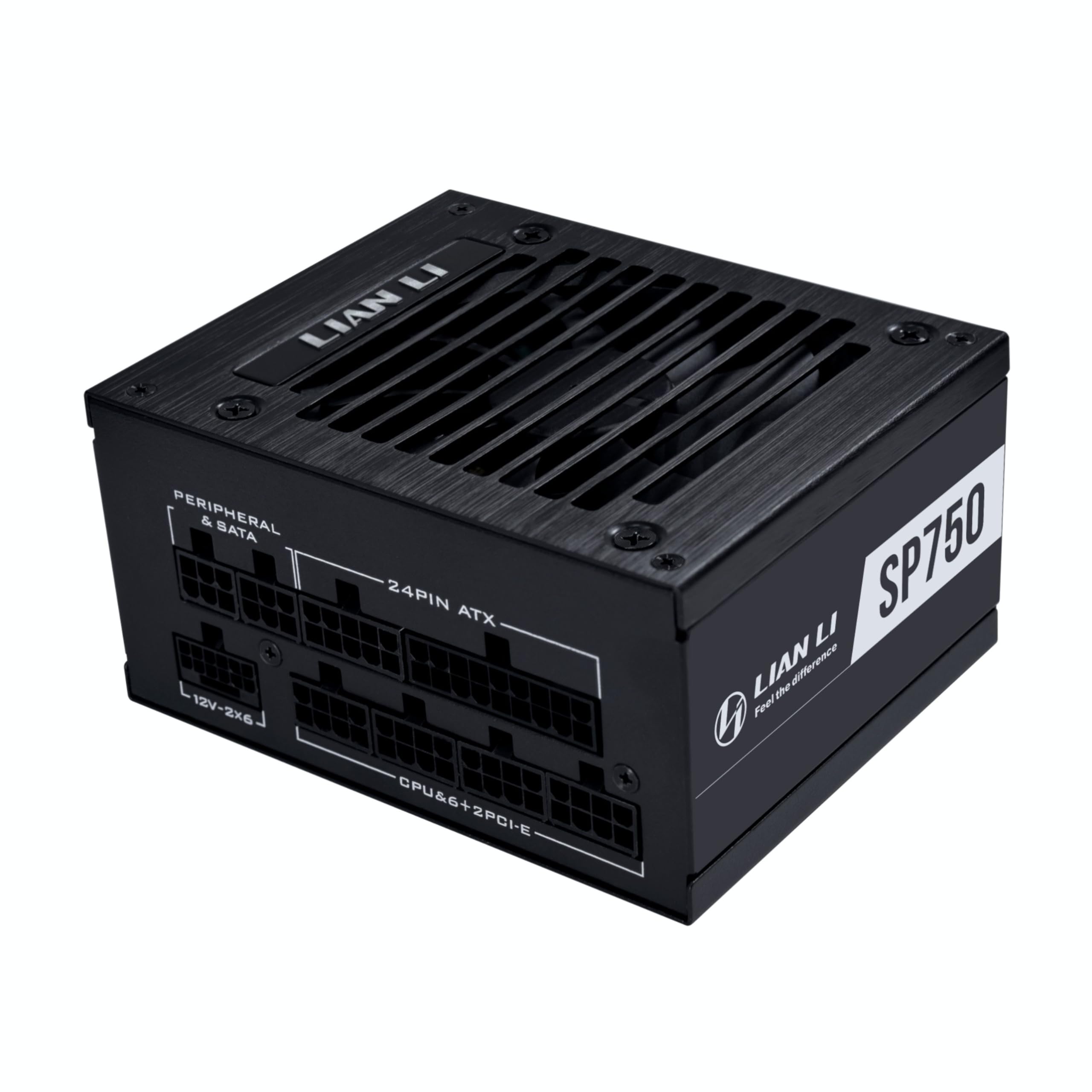
Lian Li SP750 V2

85 /100
LBD Score Excellent

Key details

Output
750 watts
Warranty
10 years
Efficiency
80 Plus Gold
GPU Connector
Native 12V-2x6
View on Amazon

The 12V-2x6 cable in the SP750 V2's box has two-tone tips — a band of lighter color at the connector housing that disappears into the socket when the plug is fully seated. It is a small thing aimed at a real problem, since a partially seated 12V-2x6 is the one connector in a modern build that can fail at the plug, and it tells you Lian Li has been paying attention to where these builds go wrong.

That cable is native rather than an adapter, so a current card runs off one lead with no squid in the middle. The rest of the package is aimed squarely at small cases: fully modular, ATX 3.1, a 92mm fluid-dynamic-bearing fan that stays parked until the load climbs, and a ten-year warranty that runs longer than the Corsair's.

We put it near the top of this group on value. 750W with Gold efficiency, a native 12V-2x6, and a decade of coverage for midrange money is the sweet spot for most small-form-factor builds, and the extra standby-rail capacity in this revision is the sort of detail that only matters when your board keeps USB ports live through sleep — and then it matters a lot.

The arithmetic is what lands it here. It does nearly everything the Corsair SF750 does — same wattage, same native connector, same true SFX footprint — for noticeably less money and two more years of coverage. That is not a small gap, and it is why this one turns up in so many of the builds we spec ourselves.

Pros

  • Native 12V-2x6 with a two-tone seating cue
  • Ten-year warranty at a midrange price
  • Fan stays off until the load climbs

Cons

  • Two PCIe cables only, which rules out three-connector cards
Our verdict

The 750W we recommend when the budget is real: a native 12V-2x6, a ten-year warranty, and quiet running for less than the premium picks.

Check Latest Price
4

Best Budget 850W

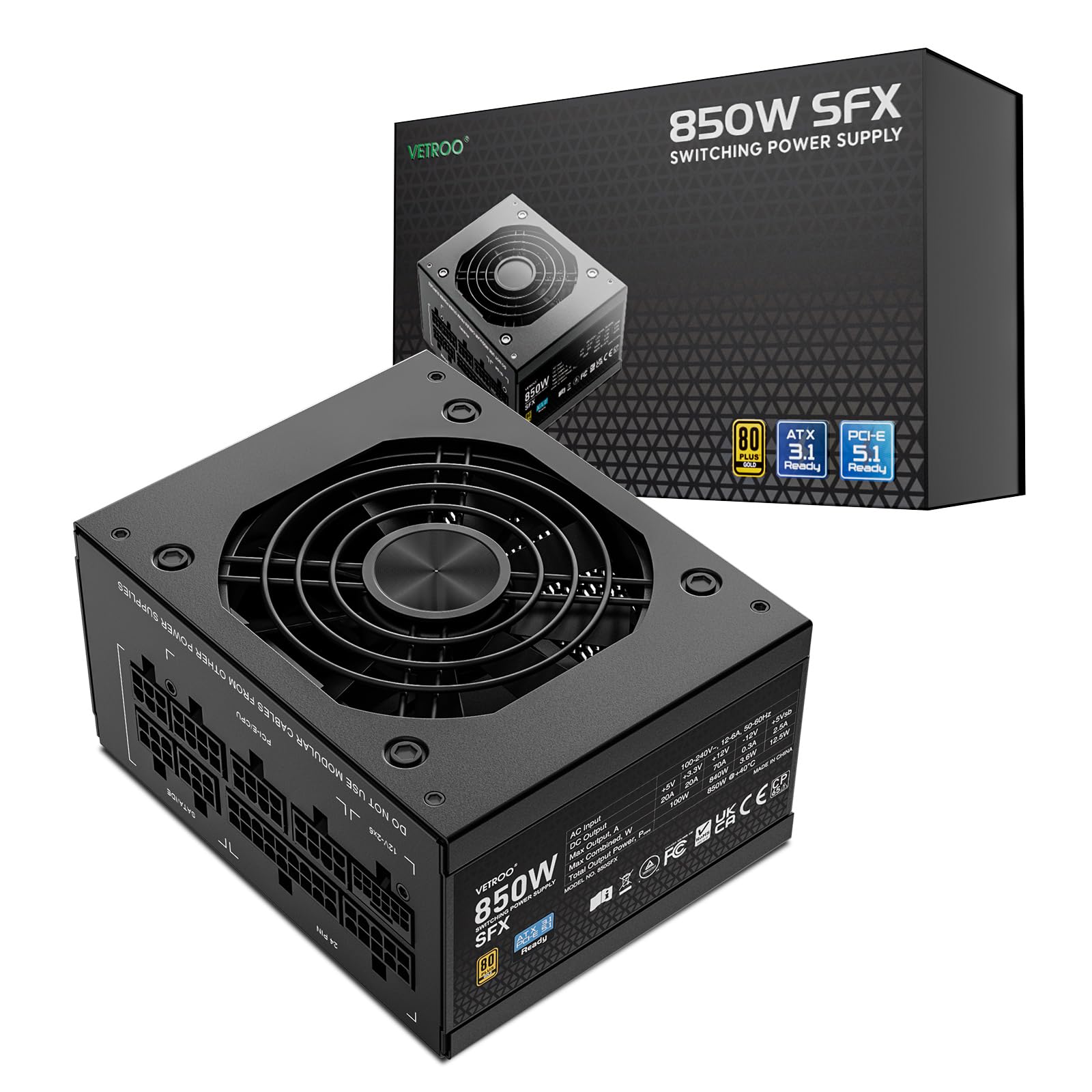
Vetroo 850W SFX

86 /100
LBD Score Excellent

Key details

Output
850 watts
Cabling
Fully modular
Warranty
10 years
Efficiency
80 Plus Gold
View on Amazon

Ten years is a long warranty for a brand most builders meet for the first time on a price list, and it is the first thing we noticed about the Vetroo 850W. It is the kind of term you offer when you expect the unit to outlive the case, and it runs longer than Corsair gives on units that cost more. The hardware behind it is 850W at 80 Plus Gold, ATX 3.1 with PCIe 5.1, a 90mm fluid-dynamic-bearing fan, and a standard 4.9 by 3.9 by 2.5-inch SFX footprint.

We rate it the value pick of this roundup. It is the least expensive way here to get 850W with a current ATX 3.1 cable set, the fully modular braided cables are the nicest at this end of the range, and the SFX-to-ATX bracket is in the box for anyone moving it into a bigger chassis.

Installation is unremarkable in the best way — standard mounting, sleeves flexible enough to fold behind a motherboard instead of fighting back, and enough connectors for a high-end board. It is the pick we reach for when the case and the card are where the money went and the power supply has to be good enough without becoming the story of the build.

Pros

  • 850W ATX 3.1 for the least money of any 850W here
  • Ten-year warranty on a budget-priced unit
  • Braided modular cables that feel premium

Cons

  • Coil whine can follow GPU load on some units
Our verdict

The value pick of this roundup: 850W with ATX 3.1 and a ten-year warranty for the least money of any 850W unit here.

Check Latest Price
5

Best Mainstream 850W

Cooler Master V850 SFX

87 /100
LBD Score Excellent

Key details

Output
850 watts
Warranty
10 years
GPU Power
12V-2x6, up to 600W
Efficiency
80 Plus Gold
View on Amazon

Cooler Master has revised this unit more than once, and which version you end up with changes the experience more than the spec sheet suggests. The current V850 SFX Gold is the ATX 3.1 model with the 90-degree 12V-2x6 connector and a Cybenetics Noise A- rating; earlier revisions ran a fan curve that ramped hard at low load and were audible from across a room. Buy the ATX 3.1 one.

What you get for the money is 850W of Gold-rated power in a 3.94 by 4.92 by 2.5-inch body, able to push up to 600W to a card through a single 12V-2x6 lead. The 90-degree connector is the detail we appreciate most: the cable leaves the unit flat against the chassis instead of looping into a side panel, which in a 10-liter case is the difference between a panel that closes and one that bulges.

Cable length is the compromise the design makes. These runs are cut for ITX cases and reach comfortably in something like a Jonsbo or an NR200, but they come up short if the power supply sits at the bottom of a mid-tower with a motherboard tray in between. That is a deliberate trade for the case this unit is actually for, and it is why we would not put it in a big build.

Where it lands for us is the middle of this group: a well-built 850W with ten years of coverage and a connector design better thought out than most, at a price that leaves room for the rest of the build. It is the one we reach for when 850W is the requirement and the Corsair premium is not in the budget.

Pros

  • Up to 600W through a 90-degree 12V-2x6
  • Ten-year warranty with long spare-part availability
  • Compact true SFX body that fits ITX cases

Cons

  • Coil whine can show up under load
Our verdict

A well-built 850W with a 600W GPU cable and ten years of coverage — worth it if you buy the ATX 3.1 revision and your case is small.

Check Latest Price
6

Low-Power Builds

FSP SFX Pro 450W

77 /100
LBD Score Very Good

Key details

Output
450 watts
Cabling
Non-modular
Warranty
3 years
Efficiency
80 Plus Bronze
View on Amazon

Not every small-form-factor build has a graphics card in it. An APU in a case the size of a hardback, an HTPC under a television, a small NAS — those builds need a power supply that is small, quiet at low draw, and inexpensive, and that is the entire brief the FSP SFX Pro 450W is answering.

It is 80 Plus Bronze and non-modular, built around a DC-to-DC design for voltage regulation, with an 80mm fan that varies with temperature and all-black ribbon cables. FSP includes the SFX-to-ATX bracket, so it drops into a Mini-ITX board or a Micro-ATX office box, and the three-year warranty matches what you expect at this end of the market.

We think it is the right unit for a light build and the wrong one for anything with a card in it. A 65W APU and integrated graphics sit squarely inside what 450W Bronze is for, and at low draw the fan is quiet enough to disappear under a television. What you accept in return is a bundle of cables that has to live somewhere in a case with no spare volume, which is the opposite of what a small build wants.

Pros

  • Least expensive way into a true SFX unit
  • SFX-to-ATX bracket included
  • Quiet at the low draw it is built for

Cons

  • Non-modular cables crowd a small case
  • A single PCIe connector rules out most cards
Our verdict

The right unit for an APU, HTPC, or small NAS build with no graphics card — and the wrong one the moment a discrete GPU enters the plan.

Check Latest Price
7

Budget 1000W Builds

Thermaltake Toughpower 1000W

80 /100
LBD Score Excellent

Key details

Output
1,000 watts
Warranty
7 years
Dimensions
4.05 x 4.9 x 2.5 inches
Efficiency
80 Plus Platinum
View on Amazon

Compared with Corsair's SF1000, the Toughpower buys the same 1000W and the same Platinum rating for considerably less, and we read that gap as a warning rather than a bargain. This is the pick in the group we trust least, and almost none of that doubt comes from the numbers on the box.

The numbers are genuinely good: ATX 3.1 with a native 12V-2x6 connector, under 30mV of ripple, voltage regulation inside plus or minus 2 percent, 17ms hold-up time, a 90mm fluid-dynamic-bearing fan, a seven-year warranty, and the SFX-to-ATX bracket in the box. On paper it is the most power and the highest efficiency rating here for the least money.

Two details change the calculation. The footprint measures 4.05 inches across the face that should be 100mm, roughly 3mm over the SFX standard, and a case with a machined cutout will not forgive 3mm. And if you are planning around a 600W card, read the rating printed on the bundled 12V-2x6 cable itself — the headline number describes the unit, not necessarily the lead in the box.

The appeal is narrow and specific, then: the most watts and the best efficiency rating here for the least money, in a body that mostly fits. Whether that trade is worth making comes down to how much you value seven years of warranty against ten from the brands around it, and how easy a return would be if the unit turns out to be one of the unlucky ones.

Pros

  • 1000W Platinum for the least money here
  • Tight ripple and voltage regulation numbers
  • ATX 3.1 with a native 12V-2x6 connector

Cons

  • First-year failures are the recurring mark against it
Our verdict

The cheapest route to 1000W of Platinum power in SFX, and only worth taking if your case has spare room and you accept the risk.

Check Latest Price

How We Tested SFX Power Supplies in Real Small Builds

We built the shortlist from spec sheets first: an SFX or SFX-L footprint, 80 PLUS Gold or better where the price allowed, a fully modular cable set, and an SFX-to-ATX bracket in the box. That cut a long list of listings down to 11 units, which we bought outright rather than borrowed — 450 watts at the low end, 1,000 at the top, Bronze through Platinum.

Each one lived in at least two chassis: a mesh-fronted console-style case in a living room and a tight mini-ITX desk build, with several moved into a mid-tower ATX case on the included bracket so we could see how the cables behaved over a longer run. We logged wall draw and checked the 12V, 5V, and 3.3V rails with a multimeter at idle, after a two-hour gaming session, and during a synthetic full-load burn.

Noise came next, measured with a decibel meter a foot from the front panel — first at idle, where the zero-RPM units sat silent, then under load. We also sat in a quiet room after hours listening for coil whine and fan ticking, since that is when a small build in a living room actually announces itself.

Cables were handled the way a builder handles them: we counted usable length after routing to a GPU and a front-panel header, then bent each one at the connector to see whether it kinked or held. Quality and reliability showed up in the details — whether the 12V-2x6 seated with a positive click, whether the modular sockets gripped, whether anything rattled after repeated power cycles across eight months. Value we judged last, against what the wattage and certification actually bought.

How to Choose an Sfx Power Supply

Match the wattage to the card, not to the sticker

A 1000W badge does not make a build faster; it makes the power supply bigger, hotter, and more expensive than the build needs. Most small-form-factor systems with a midrange or upper-midrange card sit comfortably at 750W, which is where two of our picks land. Step to 850W when the card's transient spikes are what you are trying to absorb, and to 1000W only for a flagship GPU.

The connector matters as much as the number. A card that pulls its power through 12V-2x6 wants a native cable, because an adapter adds a joint in the one place a small case has no room for one. Everything here from the Lian Li upward is ATX 3.1 with a native connector; the FSP is the budget exception and belongs in a build without a discrete card.

Check that the bay is really SFX

SFX is 125 by 100 by 63.5 millimeters. SFX-L keeps the same face and stretches the depth to 130mm, and that extra 5mm is the difference between a side panel that sits flat and one that does not. The units here are SFX height and SFX depth rather than SFX-L, with one thing to check: the Thermaltake measures 4.05 inches across the 100mm face, roughly 3mm over, and a tightly machined cutout will notice.

Count connectors and measure reach

SFX cable sets are short on purpose. The power supply usually sits a few centimeters from the motherboard, and a long 24-pin would be a coil of spare wire in a 10-liter case. That is a feature until you move the unit into a mid-tower, where the same cable will not reach around a tray. Count the PCIe connections your card needs before you order — the Lian Li ships two, which rules out a three-connector card — and if your case is bigger than an ITX box, put an extension set in the cart at the same time.

Read the fan spec, not the noise claim

Every unit here advertises low noise; the useful part is how it gets there. A 92mm fluid-dynamic-bearing fan moves the same air at lower RPM than an 80mm sleeve fan, and a zero-RPM mode parks the fan entirely below a load threshold, which is what makes these units silent at idle and audible only under a long load.

Revisions matter as much as specifications. Cooler Master's current V850 is a quieter unit than the version it replaced, so buy the ATX 3.1 model rather than whatever is cheapest on a marketplace listing that may still be shipping old stock.

Weigh efficiency and warranty together

Gold versus Platinum is worth a few percent of efficiency and, more usefully in a small case, a few degrees of waste heat that has nowhere to go. That is the real argument for the Platinum units here rather than the electricity bill. Warranty is the better tiebreaker: Corsair gives seven years, while Lian Li, Vetroo, and Cooler Master give ten. Between two units this close on paper, a decade of coverage is worth more than a badge.

Frequently Asked Questions

Final Verdict

The Corsair SF750 is the unit we point to first: 750W of Platinum-rated, ATX 3.1 power in a true SFX body, quiet enough to forget about, with a cable set cut for the cases it actually goes into. If the budget is tighter, the Lian Li SP750 V2 does nearly the same job with a native 12V-2x6 and two extra years of warranty, as long as your card does not need a third PCIe lead.

And if your graphics card is a flagship, the SF1000 is the same design with the headroom that build needs. Those three cover almost every small-form-factor build we would spec; the rest of the list is there for the cases where wattage, budget, or the absence of a graphics card changes the answer.