Best RV Surge Protectors of 2026

Campground power isn't the clean electricity you get at home. It's a shared box at the end of a row of sites, cycled through by every rig that arrived before yours, and one worn outlet can send a spike into your converter, your fridge, and the control board on your AC. I've stood in the dark watching a pedestal arc and sizzle. A surge protector is cheap insurance between that box and everything you own.

Nearly every unit claims full protection, but what separates them is whether they tell you what's wrong — reversed polarity, an open ground, voltage that's sagging — before you plug in, and whether they still do it after a season of rain. I've spent nine months with eight of these, from plain circuit analyzers to Bluetooth models that report voltage to your phone.

Worth knowing before you shop: these units are sacrificial, so the one that dies saving your rig did its job, and a big joule number matters less than a readable analyzer and an amp rating that matches your hookup. The picks below cover both.

1

Best Overall

GEARGO 30-Amp Surge Protector

95 /100
LBD Score Outstanding

Key details

Amperage
30 A
Diagnostics
Wiring, ground, neutral, and polarity lights
Surge Rating
12,000 joules
Weather Rating
IP68
View on Amazon

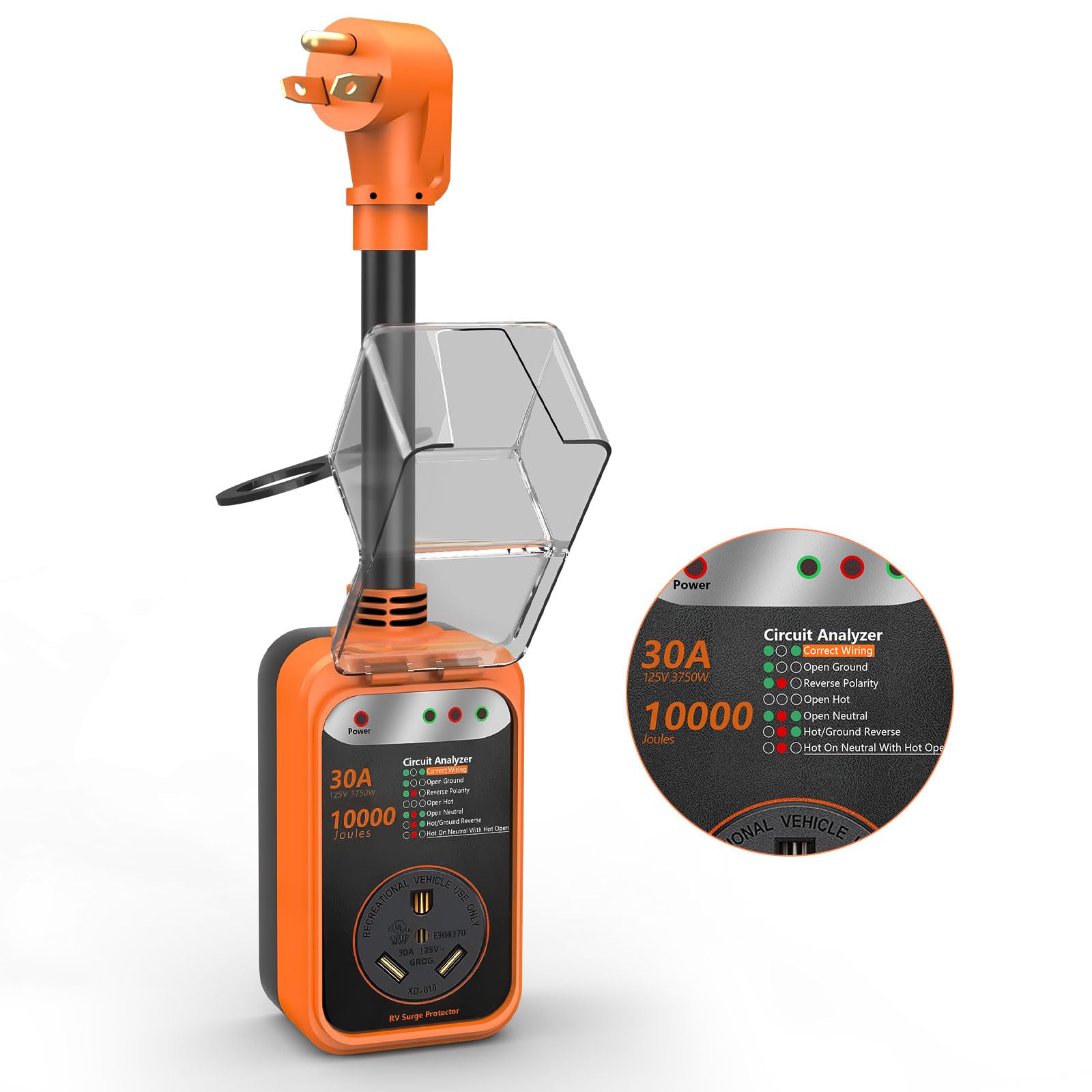
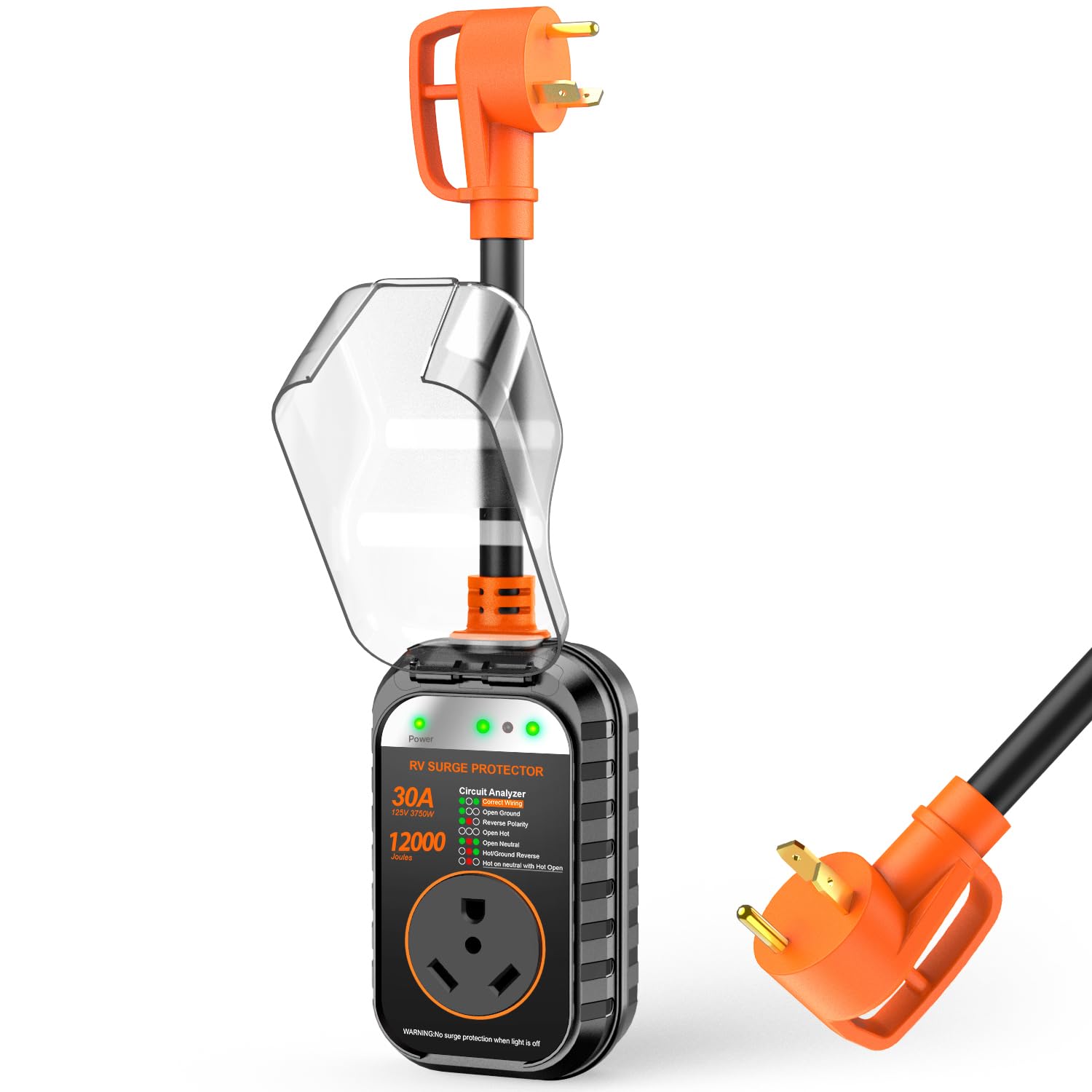
Every hookup starts with the same question: do you trust this pedestal? The GEARGO answers it in the thirty seconds before you connect, with lights that show correct wiring, open ground, open neutral, and reversed polarity, so a bad box never reaches your rig. Twelve thousand joules of absorption puts it near the top of the 30-amp units here, and it does that for about what the cheapest analyzer in this group costs.

The housing is the part we underrated at first. It is rated IP68, and the lid hinges over the plugged-in end, which matters because pedestal boxes sit out in weather and almost never sit level. A right-angle male plug keeps your cord from hanging straight down off the box, and the molded handles give you something to hold when a plug has been in the sun all afternoon. The whole thing stores in an 11-by-5-inch footprint, so it lives in the bin by the door rather than at the bottom of the bay.

That combination is why this is our default. The failures that strand an RV are miswired outlets and lost neutrals, not lightning, and a protector you will actually carry and use every single time beats a better one left at home. We have come to think of the analyzer lights as the real purchase and the surge suppression as the insurance policy behind them.

If you want the device to act rather than report — cutting power when voltage drifts and pushing an alert to your phone — that is the Watchdog's territory, and this one does not go there. What it does have is a color you cannot miss on a wet pedestal in a hurry, and that small piece of design has probably saved more of these from being left behind than any specification on the box.

Pros

  • Full wiring, ground, neutral, and polarity diagnostics
  • 12,000 joules, high for a budget 30-amp unit
  • IP68 housing with a hinged cover over the plug
  • Right-angle plug and grip handles ease hookups

Cons

  • Warns about bad power but will not disconnect it
  • Durability trails the 50-amp version in this lineup
Our verdict

For a 30-amp trailer, this is what we tell people to buy: full pedestal diagnostics, real surge capacity, and a sealed body at a price that makes carrying it every trip easy.

Check Latest Price
2

Best for 50-Amp Rigs

GEARGO 50-Amp 15,000J Protector

93 /100
LBD Score Outstanding

Key details

Amperage
50 A
Warranty
3 years
Surge Rating
15,000 joules
Weather Rating
IP68
View on Amazon

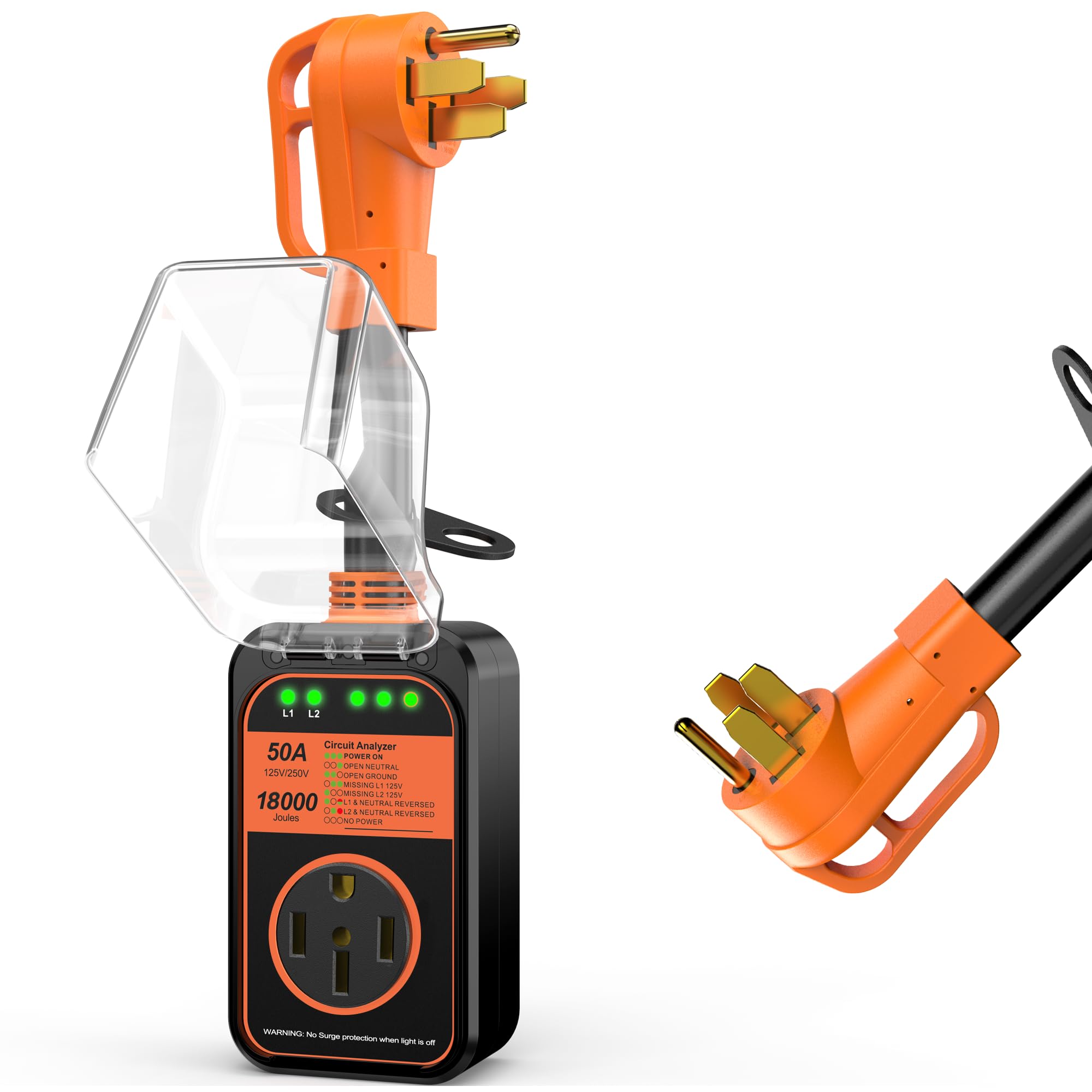
Fifty-amp coaches run two legs and twice the current, and the case for this GEARGO is the one that wins the 30-amp slot: a full bank of diagnostic lights, a sealed body, and a price at the bottom of this group. The difference is headroom. Fifteen thousand joules is ahead of every other 50-amp unit here except the MILLIONHOME's printed figure, and roughly nine times what the Progressive SSP-50XL claims.

Physical details do the quiet work: 3.26 pounds in a 10-by-7-inch body, a hinged lid over the connection, a right-angle plug, molded handles, and a metal tab you can thread a cable lock through. The three-year warranty is short next to the lifetime coverage on the Progressive units, and there is no app — nothing to pair, and no way to see your amp draw from inside the coach.

What mattered more to us is that durability is the strongest of any 50-amp pick here, which is the dimension that usually decides whether one of these survives three seasons of being dropped in gravel. It still will not disconnect when park voltage sags, so it rewards the camper who reads the lights at setup rather than the one who plugs in and leaves for the day.

Pros

  • 15,000 joules, second only to one pick here
  • IP68 sealing with a cover over the plugged-in end
  • Metal tab accepts a cable or lock at the pedestal

Cons

  • No app or power monitoring
  • Three-year warranty is shorter than lifetime coverage elsewhere
Our verdict

If your rig runs a 50-amp cord and you want the most protection for the least money, we point you here — the same diagnostics as our top pick with more headroom.

Check Latest Price
3

Best Warranty

Progressive Industries SSP-30XL

95 /100
LBD Score Outstanding

Key details

Amperage
30 A
Warranty
Lifetime, weather shield excluded
Diagnostics
Voltage, ground, neutral, polarity, and frequency
Surge Rating
825 joules
View on Amazon

Eight hundred and twenty-five joules looks like a typo beside the five-figure numbers printed on budget boxes, and it is the rating Progressive actually publishes for this unit. What you buy instead is diagnostics: over- and under-voltage, open ground, open neutral, reverse polarity, surge failure, and even AC frequency, all reported on a row of LEDs that stay readable in low light.

We prefer to judge this one on what it catches rather than what it absorbs, because a miswired pedestal is the problem you will actually meet. It is built for the outside, too — Lexan housing, an all-weather shield assembly, a locking bracket, and a two-pound, fourteen-inch body that stows without argument. The lifetime warranty is what makes the small joule number easier to live with, and it is why this stays in the roundup despite giving away so much on paper.

Two things to know before you pick it. The weather shield is excluded from that lifetime coverage, so the piece most likely to wear out is the piece you will pay for. And longevity is the weakest of any 30-amp unit here — the ones that fail tend to fail at the plug end or go dark on the indicators — so look at the blades each season and use the warranty if it comes to that.

Pros

  • Checks AC frequency as well as wiring and voltage
  • Lifetime warranty from a long-established brand
  • Locking bracket and weather shield included

Cons

  • 825 joules is the lowest surge rating in this group
Our verdict

We recommend it to the camper who wants a diagnostic-first unit from a company that will still answer in ten years, and who can live with a modest joule rating.

Check Latest Price
4

Best 50-Amp Warranty

Progressive Industries SSP-50XL

94 /100
LBD Score Outstanding

Key details

Amperage
50 A
Capacity
12,000 W at 120/240 V
Warranty
Lifetime, weather shield excluded
Surge Rating
1,650 joules
View on Amazon

A lifetime warranty on a device designed to destroy itself absorbing a surge is a real promise rather than a marketing line, and it is the first reason to look at this Progressive before the cheaper 50-amp boxes. The housing is Lexan, the unit is made in the U.S., and the box includes a locking bracket, a cover, and the weather shield.

It is rated for 50 amps at 120/240 volts and 12,000 watts, with full fault detection: over- and under-voltage, open ground and neutral, reverse polarity, surge failure, and AC frequency. The LED indicators read clearly in low light, which sounds trivial until you are hooking up at dusk with a flashlight between your teeth.

It lives at the pedestal, so the accessories matter as much as the electronics. The bracket gives you something to run a cable through, the shield keeps rain off the joint, and the fourteen-inch body is easy to stow but leaves the connection hanging out where a lid earns its keep. Neither accessory is elegant, and the shield is the one piece the lifetime warranty does not cover.

Then there is the number that gives us pause: 1,650 joules is modest for a 50-amp coach, well behind the GEARGO and the MILLIONHOME. We still recommend it to the buyer who wants one purchase and a manufacturer still on the hook in year eight, because a protector covered for life is one you keep using after it takes a hit instead of quietly leaving in a drawer.

Pros

  • Lifetime warranty on a sacrificial device
  • Full fault detection including AC frequency
  • Locking bracket, cover, and weather shield included

Cons

  • Cover can be hard to latch over a large plug head
  • 1,650 joules is modest for 50-amp service
Our verdict

Buy this if you want a 50-amp protector covered for life and you would rather have fault detection than a big absorption number.

Check Latest Price
5

Best Smart Monitor

Power Watchdog PWD30

95 /100
LBD Score Outstanding

Key details

Weight
3 lb
Amperage
30 A
Monitoring
Bluetooth volts, amps, and watts
Surge Rating
3,000 joules
View on Amazon

This is the pick for the RVer who wants to see the numbers rather than hand the decision to a box. It reports volts, amps, and watts to your phone over Bluetooth, tracks kilowatt hours, and lets you set alert thresholds, so you learn what the coffee maker, the microwave, and the air conditioner each cost you on a 30-amp feed. What it will not do is disconnect: when park voltage sags, it tells you and keeps passing power.

Around that, the hardware is standard Watchdog fare: 3,000 joules, full LED park-power diagnostics, a three-pound fourteen-inch body, and a three-year warranty. Bluetooth is the fussy part. The radio is short-range and pairing can take a couple of attempts, so do it while you are standing at the pedestal rather than from the dinette, and treat the app as a setup tool rather than something to check from the pool.

Pros

  • Real-time volts, amps, and watts on your phone
  • Customizable alert thresholds for out-of-range power
  • Three-year warranty and full LED diagnostics

Cons

  • Does not disconnect when voltage goes bad
  • Bluetooth pairing and range are inconsistent
Our verdict

We like it for the RVer who wants to see amp draw and kilowatt hours on a phone, and who does not expect the unit to cut the power for them.

Check Latest Price
6

Best for Automatic Shutoff

Power Watchdog PWD50EPO

95 /100
LBD Score Outstanding

Key details

Amperage
50 A
Monitoring
Bluetooth volts, amps, and kilowatt hours
Surge Rating
6,100 joules
Automatic Shutoff
Cuts power, 90-second restart delay
View on Amazon

Five pounds, eighteen inches long, and the priciest thing in this roundup — the PWD50EPO is not a unit anyone buys on impulse. It is the one you buy when the coach is worth protecting properly and you would rather not walk out to a pedestal at midnight to find out what happened.

What it adds over a warning device is action. It cuts power when voltage leaves range or the wiring is wrong, holds off for 90 seconds after a fault so the air conditioner compressor does not restart into a locked rotor, and pushes an alert to your phone. Around that sit 6,100 joules, IP65 sealing, full LED diagnostics, a four-second analysis at plug-in, and a replaceable surge module — the part that dies in a big hit gets swapped instead of the whole unit.

The display is the thing we minded. It is bright on purpose, and at night it lights the side of the coach well enough that your neighbors will notice. The other behavior to expect is the unit doing its job: if power keeps dropping once the air conditioner starts, that is the protector reacting to a weak pedestal, and you will be resetting a breaker until you move sites or shed a load.

We think the price is justified by a narrow set of buyers: people who leave pets or a residential fridge running while they are out, anyone wintering where the grid is soft, and campers who have already lost an appliance to a bad pedestal. If none of that describes you, the GEARGO units do the important half of the job for a fraction of the money.

Pros

  • Cuts power on out-of-range voltage and alerts your phone
  • 90-second restart delay protects the air conditioner
  • Replaceable surge module instead of a new unit
  • 6,100 joules, the highest here among units that disconnect

Cons

  • Priciest unit in this set by a wide margin
  • Bright display is hard to ignore at night
Our verdict

Worth the money if you leave the coach powered while you are away: it is the one here that disconnects, alerts you, and takes a new surge module afterward.

Check Latest Price
7

Tight Budgets

EPLCSE 30-Amp Surge Protector

94 /100
LBD Score Outstanding

Key details

Weight
1.98 lb
Amperage
30 A
Surge Rating
10,000 joules
Certifications
FCC and RoHS
View on Amazon

The EPLCSE does most of what our top pick does — a 10,000-joule rating, a circuit analyzer that reads correct wiring and faults on a row of lights, a flame-retardant housing, and a waterproof cover over the joint — and it does it for less money. The body is lighter, at just under two pounds, and it carries RoHS compliance alongside FCC, which the GEARGO does not claim.

Where it gives ground is in the feel. The molding is lighter in the hand, and the weather duty is handled by a cover over the plug rather than a shell the GEARGO rates at IP68. We found that trade acceptable for a first trailer, a second rig, or a unit that lives in the tow vehicle as a spare. If you hook up in the rain more often than not and want the housing itself sealed, spend the extra on the top pick.

Pros

  • Analyzer lights and 10,000 joules at the lowest price here
  • Under two pounds, easy to stow and carry
  • Waterproof cover keeps the connection dry

Cons

  • Weather duty rests on the plug cover, not a rated housing
Our verdict

Our pick when the budget is tight: it reads the pedestal and absorbs a surge for less than the top pick, with a lighter body and a cover doing the weather work.

Check Latest Price
8

Small Storage Bays

MILLIONHOME 50-Amp Surge Protector

94 /100
LBD Score Outstanding

Key details

Weight
1.5 lb
Amperage
50 A
Dimensions
3.94 x 3.94 x 3.94 inches
Surge Rating
18,000 joules
View on Amazon

Eighteen thousand joules is the biggest number printed on any box in this roundup, and it sits on a device that weighs a pound and a half. Treat the figure as a claim rather than a guarantee, because joule ratings are marketing as much as engineering, but there is no arguing with the size: a four-inch cube drops into a storage bin and disappears.

For that you get a 50-amp plug, circuit-analyzer lights that show whether the pedestal is wired correctly, flame-retardant materials, a waterproof cover over the connection, and plug-and-play setup with nothing to pair or configure. The orange body is easy to spot on a wet pedestal, which matters more than it sounds when you are packing up in a hurry.

What keeps it out of the top tiers is everything a joule number cannot tell you. Longevity is the open question here, and a protector that quits in its second season is worse than a plain unit that keeps working. We see it as a second unit for a guest rig or a light 50-amp trailer where the bay is tight; if this is the only protector the coach will ever have, the GEARGO or the Progressive is the safer place to put the money.

Pros

  • Biggest joule claim in this set at 18,000
  • Four-inch cube and 1.5 pounds stow anywhere
  • Analyzer lights and waterproof cover

Cons

  • Longevity is the open question at this price
Our verdict

A compact, budget route into 50-amp protection with the biggest joule claim here — pair it with realistic expectations about how long it lasts.

Check Latest Price

How We Tested RV Surge Protectors at Real Campground Pedestals

My team and I built the shortlist by pulling every portable 30- and 50-amp unit we could find, then filtering on amp rating, joule rating, water resistance, and whether the diagnostic lights were labeled in English instead of a code you'd have to hunt for in a manual. Price counted, but only against how long a unit was likely to last. Eight made the cut, ranging from simple analyzers to smart models with app monitoring.

Testing ran nine months, across a full camping season: a 30-amp travel trailer on a state park loop where afternoon voltage sagged whenever the neighbors kicked on their AC, a 50-amp site at a private resort, and a long driveway hookup at home. I plugged in during the hottest part of the day with the AC running and watched the voltage readout, then pulled heavy loads — microwave, hair dryer, coffee maker — to see whether the amperage display kept up. At night I timed how long it took to read the fault lights by headlamp.

Durability got its own round of abuse: I hosed each unit down, left two out through an overnight rain, dropped them off a tailgate onto gravel, and coiled stiff cords in cold weather. For the Bluetooth models, I paired each one and walked to the rear of the trailer and into the tow vehicle to find where the signal dropped, then checked whether the app logged a sag after the fact. Nothing was judged on the spec sheet alone.

How to Choose an Rv Surge Protector

Start With the Plug, Not the Joules

RV shore power comes in two flavors. Thirty-amp service is a single 120-volt leg and the norm for travel trailers; fifty-amp service is two legs and 12,000 watts for coaches running two air conditioners. The protector has to match the inlet on your RV, and the two plug shapes do not interchange.

A 30-amp unit on a 50-amp coach will work through a dogbone adapter, but it caps the whole rig at 30 amps, so the second air conditioner is out. If you plan to run everything, buy the 50-amp device. Check the plug type before you order rather than after the box arrives.

What the Lights Actually Buy You

Surges get the marketing; pedestal wiring is what bites. An open neutral, reversed polarity, or a missing ground at a campground box can put line voltage where it does not belong, and none of that is a surge. A circuit analyzer reads the outlet before you connect and tells you to move sites.

We treat that check as the more valuable half of the purchase. The trap is assuming a green light means good power: the lights report the wiring at the receptacle, not the condition of the breaker behind it, so a pedestal that tests correct can still sag when every site switches on an air conditioner.

Warn or Disconnect

A basic protector absorbs a spike and shows you the fault; it keeps passing power whatever the voltage does. An EMS-style unit also cuts the connection when voltage climbs too high or sags too low, then restores it after a delay — the Power Watchdog holds 90 seconds so an air conditioner compressor does not restart into a locked rotor.

Low voltage on a hot afternoon is the quiet killer of compressors and motors, and it is why people who leave the rig powered while they are out pay for the disconnect. If you stand at the pedestal and read the lights at every hookup, a warning device is enough.

Joules, Modules, and the Fact That These Are Consumables

A protector absorbs energy by sacrificing metal-oxide varistors inside it, so a big enough hit ends the unit. That is the design working, not a defect, and it is why a scorched plug end or dead indicator lights means replacement rather than repair.

What changes the math is whether you replace a module or a whole device: the Power Watchdog EPO models take a replaceable surge module, while Progressive backs its units with a lifetime warranty that excludes the weather shield. Joule ratings are worth comparing, but treat them as a rough measure rather than a promise.

Sealing, Size, and the Pedestal Reality

These live outdoors, in rain, on boxes that are never level. Look for a hinged or tethered cover that closes over the plugged-in end, and check that your own plug head fits under it — a large molded handle can hold a lid open, and an open lid is a wet connection.

Weight and footprint matter in a full storage bay; a 1.5-pound cube disappears into a bin and a 5-pound brick does not. These are also among the most stealable things at a campsite, so a lock ring or locking bracket earns its place on the shortlist.

Frequently Asked Questions

Final Verdict

For most travel trailers, the GEARGO 30-amp is the one to buy: it checks the pedestal's wiring before you connect, it absorbs a serious surge, and it is sealed well enough to leave out in the rain at a price that makes carrying it every trip an easy yes. If your rig runs a 50-amp cord, buy its 15,000-joule sibling instead.

The exception is the camper who leaves the coach powered while away. For that, the Power Watchdog PWD50EPO is the only unit here that cuts the power, alerts your phone, and lets you swap the surge module afterward rather than replace the whole device.