Best Robotic Pool Cleaners for Inground Pools of 2026

You finish a lap and a plume of fine dust lifts off the floor behind you — the pool looked clean until you touched it. That's the job a robotic pool cleaner takes over: it drops in, drives itself around the floor and walls, and filters the water while you do something else. The catch is that cordless freedom has its own failure modes — a tired battery, a filter that holds leaves and nothing finer — and both put you right back at the skimmer net. We spent seven months with eight of these to find the ones that don't.

Spec sheets barely help. Suction and runtime figures are measured on a bench, and the things that keep a pool clear — how a robot reads the shape of the pool, whether its filter catches silt as well as oak leaves, whether the app holds a schedule at the far end — rarely make the bullet points. Wall climbing matters most at the waterline, where the scum ring forms. The picks below are the ones that earned it.

1

Best Overall

Beatbot Sora 10

81 /100
LBD Score Excellent

Key details

Weight
18.7 lb
Runtime
Up to 300 minutes
Suction
6,800 GPH
Debris Capacity
5 liters
View on Amazon

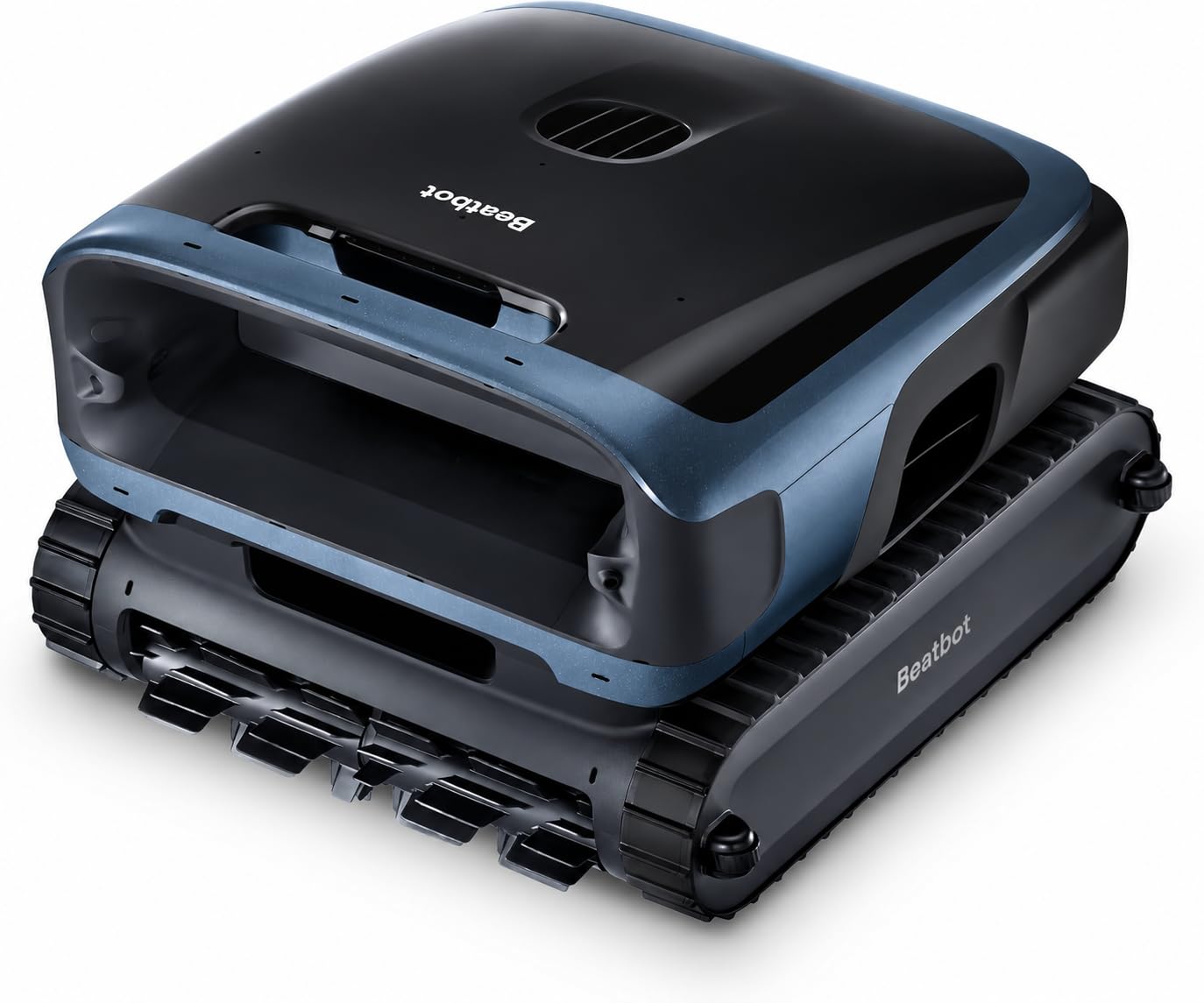
Three hundred minutes of floor cleaning is the figure that decides the Sora 10 for us. Beatbot rates it at 3,229 square feet per charge from a 7,800 mAh battery, with 6,800 GPH of suction feeding a 5-liter basket — enough that a large inground pool is finished in one pass rather than two, and enough capacity that you aren't emptying the basket every other day.

What earns it the pick is how little it gives up to the flagship. The suction figure is identical to the Sora 70's, the waterline parking is the same trick — the robot rises, holds at the edge for ten minutes, and waits for you — and the shallow-water setting reaches down to 12 inches, which is what gets a sun shelf or a wide top step clean instead of merely wet.

The body is rated fully saltwater-safe to 5,000 ppm NaCl, a detail we underline for anyone running a salt cell, because corrosion is what ends these machines early. The 5-liter basket carries a 150-micron filter for everyday debris and accepts a 3-micron layer for sand. We like that the fine layer is a choice rather than a default: it's the difference between a basket that rinses in seconds and one you pick grit out of.

It isn't perfect. A raised floor drain or a pool light can stop it mid-pass, and a reset in the app gets it moving again — if your pool has several, plan to glance out once an hour. At 18.7 pounds it's a two-hand lift, but the waterline park means you're lifting from the edge, not from the deep end.

Pros

  • 300 minutes of runtime covers large pools
  • 5-liter basket with an optional 3-micron layer
  • Waterline parking keeps retrieval dry
  • Saltwater-safe to 5,000 ppm

Cons

  • Leaves fine silt in corners
Our verdict

Our default for most inground pools: one charge covers a rated 3,229 square feet, and it parks at the waterline so nobody has to wade in after it.
Check Latest Price
2

Best for Surface Debris

Beatbot Sora 70

85 /100
LBD Score Excellent

Key details

Weight
22.9 lb
Runtime
Up to 5 hours
Coverage
Floor, walls, waterline, surface
Debris Capacity
6 liters
View on Amazon

This is the priciest cleaner in the group, and the money buys something the others can't do: it skims. The JetPulse deck fires dual water jets into four streams that herd floating leaves into the intake, so what falls in today doesn't sink to the floor for tomorrow's cycle. On a pool with trees hanging over it, that's the difference between running the robot twice a week and running it every day.

Underneath, it's the same architecture as our top pick with more of everything: a 10,000 mAh battery rated for five hours of floor cleaning and 3,200 square feet, a 6-liter basket, and the same 6,800 GPH of suction. It also works in shallower water than the Sora 10 — eight inches against twelve — so a wide top step or a wading ledge gets covered.

Retrieval is handled properly. It surfaces, parks at the edge, drains its own water, and stays afloat while it pings the app, which keeps a 22.9-pound machine a one-person lift from the deck. Charging runs about four and a half hours, the longest stated turnaround here, so a big pool on a daily schedule wants an overnight routine rather than a morning one.

There's also a tap-to-retrieve button that brings it to the edge without digging through menus. Small thing, but it's the button you press most.

Pros

  • Skims floating debris as well as scrubbing
  • Five-hour runtime and a 6-liter basket
  • Cleans down to eight inches of water
  • Three-year protection

Cons

  • Heaviest body here at 22.9 pounds
Our verdict

The pick for a pool under trees: it skims the surface while it scrubs floor and walls, and it comes with the longest warranty here.

Check Latest Price
3

Best for Fine Debris

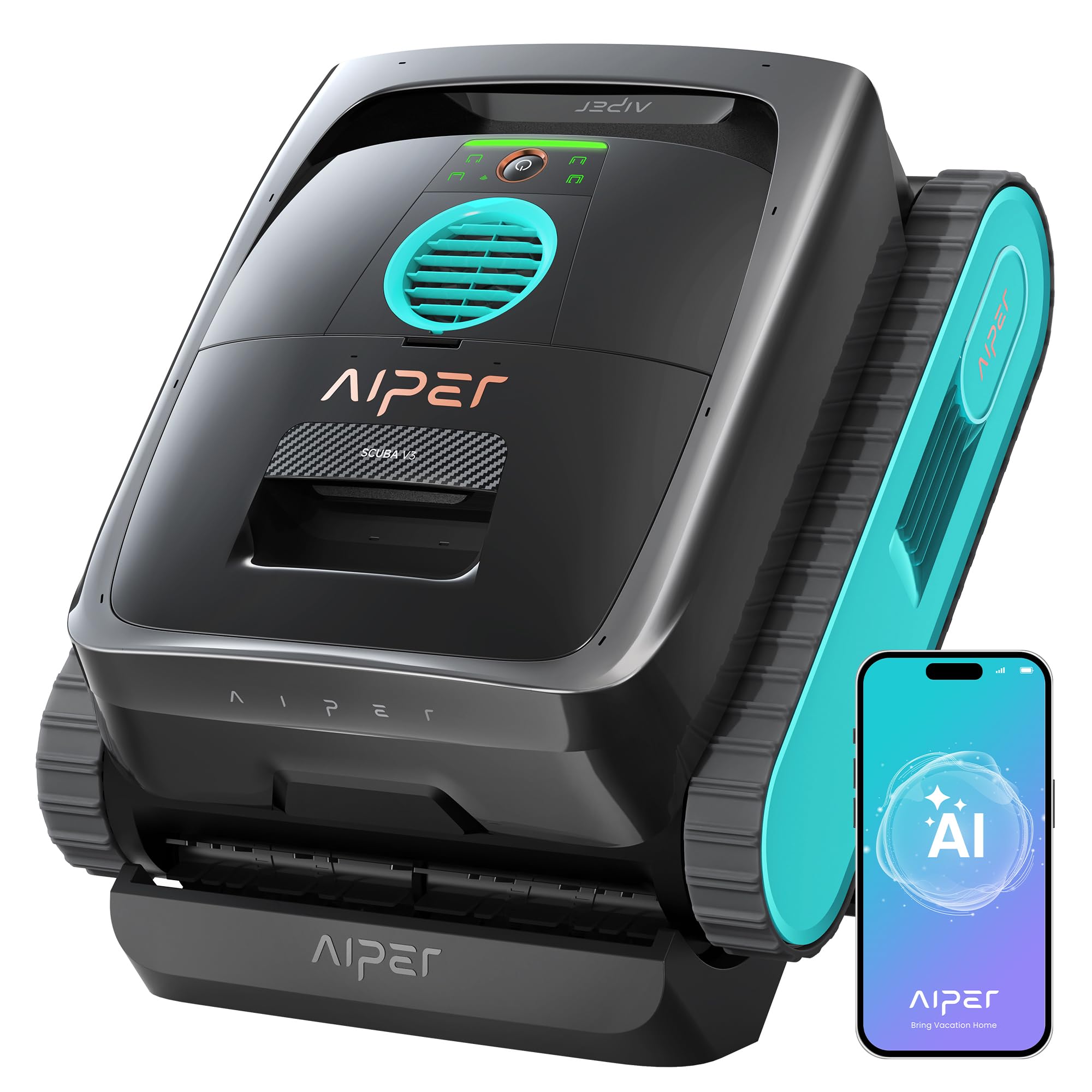
AIPER Scuba V3

93 /100
LBD Score Outstanding

Key details

Weight
18.1 lb
Runtime
Up to 240 minutes (Eco)
Charging
Wireless dock, 4 hours
Filtration
180 and 3 microns
View on Amazon

Sand is what makes a robot look useless. It lifts the leaves, leaves the grit, and the floor still feels rough underfoot. So the number we care about on the Scuba V3 is three microns — the finest filtration in this group, tied with the Gosvor. Behind a 180-micron debris basket sits a 3-micron layer in AIPER's MicroMesh stack that is meant to catch the particles you can't see.

We're less moved by the ten-times-faster headline than by the retrieval routine. When the cycle ends, the V3 rises to the waterline, holds there for ten minutes, and sends a notification, so the lift happens from the deck. The single front camera spots debris and steers to it rather than sweeping a fixed pattern — worth something on a freeform pool, worth less on a plain rectangle.

The rest of the package is premium: a 3.5-liter basket, 18.1 pounds, a wireless charging dock, up to 240 minutes in Eco mode, IPX8 sealing, and a two-year warranty. The trade is cost, and the finer the filter the more often the basket wants rinsing. Neither is a dealbreaker if grit is what has been beating you.

Pros

  • 3-micron layer traps sand and silt
  • Parks at the waterline and notifies the app
  • AI camera steers directly to debris
  • Wireless charging dock

Cons

  • Premium price for the filtration gain
Our verdict

Buy this if fine grit is the problem: the 3-micron layer traps what coarser baskets pass, and it lifts out at the waterline instead of the deep end.

Check Latest Price
4

Best for Easy Handling

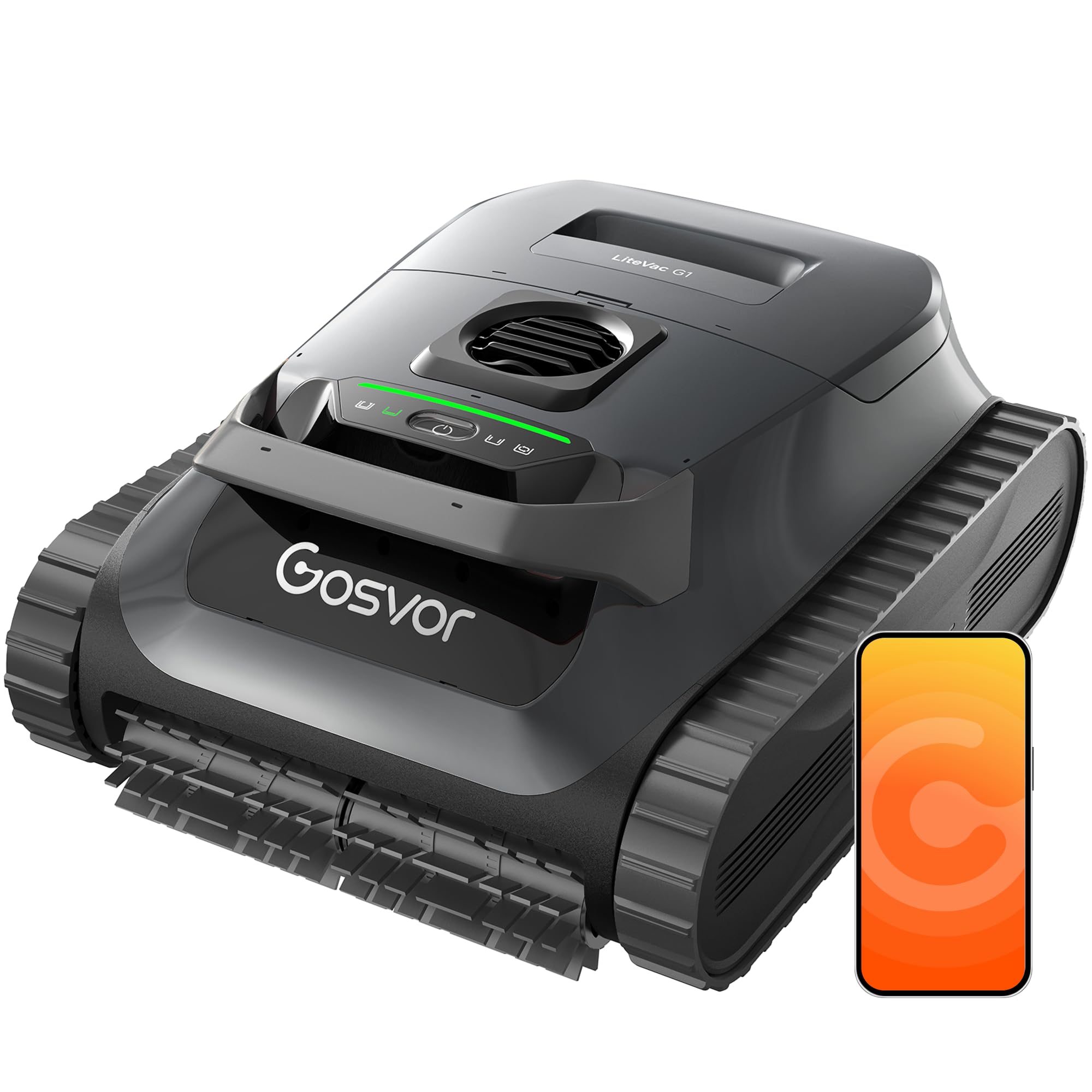
Gosvor LiteVac G1

85 /100
LBD Score Excellent

Key details

Weight
15.2 lb
Runtime
150 to 200 minutes
Coverage
Floor, walls, waterline, shallow areas
Filtration
3 and 180 microns
View on Amazon

Fifteen pounds is light enough that getting the robot out stops being the chore you postpone until tomorrow. At 15.2 pounds the LiteVac G1 is the lightest full-featured cleaner here, and quick drainage means the lift is a one-hand job off the top step. If you clean the pool alone, or the equipment pad is a walk away, that matters more than a suction figure.

It isn't a stripped-down model. You get up to 200 minutes in Eco mode, a rated 2,153 square feet, 3,960 GPH, a 3.6-liter basket with 3-micron and 180-micron layers, and coverage of floor, walls, waterline, and shallow areas deeper than 12 inches. Caterpillar treads and 260 mm dual roller brushes do the climbing, and five modes plus a cross-pattern path handle the schedule.

The quirk worth knowing: the app only works while the unit is on land, so set the mode before you drop it in. You can't redirect it from the deck mid-cycle. Once that's habit it stops mattering, and the push-button controls cover the basics without opening the app at all.

Flow is where it concedes ground to the Beatbots — 3,960 GPH against their 6,800 — so a pool that collects heavy leaves after a storm is likely to want a second pass. For the everyday dust, pollen, and grit that a screened or covered pool collects, it's plenty.

Pros

  • Lightest full-featured body at 15.2 pounds
  • 3-micron and 180-micron double filtration
  • Cleans walls, waterline, and shallow areas
  • Two-year warranty

Cons

  • Lower rated flow than the Beatbot picks
Our verdict

The one for someone who cleans the pool alone: 15.2 pounds, up to 200 minutes, and 3-micron filtration that matches the premium picks.

Check Latest Price
5

Best for Smaller Pools

WYBOT B1

83 /100
LBD Score Excellent

Key details

Weight
14.3 lb
Runtime
Up to 120 minutes
Charging Time
3 hours
Debris Capacity
6 liters
View on Amazon

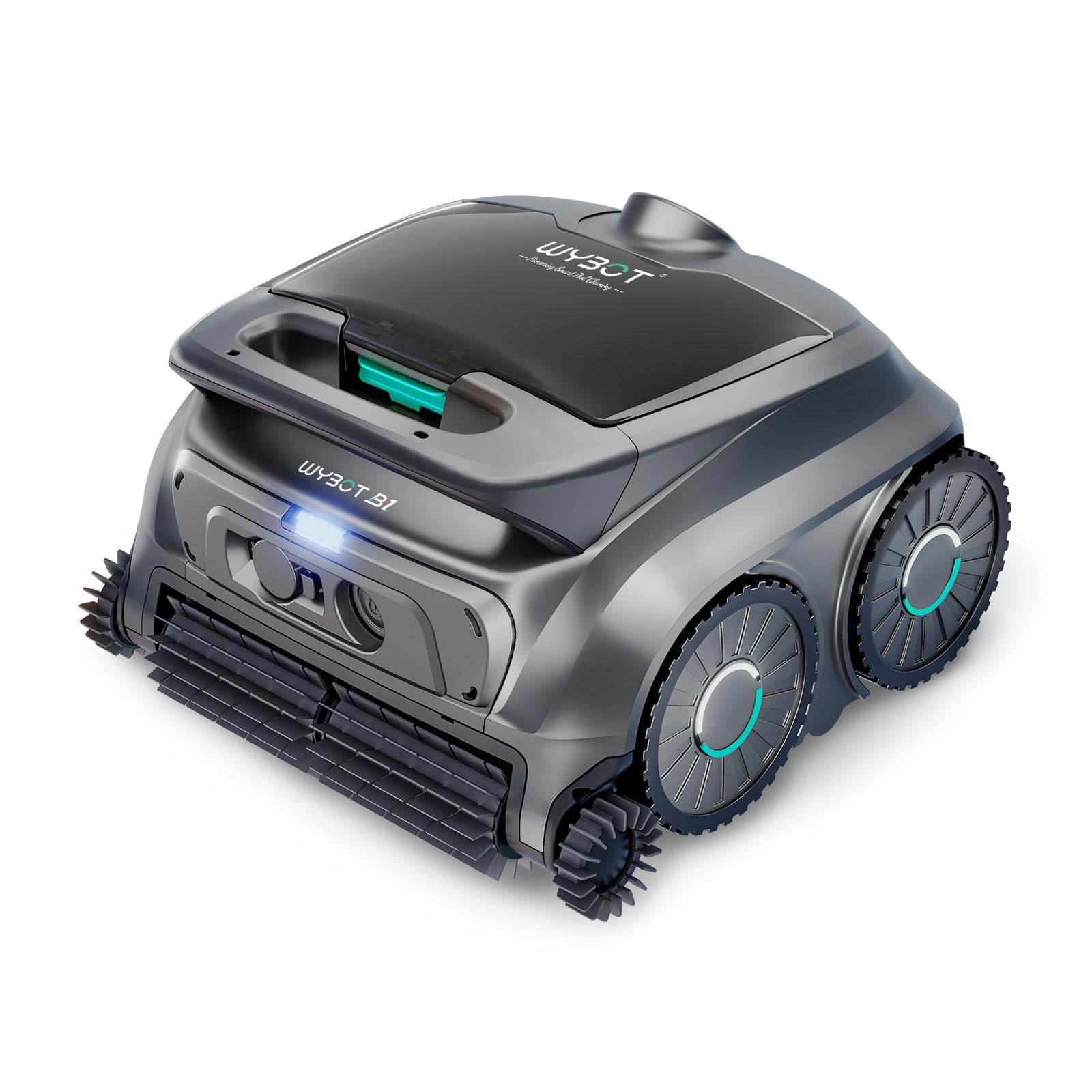
A 6-liter basket inside a 14.3-pound body is the combination that defines the B1. That's more debris capacity than our top pick carries, in a shell that's several pounds lighter, and the quad roller brushes underneath give it traction on slopes and seams where a flat-bottomed robot starts to spin.

Capacity is the practical part. On a leaf-heavy week you're emptying the basket weekly rather than after every run, and the top-load design means no wrestling with a clip-in cartridge while standing on a wet deck. Five modes through the WYBOT app split floor, wall, and waterline cleanly, so a quick floor-only pass is a two-tap job.

The high obstacle crossing is the spec doing quiet work: it rides up and over a raised drain cover or a light housing rather than parking on it until somebody notices. A three-hour charge on a 29.4-volt pack rounds it out, and OTA updates mean the firmware can improve without a new machine.

Pros

  • 6-liter basket in a 14.3-pound body
  • Roller brushes ride over drains and seams
  • Five app modes and OTA updates

Cons

  • 120-minute runtime won't cover a large inground pool
Our verdict

For a modest inground pool, this is the easiest robot here to live with: the lightest body, a 6-liter basket, and brushes that ride over drains.

Check Latest Price
6

Best Budget

BRINBO C1

84 /100
LBD Score Excellent

Key details

Runtime
Up to 180 minutes (Eco)
Warranty
2 years
App Controls
7 modes, 7 paths, 4 timers
Pool Coverage
Up to 1,615 square feet
View on Amazon

There's a specific buyer for the BRINBO C1: someone with a straightforward inground pool who wants the floor and walls clean without paying for cameras, surface skimming, or an app that plans routes. It's the budget pick in this group, and it keeps the things that matter — 180 minutes in Eco mode, coverage from floor to waterline, and a two-year warranty that matches the AIPER and the Gosvor, both of which cost more.

The hardware is a triple-motor suction unit with dual filtration, rated for pools up to 1,615 square feet. Through the app you get seven cleaning modes, seven path patterns, and four timer settings, which is more configurability than most people will use — we set a cross pattern and a start time and stopped opening the app. OTA updates mean the firmware can change without a new unit.

Two honest limits. The rated coverage is the smallest in this group, so a long freeform pool needs more than one cycle or a midweek top-up. And there's no micron figure published for the basket, so if sand is your issue, ask the maker which mesh it uses before you order.

Pros

  • 180 minutes of Eco-mode runtime
  • Scrubs floor, walls, and waterline
  • Two-year warranty at the budget end

Cons

  • Smallest rated coverage here at 1,615 square feet
Our verdict

If the budget is fixed and the pool is a simple shape, this covers floor to waterline, runs 180 minutes, and carries a two-year warranty.

Check Latest Price
7

Entry-Level Setups

CZYBYTE Cordless Pool Robot

80 /100
LBD Score Excellent

Key details

Runtime
120 minutes
Suction
4,500 GPH
Pool Coverage
Up to 2,000 square feet
Debris Capacity
4 liters
View on Amazon

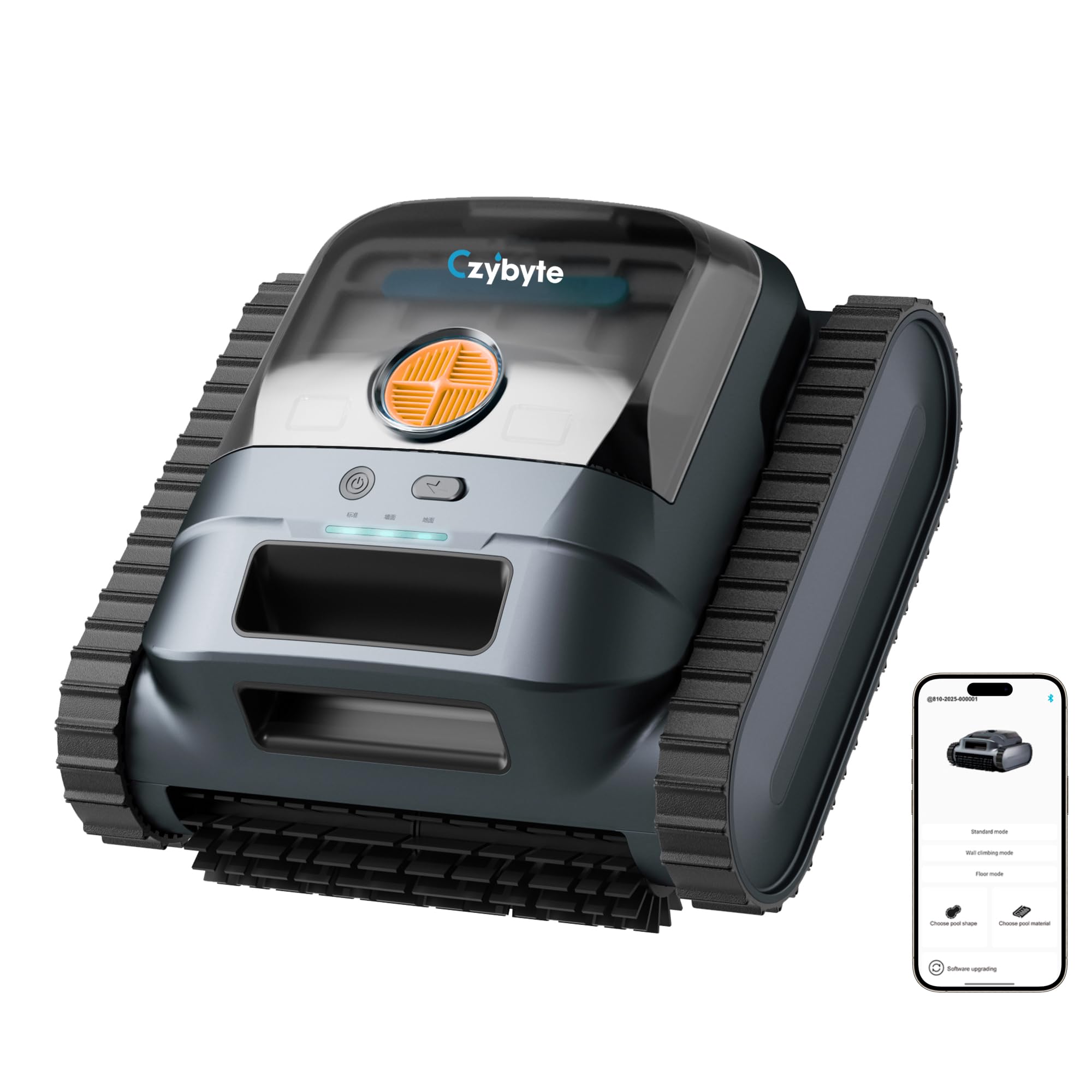
Sand and fine grit are where this one earns its keep. A 4-liter top-load basket with 150-micron mesh, 4,500 GPH of suction, and a rated 2,000 square feet add up to a cleaner that lifts the fine material off the floor and leaves the big stuff for your skimmer. That's the honest split: it handles sand better than it handles a full leaf drop.

For the money it does more than we expected. Three modes cover floor, walls, and waterline, the app handles scheduling, and the unit parks at the wall when the cycle ends so you aren't fishing around the deep end. At 15.6 by 15.2 by 8.9 inches it's compact enough to live on a shelf rather than the garage floor.

The limit is time. A 120-minute cycle off a 97.68-watt-hour pack means a larger pool gets one pass and then a wait, and that's the whole story on capacity. For a small inground pool — a plunge pool, a spa-topped pool, a plain rectangle — it's the cheapest way here into a robot that scrubs walls.

Pros

  • 4-liter basket with 150-micron mesh
  • 4,500 GPH suction for fine debris
  • Parks at the wall for easy retrieval

Cons

  • 120-minute cycle limits it to smaller pools
Our verdict

A good first robot for a small pool: 4 liters of basket, 4,500 GPH, and a better showing on sand than on a heavy leaf drop.

Check Latest Price

How We Tested Eight Pool Robots Over a Full Season

I started with every cordless model rated for an inground pool, then cut anything without a replacement filter or a published runtime, which left eight. Testing ran seven months, from a messy spring opening through the fall leaf drop, across three pools: my own plaster pool, a neighbor's vinyl-liner pool under two maples, and my in-laws' pool that collects pine needles, sunscreen, and dog hair all summer.

Instead of trusting the runtime on the box, I timed every full cycle with a stopwatch and ran units back-to-back until they quit, noting where each one stopped — a robot that dies against the deep-end wall is one you have to fish out. I paired each app, walked to the far end of the pool and behind the pump house to see whether the schedule held and the connection recovered, and counted the taps it took to start a clean.

Every unit went in at the same spot by the steps so I could see where it headed first. For debris pickup, I seeded marked squares of floor with oak leaves, pine needles, sand, and hair, then checked the basket to see what came up and what got pushed around instead. A chalk line along the waterline tile showed whether the scum ring was actually gone after a run. Ease of use came down to lifting each one out by its handle and rinsing the basket.

Value got judged over time, not at checkout: filter replacements, brushes that needed swapping mid-season, and whether one charge finished my pool with anything left. The simplest effectiveness test was whether I could see the main drain from the deck without squinting.

How to Choose a Robotic Pool Cleaner for an Inground Pool

Match Runtime to Your Pool's Surface Area

Most cleaners here publish a runtime and a coverage figure in square feet. Treat that coverage number as a ceiling rather than an expectation: it is measured on a clear floor, and a pool with steps, a sun shelf, and a lot of wall will burn the same charge faster. If your pool sits near the top of a robot's rated area, plan on two cycles rather than one.

This is where the Beatbots pull ahead for large pools — both run about 300 minutes on floor cleaning. The WYBOT B1's two hours is a small-pool number, and no amount of suction changes that.

Floor, Wall, and Waterline Are Three Different Jobs

Climbing is easy to claim and harder to do well. A robot gets up a wall by pressing against it and driving, so a vinyl liner with some give is tougher than plaster, and the waterline — where sunscreen and oils collect — is usually the first thing an owner notices going scummy.

Look for a stated waterline or shallow-area mode rather than a wall-climbing badge, and check the depth it works in if you have a sun shelf or a wide top step. The Sora 70 reaches down to eight inches of water; the Sora 10 and the Gosvor state twelve.

Baskets, Microns, and How Often You Empty It

Capacity is measured in liters and it decides how often you handle wet leaves. Three liters is a daily-empty basket on a leaf-heavy pool; five or six buys you a week. Filtration is the other half of the job. A 150- to 180-micron basket takes leaves and coarse grit, while a 3-micron layer takes sand and silt but loads faster and wants rinsing after every cycle.

If your pool collects sand, pay for the fine layer — the AIPER, the Gosvor, and the Sora 10 all offer one. If it collects leaves, buy liters instead.

Weight and Retrieval Decide Whether You Actually Use It

A cleaner is automatic only up to the point where you lift it out. Dry weight is the number you can check; wet weight is that figure plus whatever the basket and housing are holding, which is why waterline parking and self-draining matter more than a pound or two on the spec sheet.

Under about 18 pounds is a comfortable one-person lift from the deck. The WYBOT B1 is 14.3 pounds and the Gosvor 15.2; the Sora 70 is 22.9 and earns its park-and-drain routine.

Cord or Battery, and What You're Buying Two Seasons In

A corded robot runs indefinitely and never asks for a charge, but the cable lives in the water and the power supply sits on your deck — and the power supply is the piece we watch on any corded unit. Battery cleaners trade that for a hard runtime limit and a three- to four-and-a-half-hour recharge.

Either way the warranty is the specification that pays out. This group runs from two years to Beatbot's three, and parts availability matters as much as the term. Rinse the unit after each cycle and store it out of the sun.

Frequently Asked Questions

Final Verdict

For most inground pools, the Beatbot Sora 10 is the cleaner we recommend. One charge covers close to 3,200 square feet, the basket holds five liters, it works down to twelve inches of water, and it parks at the waterline so retrieval doesn't mean getting wet — the balance of runtime, capacity, and cost is the best in this group.

If leaves land as fast as they sink, the Sora 70 skims the surface as well as the floor, and it carries the longest warranty here. If the budget is the binding constraint, the BRINBO C1 covers floor to waterline at 180 minutes a cycle with two years behind it.