Best Powered PA Speakers for Live Bands of 2026

The first time my band showed up to a backyard party with nothing but a borrowed combo amp, I learned what a PA actually does: it's the difference between a room hearing you and a room hearing mud. A powered speaker does the whole job itself — amp, mixer, and cabinet in one box you can carry with one hand — and what you're really buying is headroom, so vocals sit on top of the drums instead of somewhere behind them.

My team and I spent the past eight months running 10 powered PA speakers through rehearsals, wedding sets, and a couple of very loud basements. The ones that held up stayed clean when we pushed them, and we got picky about the unglamorous parts: how a cabinet survives a hatchback, how long a battery actually lasts at gig volume, and whether Bluetooth holds when someone wanders off with their phone.

One thing worth knowing before you shop: wattage numbers don't compare cleanly across brands. Peak figures flatter, RMS tells you more, and a well-tuned small box can out-clear a cheap big one on vocals. Below are the speakers we'd happily load into our own van again.

1

Best Overall

Electro-Voice Everse 8

91 /100
LBD Score Outstanding

Key details

Driver
8-inch woofer + 1-inch tweeter
Weight
16.8 lb
Battery
Up to 12 hours
Weather Resistance
Water resistant
View on Amazon

The three-year warranty and weatherized cabinet are the first things we noticed, because most battery-powered PA speakers are treated as fair-weather gear. The Everse 8 is a 16.8-pound, 8-inch two-way cabinet with up to 12 hours of battery, Bluetooth audio and app control, and an onboard mixer. The polypropylene enclosure is listed as water resistant, which matters for outdoor ceremonies, patios, and load-ins that happen before the weather turns.

We recommend it as the default for small live bands because it puts the practical pieces in one box: a real 8-inch woofer and 1-inch tweeter, automatic feedback suppression, music ducking, and a three-year warranty. The 8-inch driver gives vocals and acoustic instruments a clean, balanced presentation, and the feedback suppression earns its keep when a vocal mic and a small stage share tight space. For a duo, trio, or compact electric act, it covers the set without a separate mixer or a second trip to the van.

The app and Bluetooth control are useful for setup and playback, but we treat the wired inputs as the gig connection. The cabinet's weight and handle make it easy to move without a second person, and the battery means you can set up before power is sorted. This is the one we point to first when the gig is portable, outdoor, or simply too small for a pair of 12-inch mains.

Pros

  • Weatherized cabinet with 12-hour battery
  • Three-year warranty
  • Automatic feedback suppression
  • 16.8 lb and easy to move

Cons

  • One 8-inch cabinet won't carry a loud full band
  • Onboard display is hard to read in bright sun
Our verdict

For small live bands that need a weather-ready, battery-powered main with real feedback control, the Everse 8 is the one we recommend first.

Check Latest Price
2

Best for Solo and Duo Acts

Bose S1 Pro+

91 /100
LBD Score Outstanding

Key details

Mixer
3 channels
Output
150W
Weight
14.4 lb
Battery
Up to 11 hours
View on Amazon

Four positioning options are what make the S1 Pro+ more useful than its size suggests: upright, tilted back, horizontal, or on a 35 mm stand. At 14.4 pounds, it has a carry handle, a 150W amplifier, a three-channel mixer, and up to 11 hours of battery. We like that a solo act can set it on the floor as a wedge, tilt it back for a small audience, or put it on a stand without adding a separate monitor.

We recommend it for solo and duo gigs where the car is small and the load-in is short. The three-channel mixer gives you two channels for mics or instruments and one for playback, which is enough for a singer-songwriter with a guitar and a backing track. Bluetooth is handy for walk-in music, but we keep stage inputs wired. The battery is rated at up to 11 hours; high volume and a cold outdoor set will eat into that, so carry the power cord.

What remains is a well-sized, flexible cabinet that solves the solo-gig problem better than a bigger speaker you dread carrying. For a café, a ceremony, or a duo set with a small footprint, it is the one we reach for.

Pros

  • Four positioning options
  • Three-channel mixer
  • 14.4 lb with carry handle
  • Up to 11 hours battery

Cons

  • 150W output is modest for a full band
Our verdict

For solo and duo acts who want four placement options and a three-channel mixer in a 14.4-pound cabinet, the S1 Pro+ is the easy carry.

Check Latest Price
3

Best for Scalable Band Rigs

ALTO TS408

83 /100
LBD Score Excellent

Key details

Mixer
3 channels
Driver
8-inch woofer + 1.4-inch tweeter
Weight
20.7 lb
Peak Power
2,000W
View on Amazon

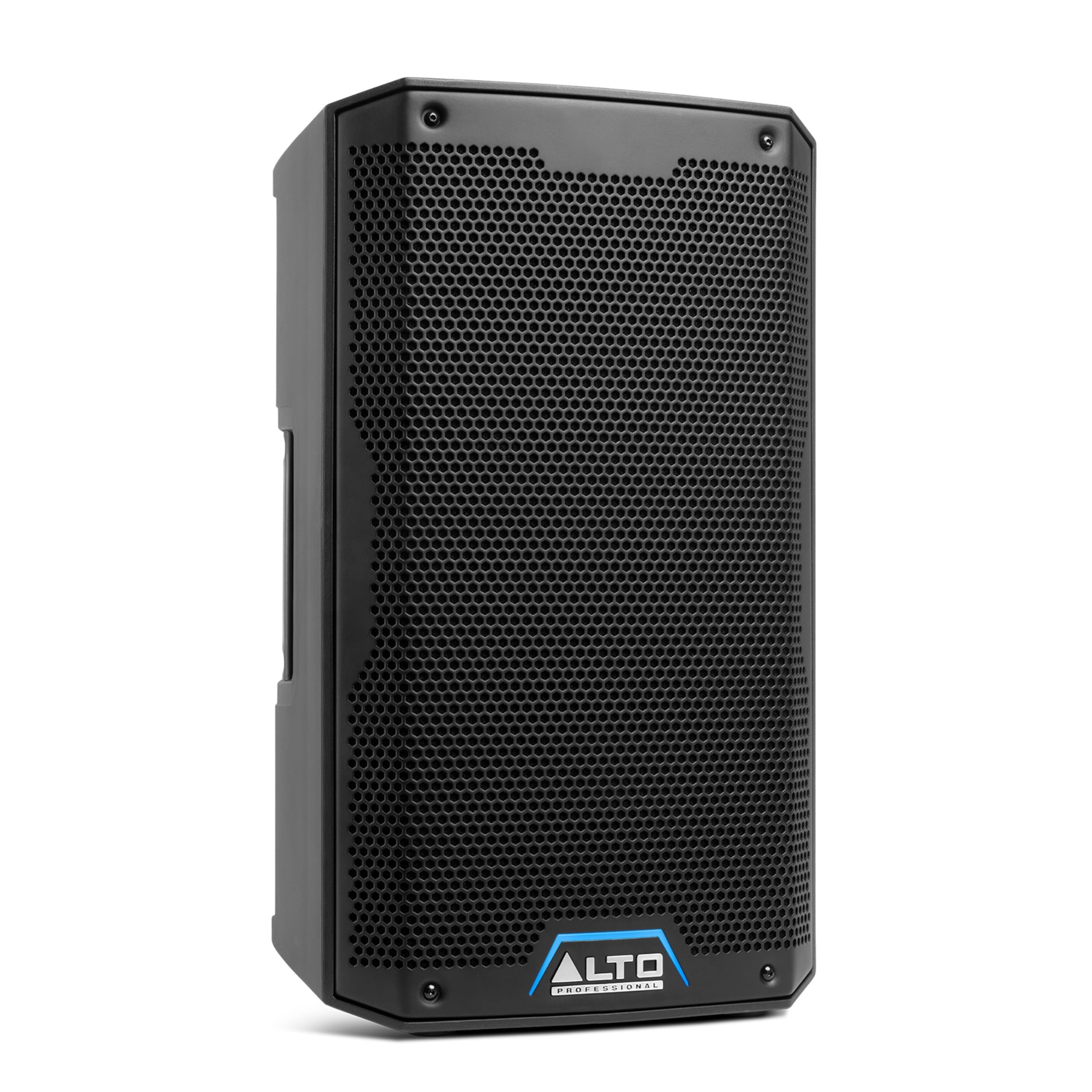
The 2,000W peak figure is the headline, but the useful part is the rest of the TS408: an 8-inch woofer, a 1.4-inch high-frequency driver, a three-channel mixer, DSP and app control, and a 20.7-pound cabinet that can sit on a pole, in a wedge position, or fly from M6 points. That combination makes it a scalable building block for a small band rather than a one-trick party speaker.

The dual XLR/1/4-inch combo inputs and independent level controls cover a vocal mic, an acoustic instrument, and a playback source, while the app gives you speaker-use modes and EQ without reaching around the back. For a pair of guitars and vocals, one or two TS408s are a practical rig. The cabinet can sit on a pole, in a wedge position, or fly from M6 points, which makes it easier to fit around a small stage.

We recommend it for bands that want to start with one cabinet and add a second later. Bluetooth streaming is convenient for breaks and backing tracks, but we keep the set on the wired inputs. The 20.7-pound weight is manageable for one person, and the DSP makes it easier to match the speaker to the room. When the room is small and the band is compact, this is the powered speaker we recommend pairing up.

Pros

  • 2,000W peak output
  • Three-channel mixer with XLR/1/4-inch inputs
  • DSP and app control
  • Pole, wedge, and flown mounting

Cons

  • 8-inch woofer needs a sub for kick and bass
  • Bluetooth can drop out in a live set
Our verdict

For a band that wants to build a scalable rig around an 8-inch active speaker with DSP and app control, the TS408 is the practical starting point.

Check Latest Price
4

Best Budget Complete System

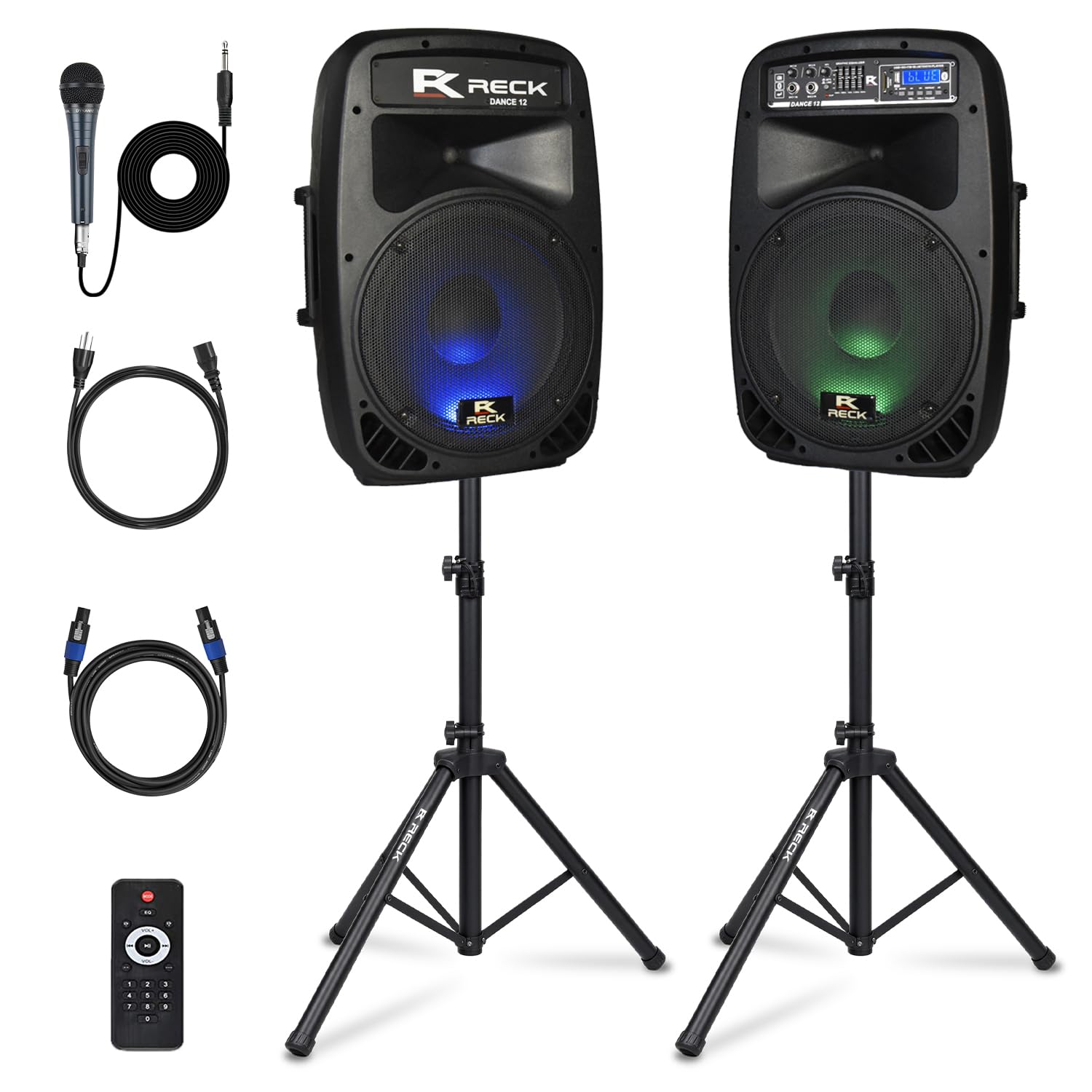
PRORECK Dance 12

90 /100
LBD Score Outstanding

Key details

Power
150W RMS / 1,000W peak
Driver
12-inch woofer + 1.35-inch driver
Included
Two stands and wired mic
Playback
Bluetooth, USB, SD, FM
View on Amazon

A pair of 12-inch speakers, two stands, a wired mic, and the cables arrive in one box with the Dance 12. That completeness is the point: for a small band or a solo act without a trailer full of gear, it turns a shopping list into a single purchase. The active cabinet carries the amplifier and mixer, and the second cabinet is powered from it, so you are not adding a separate power amp.

The numbers to plan around are 150W RMS and 1,000W peak, with a 12-inch woofer and a 1.35-inch titanium compression driver. The 12-inch driver gives vocals and acoustic instruments more body than an 8-inch cabinet, and the included stands get the sound above the crowd. Bluetooth, USB, SD, and FM cover playback and walk-in music, while the 30-foot speakon cable gives you some room to separate the speakers.

We think this is the budget package to consider when the gig is a small room, a party, or a relaxed outdoor set. The 12-inch drivers and included stands do the heavy lifting, and the active cabinet keeps the setup simple. For a first PA or a backup system, it covers vocals, acoustic instruments, and playback without a separate mixer.

Pros

  • Complete package with stands and mic
  • 12-inch woofer and titanium driver
  • 150W RMS / 1,000W peak
  • Bluetooth, USB, SD, and FM playback

Cons

  • No XLR inputs on the main cabinet
  • 150W RMS leaves little headroom for loud drums
Our verdict

For a first PA on a tight budget, the Dance 12 package delivers two 12-inch speakers, stands, and a mic in one purchase.

Check Latest Price
5

Rehearsal and Gigs

Rockville BPA10

88 /100
LBD Score Excellent

Key details

Power
400W peak / 100W RMS
Driver
10-inch woofer + 1-inch driver
Inputs
XLR and 1/4-inch mic
Weight
18.5 lb
View on Amazon

The BPA10 is the least expensive way here to get a powered cabinet with a 10-inch woofer, a 1-inch titanium compression driver, XLR and 1/4-inch mic inputs, and a built-in two-band EQ. At 18.5 pounds, it is light enough to carry with one hand and small enough to fit in a corner of a rehearsal room. The 400W peak / 100W RMS rating is the first thing to check against the room.

We recommend it for rehearsals, solo practice, and small gigs where a vocalist or acoustic player needs a clean, portable box. The XLR input and line output make it easy to chain a second speaker or feed a monitor, and the pole mount gets it off the floor. The 10-inch woofer gives more low-end than a typical 8-inch portable, and the two-band EQ is enough to tame a bright room.

Bluetooth and USB/SD playback are handy for backing tracks, and the flyable enclosure gives you options beyond a stand. What we like most is the simplicity: one input, one level, one speaker, and a weight that does not turn load-in into a workout. It is a starter cabinet, but a sensible one for the player who needs sound now and a second speaker later.

Pros

  • 10-inch woofer with XLR mic input
  • 400W peak / 100W RMS
  • 18.5 lb and easy to carry
  • Pole-mount and flyable enclosure

Cons

  • 100W RMS won't carry a loud band
  • Remote and wireless controls can be inconsistent
Our verdict

For rehearsal and small gigs where a single light cabinet with an XLR mic input is enough, the BPA10 is the low-cost workhorse.

Check Latest Price

How We Chose and Tested Powered PA Speakers

We started by pulling every powered speaker we could find that had a usable onboard mixer, then filtered by cabinet size, price, and whether it ran on AC, battery, or both. Ten made the cut — a deliberate mix of compact battery units and heavier cabinets, since that's the split most bandleaders are actually choosing between.

Each one lived through eight months of Tuesday rehearsals in a garage, three outdoor sets, a basement show, and a lot of loading in and out of a hatchback. At rehearsal we ran vocals and acoustic guitar through them against a live drum kit and listened for whether the singer stayed intelligible at the volume a room really needs. We timed battery drain with a stopwatch at gig level rather than at a whisper, walked a paired phone 40 feet away to see whether the Bluetooth link survived a crowd, and tried the app and speaker-linking features mid-song to see how fast they recovered from a fumble.

We carried each cabinet up a flight of stairs one-handed where we could and noted where the handles dug in, then checked corners and grilles after a month of van life. We also logged what came in the box, because a cheap speaker that needs a stand and cables to function isn't actually cheap. Anything that hummed, clipped early, or dropped a wireless link mid-set got flagged and retested on a second night.

How to Choose Powered Pa Speakers for Live Bands

Start with headroom, not peak wattage

Peak wattage is a marketing number; the usable figure is RMS, and even that only makes sense next to driver size and cabinet design. A single 8-inch speaker with a high peak rating will not move the same air as a 12-inch cabinet, and a pair of small speakers often beats one larger box for coverage. For a duo or acoustic trio, start with an 8- or 10-inch pair. For a bar band with drums, plan on 12-inch mains and a subwoofer, or accept that the low end will be thin. We favor a realistic RMS rating over a dramatic peak figure.

Count inputs before you count features

A powered speaker with a built-in mixer can replace a small external console, but only if it has the channels you need. Two vocal mics, an acoustic guitar, and a playback source already fill four inputs; a three-channel cabinet will force compromises. The Bose S1 Pro+ and ALTO TS408 each give you three channels, which suits a solo or duo act. For a fuller band, check for XLR combo jacks, independent level controls, and a line output for linking. Leave one spare channel for a guest mic or a backup source.

Choose battery power for the right gigs

Battery power is a real convenience for ceremonies, busking, and outdoor sets where outlets are far away. It is less useful for a loud, long band set: runtime drops as volume rises, and cold weather can shorten it further. The Electro-Voice Everse 8 is the strongest battery option here because it pairs up to 12 hours of claimed runtime with a weatherized cabinet and a three-year warranty. The Bose S1 Pro+ is lighter and more flexible in placement, but its 150W amplifier is better suited to solo and duo work. If the gig has reliable AC power, a corded speaker usually buys more output for the money.

Plan for transport, mounting, and growth

A 20-pound speaker is easy for one person; a 60-pound package with stands is a two-trip load-in. Check the pole mount, the handle placement, and whether the cabinet can sit as a wedge or fly from rigging points. If you plan to add a second speaker or a subwoofer, look for a line output, a high-pass filter, or a subwoofer mode. The ALTO TS408 is the most flexible of these for growth, with pole, wedge, and flown options. The PRORECK Dance 12 is the opposite approach: a complete package that gets you started but limits later expansion.

Frequently Asked Questions

Final Verdict

For most live bands, we recommend the Electro-Voice Everse 8 as the first powered speaker to buy. It combines an 8-inch two-way cabinet, up to 12 hours of battery, weather resistance, feedback suppression, and a three-year warranty in a 16.8-pound package. Add a second for stereo coverage, or move to the ALTO TS408 if you want a scalable AC-powered rig with DSP.

The Bose S1 Pro+ is the solo-and-duo choice; the PRORECK Dance 12 is the budget complete-system answer; the Rockville BPA10 is the rehearsal and small-gig starter. Choose the one that matches the room and the load-in, not the biggest peak wattage number.