Best Outdoor Projector Screens of 2026

The first time I hosted a backyard movie, I taped a white bedsheet between two fence posts. It looked fine until the wind picked up; by the second act there was a sag in the middle and a shadow running down the crease. A real screen fixes both problems at once with a flat, tensioned surface and a frame that doesn't wander. Flat surface, steady frame — that's the whole job.

The surface matters more than I expected. Two screens lit by the same projector can look a world apart — one crisp into the corners, one washed out with a hot spot in the middle. Over six months we've put 11 screens through backyard nights, a camping weekend, and one memorably windy cookout; the good ones share creases that relax after folding, hardware you can assemble at dusk, and a frame that stays put.

Size is the other trap: a 150-inch screen sounds like an upgrade until your projector's brightness has to cover all that fabric. Below are the ones worth hauling out, from big-yard setups to something that fits in a trunk.

1

Best Overall

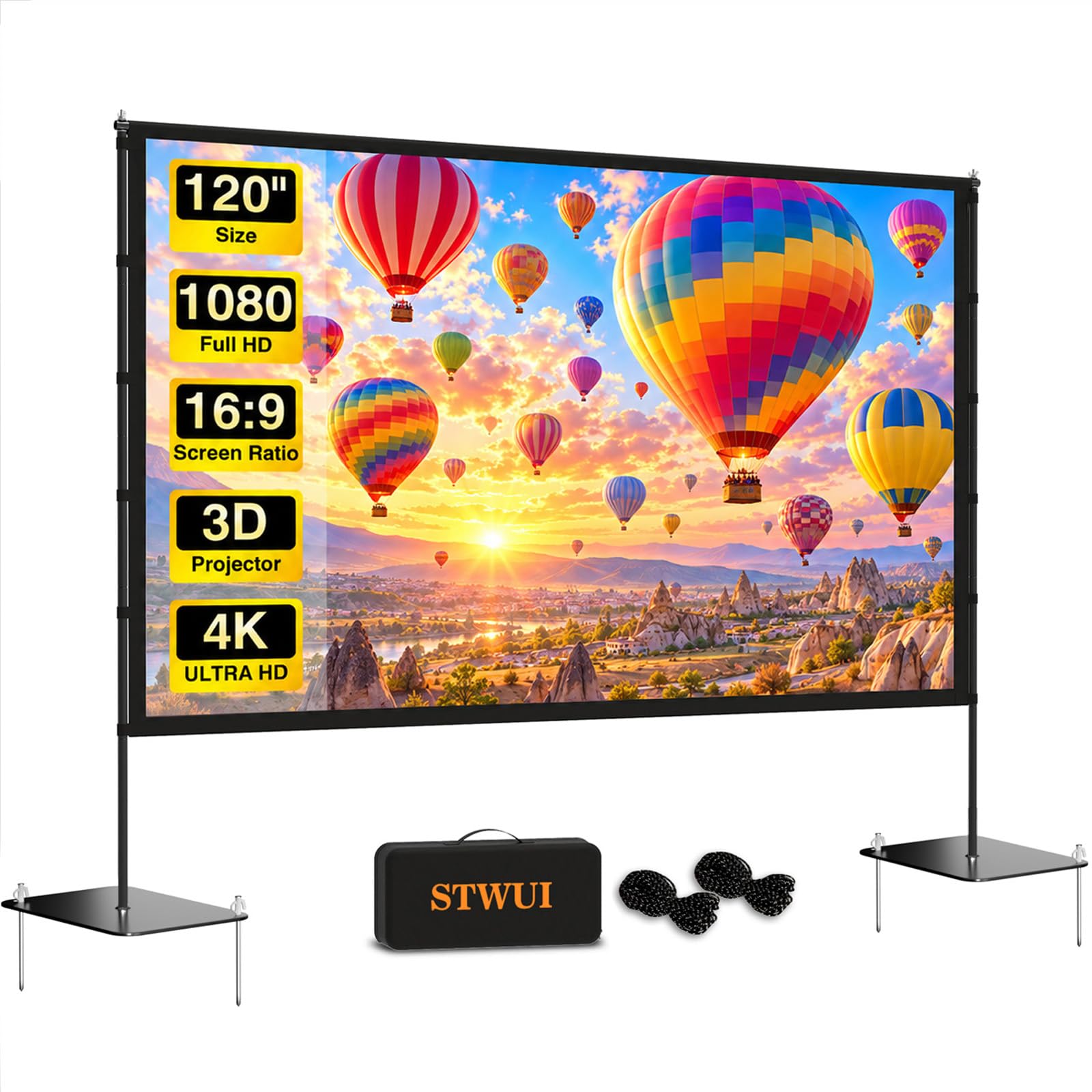
STWUI 120-Inch Screen with Stand

85 /100
LBD Score Excellent

Key details

Assembly
Tool-free, 8 minutes
Screen Size
120 inches
Aspect Ratio
16:9
Viewing Angle
160 degrees
View on Amazon

Wind decides whether an outdoor screen earns its keep, and the STWUI is built around that one problem. The base plate is widened and thickened for staking into grass, the uprights are steel rather than aluminum, and the bracket is braced rather than merely assembled. Set beside the thin tripod legs on other screens here, it reads as the more serious piece of equipment.

That emphasis is why we trust it through a normal evening more than anything else in this group. At 120 inches there's room for a dozen folding chairs, the 16:9 surface stays taut once the frame is up, and the 160-degree rating covers the seats off to either side. The assembled frame measures 108 by 78.5 inches, so check the gap between the fence and the flower bed before you commit.

Setup is genuinely tool-free: the tubes splice together, the screen fastens with Velcro along the frame, and the whole kit goes back into the carry bag. The eight-minute figure is realistic with two people; alone, the top cross bar is the awkward lift. The milk-silk fabric pulls flat, though one edge can ripple when the weather swings — a small thing you stop noticing in the dark.

Pros

  • Staked base plate that holds in wind
  • Tool-free assembly in about eight minutes
  • Wrinkle-resistant milk-silk fabric
  • Packs into a carry bag with the frame

Cons

  • Only a 30-day warranty
Our verdict

For a first backyard movie night, this is the screen we recommend: it stakes down against wind, goes up without tools, and the 120-inch surface pulls flat.

Check Latest Price
2

Best Budget

Mdbebbron 120-Inch Foldable Screen

91 /100
LBD Score Outstanding

Key details

Weight
1.7 lb
Mounting
Hooks, tape, nails, or rope
Screen Size
120 inches
Viewing Area
104"W x 58"H
View on Amazon

There's no frame and no stand in the box — just 1.7 pounds of matte polyester with grommets and a stuff bag. For anyone with a fence, a garage wall, or two trees roughly nine feet apart, that's the appeal rather than the compromise: nothing to store, nothing to rust, and a picture that's up in the time it takes to tie two lines.

The 104 by 58 inch viewing area carries the same 120-inch diagonal as the stand kits here, and the fabric takes an image from either side, so a rear set-up works if you have space behind it. Creases from the fold relax as you tension the screen, which is why pulling all four corners tight matters more than any trick with an iron.

Hanging it takes about five minutes once you've picked the anchor: rope between two trees, screw hooks into a fence, or nails into a garage wall, with the grommets doing the work at each corner. Pull it until the surface stops moving and it reads like a proper screen rather than a sheet — which is the whole trick with fabric this light.

Pros

  • 120-inch image that folds into a backpack
  • Front or rear projection from one sheet
  • Wrinkles relax once it's tensioned
  • The least expensive way to a big picture here

Cons

  • Supplied sticky hooks struggle on textured walls
Our verdict

Our budget pick: hang it from a fence or between two trees and you get a 120-inch picture for less than any stand kit here.

Check Latest Price
3

Best for Camping

AODIOU 80-Inch Screen with Stand

88 /100
LBD Score Excellent

Key details

Weight
5.49 lb
Screen Size
80 inches
Aspect Ratio
16:9
Viewing Angle
160 degrees
View on Amazon

Eighty inches is the smallest picture in this group, right up until you're packing a car for a weekend. The AODIOU kit is listed at 2.49 kg, the frame breaks down into short aluminum sections, and the whole package disappears into a suitcase in a way a 120-inch stand kit never would.

Camping is where it earns its place. The 16:9 surface and 160-degree viewing angle mean a family sitting on the ground a few feet back gets a bright, even picture, and the frame goes together without tools — no hunting for an Allen key by flashlight. Two people make it quicker, but one is enough.

The frame is light aluminum, which is the entire point, and it's happiest set up against a windbreak — a tent, a vehicle, a hedge — rather than out in the open. What it won't do is scale: 80 inches covers a dozen people sitting close on the ground or in low chairs, and the same crowd spread across a patio starts to feel like they're watching television. That's the boundary of what this one is for, and it's also why it packs so small.

Pros

  • Whole kit packs into a suitcase
  • No-tools aluminum frame
  • 160-degree viewing angle
  • Washable polyester screen

Cons

  • Light frame shifts in a breeze unless staked
Our verdict

Camping is where this one earns its place: it packs into a suitcase, goes up without tools, and 80 inches is plenty up close.

Check Latest Price
4

Best for Big Crowds

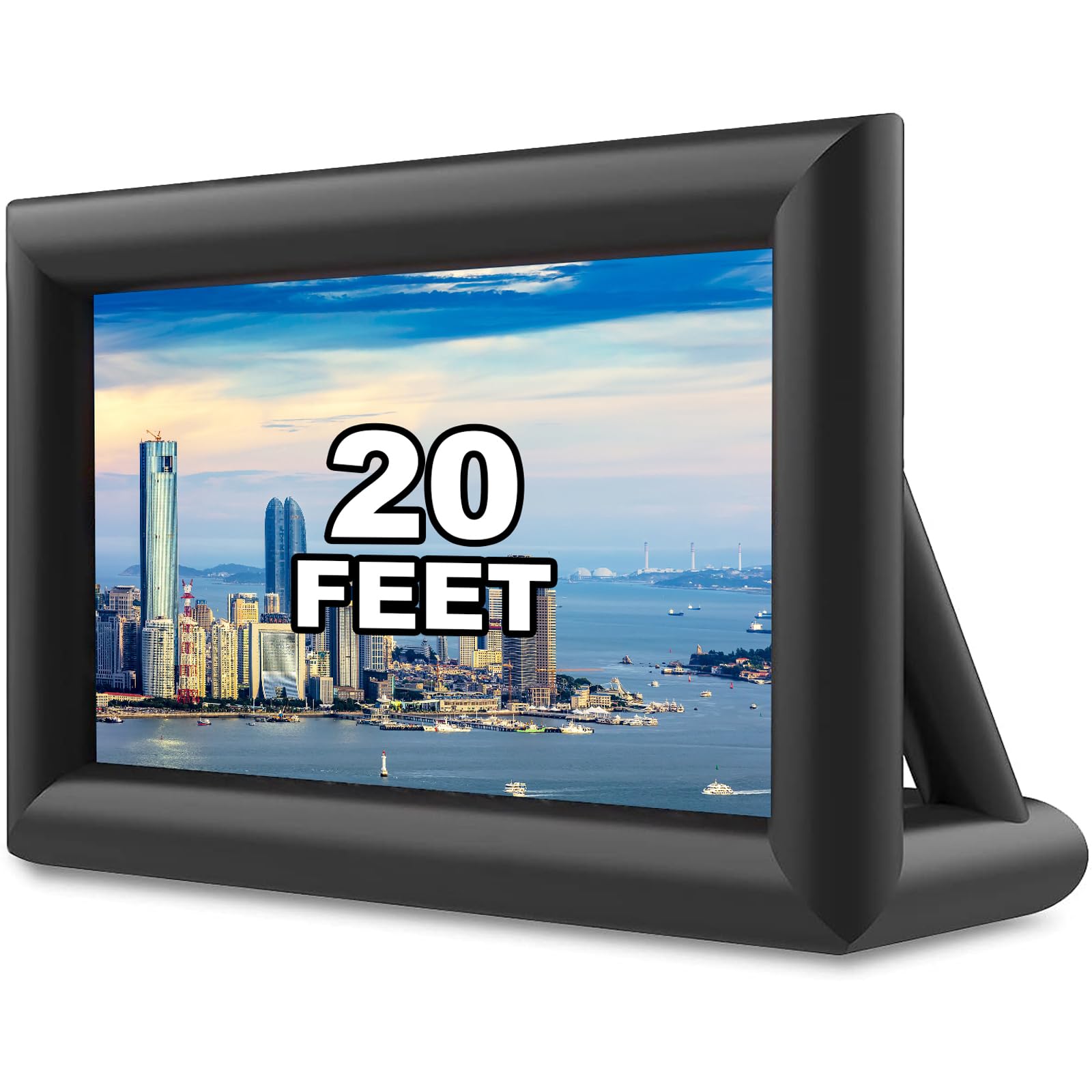
GYUEM 20-Foot Inflatable Screen

91 /100
LBD Score Outstanding

Key details

Weight
20.9 lb
Image Size
13 ft x 7.4 ft
Aspect Ratio
16:9
Overall Size
16 ft x 10.5 ft
View on Amazon

Twenty feet of inflatable screen is less a screen than a venue. The white surface itself runs 13 feet by 7.4 feet inside a 16:9 frame, and the inflated body around it measures 16 feet by 10.5 feet — the number that decides whether it fits between the garage and the fence.

Inflation is where it wins. The blower fills the frame in about two minutes, ropes and tent stakes hold it down, and the whole thing collapses into a storage bag that fits in a trunk. There's no assembly sequence to learn and no tubes to lose. At 20.9 pounds packed it's a two-hands carry, not a backpack.

We like it for the events a fabric screen can't handle: a school field, a block party, fifty people on blankets. The image reads from both sides, which is handy when half the crowd drifts behind it by the pool, and the inflated frame shrugs off the knocks that would take down a metal stand. Give it a flat, open site — this is not a screen for a small yard, and it isn't trying to be.

Pros

  • 13 ft by 7.4 ft image area
  • Inflates in about two minutes
  • Blower, ropes, and tent stakes included
  • Packs into a storage bag

Cons

  • Blower needs power all evening
  • Screen sleeve zipper is the weak point
Our verdict

For fifty people on a field, this is the one: a 13-by-7.4-foot image that inflates in about two minutes and packs into a bag.

Check Latest Price
5

Best Big-Screen Value

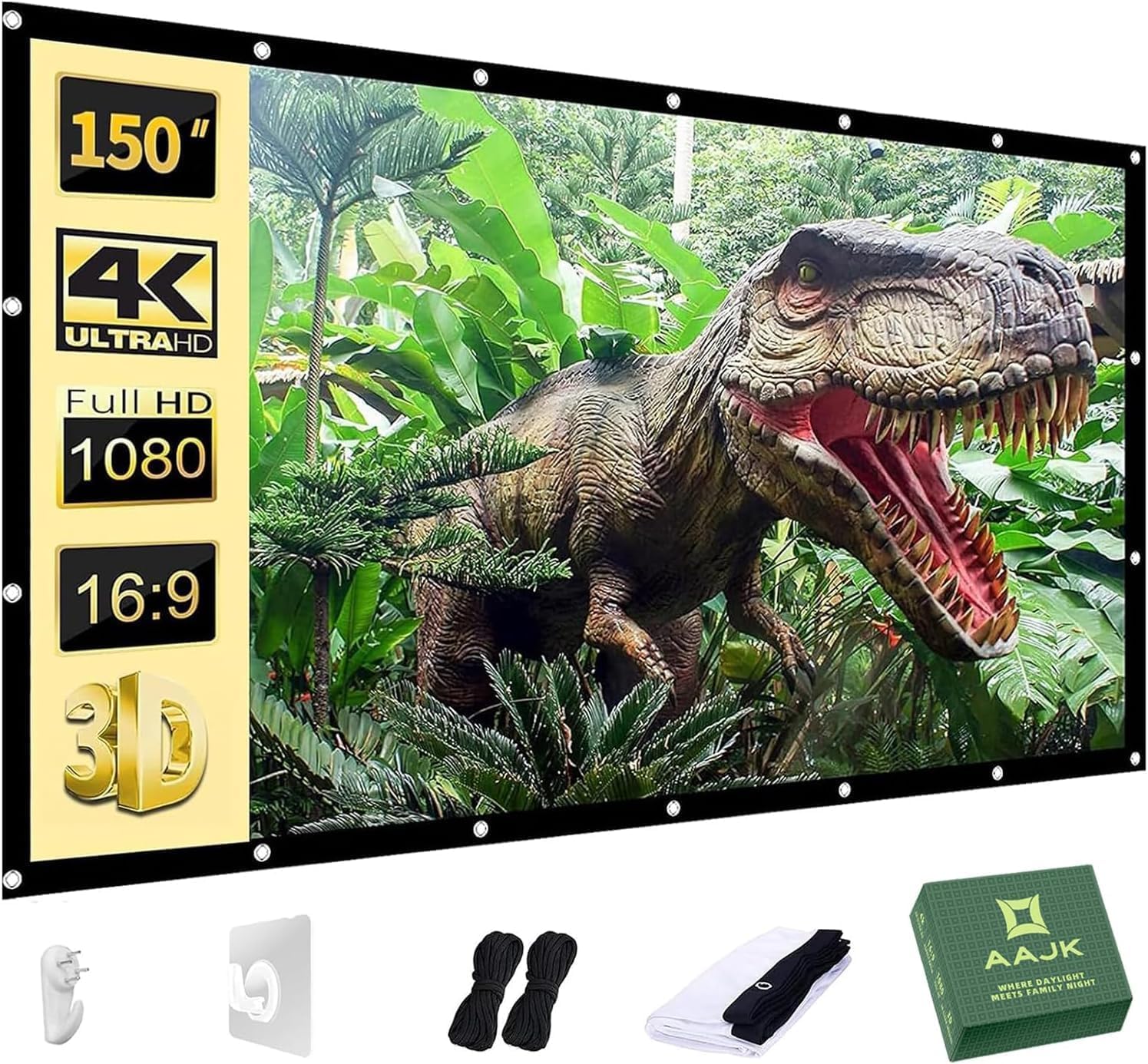
AAJK 150-Inch Foldable Screen

89 /100
LBD Score Excellent

Key details

Weight
2.8 lb
Screen Size
150 inches
Viewing Area
132"W x 72"H
Viewing Angle
160 degrees
View on Amazon

The AAJK is the cheapest way to get a 150-inch picture onto your lawn, and it gets there by being nothing but fabric: 2.8 pounds of white polyester with a 132 by 72 inch viewing area, grommets down both edges, and a bag. Everything a stand kit charges for — frame, feet, engineering — is a fence or a wall you already own.

Hung properly, it's a lot of screen. Run a line of rope or a row of screw hooks along a fence, thread the grommets, and pull each corner until the surface stops moving; the creases from the fold relax under tension rather than needing heat. It takes an image from either side too, so a rear set-up against a garage wall works if you flip the projector's menu setting.

The material is honest about what it is: bright white and smooth enough for a crisp image, but it isn't black-backed, so any light behind or beside it washes the picture out. Start the movie later than you think you need to, and put the screen where the porch light and the streetlamp aren't directly behind it.

Pros

  • 132 by 72 inch viewing area
  • 2.8 pounds, folds into a bag
  • Grommets all round for an even pull
  • Washable polyester surface

Cons

  • No frame or stand in the box
Our verdict

The biggest picture here for the least money — worth it if you have a fence or wall to pull it tight against.

Check Latest Price
6

Smaller Yards

SKERELL 100-Inch Screen with Stand

89 /100
LBD Score Excellent

Key details

Screen Size
100 inches
Aspect Ratio
16:10
Viewing Area
85 x 53 inches
Viewing Angle
160 degrees
View on Amazon

Sixteen-ten is the odd ratio in this group, and it's why the SKERELL suits some rooms better than the cinema-shaped screens around it. Laptop feeds, slide decks, and 16:10 projectors fill the 85 by 53 inch surface edge to edge; a widescreen film leaves slim bars top and bottom instead of spilling past the sides.

The rest of the kit is built for speed: an aluminum floor stand, tubes that click together without tools, and a carry bag short enough to lie flat in a trunk. Five minutes is a fair estimate for one person, and the 100-inch picture is sharp with a 4K source.

A hundred inches is also the sensible size for a patio, a garage, or a classroom — big enough to feel like an event, small enough that a modest projector still looks bright on it.

Where it gives ground is the frame. The stand is light, and on open grass a modest breeze pushes it around; anchor the base, keep it against a wall or a windbreak, and it behaves. For a sheltered patio or an indoor room we think it's a sound buy; for an exposed field on a gusty night it isn't the screen to take.

Pros

  • Five-minute setup with no tools
  • Aluminum frame packs into a trunk
  • 16:10 suits laptop and slide sources
  • Sharp 100-inch picture with a 4K source

Cons

No notable drawbacks to flag.

Our verdict

Best for a patio or a smaller yard: 100 inches on a five-minute frame, as long as it's anchored and out of the wind.

Check Latest Price
7

Indoor and Patio

LCUIRC 120-Inch Metal-Frame Screen

89 /100
LBD Score Excellent

Key details

Base
12" x 8", 2 lb
Weight
8.82 lb
Screen Size
120 inches
Aspect Ratio
16:9
View on Amazon

The base on the LCUIRC is the detail that separates it: a 12 by 8 inch, 2-pound steel plate that sits low enough to slide under a rug indoors and heavy enough to matter on a patio. The frame and base are both metal rather than plastic joints dressed up to look like steel.

The screen is the other half of the design. Three pockets take the frame poles, so the fabric is held along its length rather than hung from four corners, which is how you get a flat surface without fighting it. It's polyester milk silk, and it packs into a bag with the frame.

Assembly is tool-free and quick, and indoors the low bases mean the whole thing can stand in front of a sofa without a tripod footprint in the middle of the room. Of the metal-framed kits here, this is the one that looks at home in a living room as well as a yard, and the warranty runs a year — longer cover than several kits here offer.

Pros

  • All-metal frame and weighted bases
  • Three-pocket screen holds tension along its length
  • Tool-free assembly with a carry bag
  • Low bases work indoors too

Cons

No notable drawbacks to flag.

Our verdict

Metal frame, weighted bases, and a three-pocket screen that stays taut make this the one we choose for a patio.

Check Latest Price
8

Big Freestanding Screen

FvcDmik 150-Inch Screen with Stand

81 /100
LBD Score Excellent

Key details

Frame
Iron
Anchoring
Ground nails and ropes
Screen Size
150 inches
Aspect Ratio
16:9
View on Amazon

It's the only screen here that puts 150 inches on its own frame, and that alone earns it a place: a picture that size usually means finding a wall. The FvcDmik gets there with an iron frame, ground nails, rigging ropes, and a bag, in a kit one person can carry.

Assembly is quick and tool-free; the tubes snap together and the screen stretches over the frame without needing to be ironed first. The picture holds up at 150 inches, and a screen this size changes the evening — a backyard of people stops talking when it comes on.

Plan the site. Ground nails want soft soil, the ropes want something to pull against if the wind gets up, and the frame needs level ground or one corner sits higher than the rest. Ten minutes with a tape measure and a look at which way the wind crosses the yard saves an argument later.

We think of it as an event screen rather than a permanent fixture: right for the night the whole street is invited, less right as something that lives on the lawn from May to September. If 150 inches and no wall to hang it on is the requirement, this is the kit here that answers it.

Pros

  • Only 150-inch screen here with its own frame
  • Tool-free assembly and a carry bag
  • Ground nails and rigging ropes included
  • Crisp picture at 150 inches

Cons

  • Frame flexes; squaring it takes patience
Our verdict

If 150 inches has to stand on its own, this is the one here that does it — on a calm night and a sheltered spot.

Check Latest Price

How We Chose and Tested Outdoor Projector Screens

We started with a shortlist of roughly 40 screens pulled from listings and customer reviews, then narrowed it on the things that actually change a movie night: whether a stand, stakes, or hanging hardware came in the box, whether the fabric could be hung without a frame at all, packed size and weight, and aspect ratio against the projectors we already own. Eleven made the cut, and we've lived with them for six months.

Set-up came first. I assembled every screen alone at dusk with a stopwatch running and only a headlamp, noting where the instructions lost me — missing pieces, stakes that bent on hard ground, poles that really wanted a second pair of hands. I pushed each frame with an open palm to see how much it flexed, then left several standing through a breezy evening to watch whether the legs walked or the guy lines held.

For the surface, I folded each screen back into its bag, left it in a hot car for a day, then hung it and hunted for creases under a grayscale test pattern; some relaxed within minutes, others kept a fold line all night. We checked corner sharpness, whether the edges dimmed, and whether a hot spot bloomed in the center, then compared brightness against a plain white wall to get a feel for reflectivity. Front and rear projection each got a turn.

Screens that only looked good on the first night didn't stay on the list.

How to Choose an Outdoor Projector Screen

Start With What You Can Hang It From

Screens come in three shapes: fabric only, fabric on a freestanding frame, and inflatable. Fabric only is the cheapest and folds smallest, but it needs a wall, a fence, or two anchors a little over eight feet apart for a 120-inch model. A frame buys you a freestanding picture in exchange for a bag you have to store; an inflatable buys scale in exchange for continuous power. Work out which of those three your yard can actually host before you compare anything else.

Watch the word compact. In a listing it usually describes the packed bag, not the footprint in use — a 120-inch kit still needs about nine feet of clear width and nearly seven feet of height once it's standing.

Match Size to Seating, Not Ambition

Image width is the number that decides your layout. A 120-inch 16:9 screen is around 104 to 108 inches across; a 150-inch one runs to 132 inches, or eleven feet of wall. Measure the gap between the fence and the flower bed first, because a screen that doesn't fit is a screen you stop setting up.

Size also costs light. The same projector filling a 150-inch surface is spreading its output over roughly twice the area of an 80-inch one, so a bigger screen wants a brighter projector or a later start. If you're sizing up for a crowd, budget for the projector as well as the screen.

Take Wind Seriously

Every freestanding screen here is a sail with legs. Ground stakes only work in grass or soft soil, so a deck, a patio, or a gravel yard needs weight, guy lines, or a sheltered corner instead. Tripod stands with three thin legs are the least forgiving shape and the ones most likely to end a movie early.

Look for a base plate that stakes down flat, steel rather than aluminum uprights, or an inflatable that simply flexes with a gust. Whatever you buy, plan a second anchor before the first windy night, and don't leave any frame standing unattended.

Fabric, Tension, and Light

Anti-crease fabric doesn't arrive flat; it arrives creased and relaxes once it is pulled tight from every corner. Grommets, pocket sleeves, and Velcro along a frame all exist to give you that tension, so choose the mounting method you can pull hardest on.

Opacity matters just as much. A white surface without a black backing glows when there is light behind it, which is why a screen hung across a lit window disappoints. Put the screen against something solid, or set it where nothing bright sits behind it.

Setup, Storage, and Power

Most frame kits go up in five to eight minutes without tools; the awkward part is lifting the top bar, which is a two-person job at 120 inches and above. Check the packed length against your trunk, and think about where the bag lives for the other fifty-one weeks of the year.

Inflatables add a power requirement, because the blower runs all evening. You need a live outdoor outlet and a cord run that won't trip anyone in the dark, so scout the site's power before you commit to the big screen.

Frequently Asked Questions

Final Verdict

The STWUI is the screen we point most people to: it stakes into grass, assembles without tools, and the 120-inch surface holds flat and bright — the three things that decide whether a movie night survives the first gust of wind.

If you have a fence and no appetite for storing a frame, the Mdbebbron delivers the same picture size for a fraction of the money. And if the guest list runs to fifty, nothing here matches the inflatable for scale.