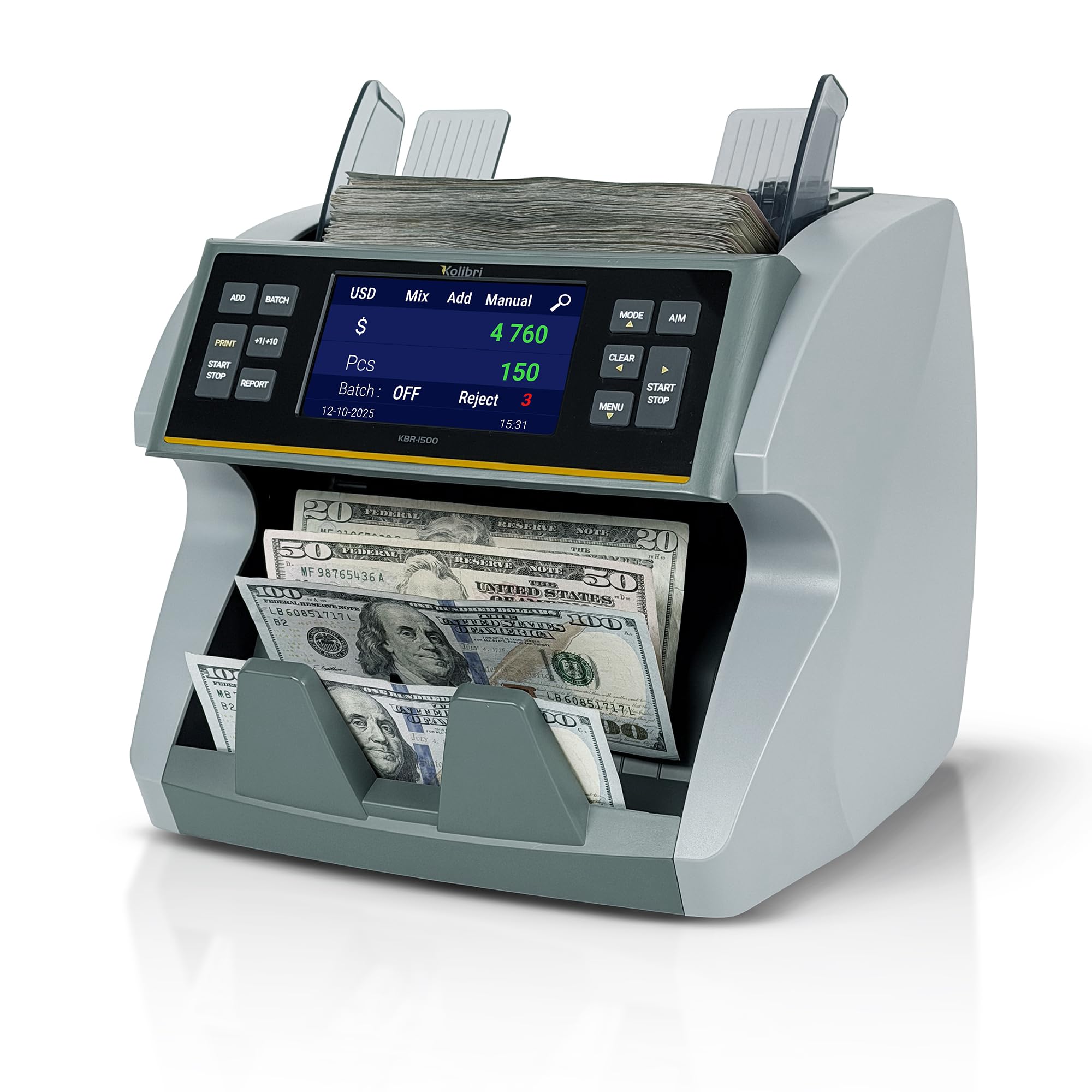
Best Money Counters of 2026

A miscount is worse than no count. Get a drawer wrong by hand and the bank tells you; let a machine do it and nobody notices until the books won't close. That's why a counter has to be accurate before it's fast — and a jam on a folded twenty is worse than the shoebox. Done right, it turns a Sunday night of drawer math into one pass.

They look identical in photos and promise the same things. The differences show up in handling: whether bills exit the top or the back, whether a mixed stack totals in one run or needs sorting by denomination first, whether the value on the display is one you'd trust on a deposit slip. Counterfeit detection is where cheap units cut corners.

I've spent six months counting ugly cash with 12 of these — market takings, café drawers, a fundraiser's bag of singles — and the good ones share one habit: they tell the truth about a stack. A counterfeit flag is a prompt to look closer, not a verdict. The picks below split by how much cash you handle at once.

1

Best Overall

Aneken AL-1000 Money Counter

91 /100
LBD Score Outstanding

Key details

Speed
1,000 bills/min
Weight
10.3 lb
Detection
UV, MG, IR, DD, DBL, HLF, CHN
Denomination Handling
Single denomination, value preset
View on Amazon

The case for this machine is arithmetic. A counter that reads a mixed stack costs roughly two to three times as much, and the AL-1000 still gets you a drawer total, in five short runs, one per denomination, instead of one. At 1,000 bills a minute those runs take seconds. For a shop, a food truck, a church, or anyone strapping a deposit at closing, that is the better trade, and it is why this is the machine we recommend first.

Value counting is the part worth understanding before you buy anything in this category. You set the denomination in your hand, twenties and then tens, and Add mode carries the running total across runs, so the display finishes on a dollar figure rather than a bill count. We paid close attention to that, because a counter returning only a count still leaves you multiplying in your head at midnight. Seven checks (UV, MG, IR, DD, DBL, HLF, CHN) run singly or together, the display throws a code when one trips, and Aneken rates the noise under 60 decibels, which is quiet enough to hold a conversation over.

Two small things stayed with us. The first is the box: it ships unbranded, which sounds trivial until you are the one signing for a parcel that announces cash-handling equipment inside. The second is the footprint. At 10.83 by 8.82 inches it leaves room on a counter that also has to hold a register. What it does not love is brand-new currency, since fresh notes stick and a crooked stack stumbles. Fan and square each strap before you feed it and the machine behaves.

Pros

  • Value mode totals a whole drawer
  • 1,000 bills a minute, rated under 60 dB
  • Seven counterfeit and error checks
  • Compact 10.83 by 8.82-inch footprint

Cons

  • Counts one denomination per run
Our verdict

For a small business counting a drawer most nights, this is the counter we recommend: value totals, seven checks, and enough speed to clear a deposit before the coffee goes cold.

Check Latest Price
2

Best for Mixed Denominations

Kolibri KBR-500

89 /100
LBD Score Excellent

Key details

Speed
1,200 bills/min
Warranty
3 years
Currencies
USD, CAD, MXN, GBP, EUR
Denomination Handling
Mixed, sorts by denomination
View on Amazon

Every machine in this guide from Aneken and PONNOR, and the Cassida 5520 as well, makes you tell it what you are feeding. The KBR-500 does not. You drop the drawer in as it comes, the machine reads each note and sorts by denomination, and the value and count come back with no preset at all. That is the difference worth paying for, and this is the least expensive place in the guide to get it.

The rest of the sheet is not an afterthought: 1,200 notes a minute, MIX, SORT, COUNT, ADD and BATCH modes, and support for USD, CAD, MXN, GBP and EUR. Kolibri backs it with a three-year warranty and lifetime technical support, which matters more on a roller-fed machine than on almost anything else you will put on a counter. Counterfeit screening runs infrared, ultraviolet and magnetic checks; treat that as a screen that stops the run rather than a certification and you will use it well.

In practice MIX is for the drawer and SORT is for the strap. Run the whole bundle through MIX for a total, then switch and let the machine group the twenties together for the deposit slip. Smooth the bundle flat before it goes in, since curled corners read badly on any machine of this type, and feed it long edge first. The 14.77-pound body and 14.3-inch footprint are the price of that, so plan on a spot that stays its own.

Pros

  • Reads and totals a mixed stack
  • 1,200 notes a minute
  • Five currencies supported
  • Three-year warranty and lifetime support

Cons

  • Wants a permanent spot and an outlet
Our verdict

If your cash arrives mixed, this is the one we reach for: it reads the drawer as it comes and returns a value without a single denomination set.

Check Latest Price
3

Best Value

PONNOR AL-5100

91 /100
LBD Score Outstanding

Key details

Speed
1,300+ bills/min
Display
3.7-inch LCD
Detection
UV, IR, MG, DD
Denomination Handling
Single denomination, value preset
View on Amazon

Most counters at this end of the market give you one button to cycle through modes. The AL-5100 puts a twelve-key numeric pad on the front, so a batch size gets typed rather than tapped up to, and the 3.7-inch screen holds the count, the mode and the error code at the same time. That sounds like a small thing until you have stood over a machine that shows one number at a time.

We rate it the value pick here because nothing important was cut to hit the price. The motor is rated above 1,300 notes a minute, four detection methods (UV, IR, MG, DD) are on board, and the twelve keys cover eleven functions, from auto and manual through batch, add, value, currency and the detectors themselves. Set the denomination, run the strap, let Add carry the total: the same workflow as machines that cost noticeably more.

The catch is regional. This is a 110-volt machine built for U.S. outlets, so it is not the one to buy for an office in Toronto or London, and the listing says as much. For a fixed counter in the States, which is where most of these end up, that changes nothing at all.

Pros

  • Numeric keypad for fast batch entry
  • Rated above 1,300 bills a minute
  • 3.7-inch display shows count and mode together
  • Four counterfeit detection methods

Cons

  • 110V, U.S. outlets only
  • Heavier than our budget pick at 12.5 pounds
Our verdict

We rate it the best value in this guide: a numeric keypad, a big screen and a real detection suite for less than machines that offer none of the three.

Check Latest Price
4

Best for Batch Strapping

Cassida 5520 UV/MG

90 /100
LBD Score Outstanding

Key details

Speed
1,300 bills/min
Batch Presets
Programmable 1–101
Hopper / Stacker
100 / 100 bills
Denomination Handling
Single denomination, ValuCount
View on Amazon

Batch presets are the reason to choose this one. Set the 5520 to 50 and it stops every 50 notes: pull a strap, set the stack down, feed the next fifty. The preset is programmable from 1 to 101, so 20s, 25s and 100s are each one button away, and an add-plus-batch mode keeps a running total while it does it.

That is worth more to us than a bigger screen or a longer feature list, because strapping is the job most small operations actually do at closing. The rest of the machine serves the same routine. A snap-open front cover gets you at a caught note in one movement, infrared sensors catch chain notes, doubles and halves, and the self-diagnostic system tells you something is off before a count goes wrong. Self-lubricating bearings mean one less thing to maintain.

The back loader takes a session to learn. The stack goes in behind the machine rather than on top of it, and the first few feeds will be slower than they are by the end of the week; hand it to someone new and expect a couple of misloads before the motion clicks. After that, 1,300 notes a minute makes short work of a deposit, and the front cover pops open whenever a note catches.

Pros

  • Batch presets programmable 1 to 101
  • 1,300 notes a minute
  • Snap-open cover for clearing a caught note
  • Infrared checks for chain, double and half notes

Cons

  • No mixed-denomination reading
  • Hopper takes 100 bills per load
Our verdict

For counting into straps, whether deposits, tills or change orders, this is our pick, with batch stops you can program and a cover that opens in one movement.

Check Latest Price
5

Best Budget Pick

Aneken DC002

87 /100
LBD Score Excellent

Key details

Speed
1,300 bills/min
Weight
8.34 lb
Hopper / Stacker
Up to 200 notes each
Denomination Handling
Single denomination, value count
View on Amazon

At 8.34 pounds this is the lightest full-size machine in the guide, and that decides where it lives. It is the one here you can carry from the safe to the counter and back, or load into a car for a Saturday market. It is also the least expensive machine here that still counts value and screens for counterfeits, which is a combination worth noticing.

The mechanism is where the money went. Aneken rates it at 1,300 notes a minute, the hopper and stacker each take up to 200 notes, double what the Cassida 5520 holds, and the detection list runs to eight checks, including thickness, dimension and magnetic-ink verification alongside the usual ultraviolet and infrared. Adaptive feeding is meant to keep new and old notes moving at the same rate, and the controls are direct: nothing to configure before the first count.

Denominations are set by hand, and the value total is only as good as the button you pressed. Run a strap of twenties with the machine still set to tens and it will give you a confident wrong total. Check the display before each run; that habit takes about a week to form. Get it, and you have the parts that matter, on a machine that costs less than the accessories people buy for the ones that do.

Pros

  • Lightest machine here at 8.34 pounds
  • Hopper and stacker hold up to 200 notes
  • Eight counterfeit and error checks
  • 1,300 notes a minute

Cons

  • Denomination set by hand each run
  • Built for USD and EUR only
Our verdict

This is where we point a first-time buyer: the cheapest counter here that does the whole job, and light enough to carry between registers.

Check Latest Price
6

Best for High Volume

Cassida 8800R V2

90 /100
LBD Score Outstanding

Key details

Speed
1,200 bills/min
Display
4.3-inch touchscreen
Detection
CIS, UV, IR, MG
Denomination Handling
Mixed, sorts by denomination, face, orientation
View on Amazon

Two things separate this from everything cheaper in the guide: contact image sensors and a printing option. A CIS reads the surface of the note the way a scanner reads a page, so the machine is checking the print itself rather than only the ultraviolet glow or the magnetic ink. Add the printer and a count arrives with a paper record you can staple to the deposit slip.

The value in a busy back office is not interrupting. MIX mode reads and sorts a mixed stack by denomination, while FACE and ORIENT modes straighten a bundle so it feeds properly, which is the real fix for the jam trouble that dogs cheaper machines. At 1,200 notes a minute, speed was never the bottleneck anyway.

Living with it is the other half. The 4.3-inch touchscreen is quick once you know where the modes sit, and there are a fair few of them: MIX, SORT, VSORT, COUNT, FACE and ORIENT, plus ADD, BATCH and multi-currency. A dedicated table and outlet are non-negotiable at 12.76 pounds, and the three-year warranty with U.S.-based support is what lets a business stop thinking about the machine after the first week.

Pros

  • CIS sensors check the printed surface
  • Built-in printer records each count
  • Sorts by denomination, face and orientation
  • Three-year warranty and U.S. support

Cons

  • Costs far more than a plain counter
  • Full-size unit needs its own table and outlet
Our verdict

We recommend it where cash is the day's work: it sorts, faces and prints a record rather than just a total, which no cheaper machine here does.

Check Latest Price
7

Reading Across the Counter

Kolibri KBR-1500 V2

89 /100
LBD Score Excellent

Key details

Speed
1,200 bills/min
Warranty
3 years
Detection
IR, UV, MG, MT, DD, HLF
Denomination Handling
Mixed, USD
View on Amazon

The KBR-1500 V2 is the KBR-500's bigger sibling: the same mixed-stack reading, a 4.5-inch color TFT display instead of an LCD, and magnetic-thread detection added to the ultraviolet and infrared checks. That display is the practical argument, since you can read a total from the far side of a counter without leaning in.

Where it gets harder to justify is the rest of the comparison. The KBR-500 reads mixed stacks too, supports more currencies, weighs less and sits lower in the range, so the extra money here buys a bigger screen and one more sensor. We pick the 1500 for a busy counter where two people need to read the total at once, and the 500 everywhere else.

Nothing about the build suggests a compromise: a 16.22-pound ABS body, 1,200 notes a minute, half-note and double-note detection, and the same three-year warranty backed by a California support team. It is a machine that expects to be used hard and left switched on.

So it earns a place on the short list rather than at the top of it. If display size is genuinely what decides the purchase for you, this is a good answer. It is just no longer the obvious one.

Pros

  • 4.5-inch TFT you can read across a counter
  • Magnetic-thread detection added
  • Three-year warranty and lifetime support

Cons

  • Mixed reading covers USD only
  • Heavier and pricier than the KBR-500
Our verdict

We rate it a capable mixed-stack counter with a display you can read across the room, though the KBR-500 here does the same job for less.

Check Latest Price

How We Tested 12 Money Counters Over Six Months

We started with the machines sold through business-supply retailers and office wholesalers, then narrowed by what actually changes the job: how bills load, whether mixed denominations total in one run or have to be sorted, which detection sensors are on board, and whether the machine reports a dollar value instead of just a piece count. A history of jam complaints or a warranty under a year was enough to cut a model before we bought it. Twelve made the cut, and we ran them for six months.

Testing happened where cash piles up: a weekend market stall's cash box on Sunday afternoon, a café drawer at close, a fundraiser's bag of singles, and the Monday deposit run. Each machine got 100-bill straps, then a deliberately ugly pile of crumpled, folded, and tape-repaired notes. We logged every jam, double-feed, and rejected bill, checked each total against a hand count, and timed the runs against counting the same stack by hand.

For detection, we ran known-good bills past each machine alongside a few marked suspects to see whether the ultraviolet, magnetic, and infrared sensors caught them, and how clearly the machine said so. Value counts were checked the same way — mixed stacks totaled by hand first, then compared with the display. We also noted how long it took someone who'd never touched the machine to reach a first count without opening the manual.

Six months of repeated use caught the slower failures: machines that counted cleanly in month one and started double-feeding by month four, or needed their rollers cleaned every other session, didn't stay on the list. Clearing a jam, switching batch mode, and reading the display in bad light were graded by whoever was standing there.

How to Choose a Money Counter

Single-Denomination or Mixed Counting

A single-denomination counter moves bills past a sensor and counts them; a value mode multiplies that count by a denomination you set. A mixed-denomination machine identifies each note as it passes, sorts by denomination and totals the stack. That second capability costs real money, and it is the only feature in this category that changes how a close works rather than how fast it goes.

The trap is the phrase value counting. On a budget machine it does not mean the counter knows a twenty from a ten, it means it multiplies. If your drawer is mostly one or two denominations, or you already sort into straps, a value-mode counter does everything you need. If a mixed bundle lands on your desk every night and nobody has time to sort it, pay for the mixed reader; the Kolibri KBR-500 is where that starts here.

Speed Matters Less Than How Often It Stops

Everything in this guide is rated between 1,000 and 1,300 notes a minute, and at that range the number is marketing. What costs you time is a run that stops: a curled corner, a taped note, a stack fed in crooked. The rated speed is what happens on a good stack of flat bills, and the differences between machines show up on the bad ones.

Three details tell you more than the speed figure. A snap-open or anti-jam cover gets you at a caught note in one movement. A bigger hopper, 200 notes rather than 100, means fewer reloads on a large deposit. And a machine that faces and orients a bundle before counting solves crooked feeds at the source. Whatever you buy, fan and square the stack first, because that one habit prevents most jams.

What Counterfeit Detection Actually Checks

Ultraviolet sensors look for the glow of the paper, magnetic sensors look for magnetic ink, infrared reads how the ink responds, and contact image sensors read the printed surface itself. More letters on the box is not automatically better protection: a single UV lamp is easy to defeat, and a machine that stops on every suspect note will stop on a genuine one now and then.

Treat detection as a screen, not a verdict. It flags a note for a person to look at, which is what you want at a register. If stopping the run is the problem, on a busy counter where interruptions cost more than the note does, look for a machine with a reject pocket or a straight-through sort. The Cassida 8800R's CIS sensors are the most thorough check in this guide.

Batch Presets, Add Mode, and the Close

Batch mode stops the machine at a set number of notes so you can strap; add mode keeps a running total across runs. Together they turn a counter into a closing routine rather than a novelty. A programmable batch, like the Cassida 5520's 1 to 101, covers whatever your bank asks for: 25s for a change order, 100s for a deposit.

If you never strap and only want a total, batch is the feature you can skip. Add mode you cannot: it is what lets you run four denominations and read one final number instead of writing four down.

Space, Noise, and What Happens After the Sale

These are countertop appliances, not laptops: roughly 8 to 22 pounds and about a foot in each direction, and they need an outlet that stays free. Measure the spot before you order, and be honest about whether the machine moves. A 12-pound unit that lives on a shelf is fine; a 16-pound one that has to be carried every night is not.

Two last checks. Noise: most run quietly enough for a front counter, but a quiet setting or a sub-60-decibel rating earns its place in a small shop. Warranty and support: rollers, sensors and belts are the parts that wear, so a three-year warranty and a reachable support line are worth more than an extra mode you will never press.

Frequently Asked Questions

Final Verdict

Buy the Aneken AL-1000 if you want one machine to clear a drawer, total it by denomination and flag bad notes without spending much. It fits the widest range of small cash operations, and the five-pass routine is faster than it sounds.

If your cash arrives mixed and presets are the thing you want gone, spend the extra on the Kolibri KBR-500, which reads the stack as it comes. And if you strap deposits to a fixed count every night, the Cassida 5520's programmable batch stops will matter to you more than either.