Best Microphone Shock Mounts of 2026

A shock mount is a deceptively simple piece of gear: a frame that clamps to your stand, a cradle that holds the mic, and elastic bands stretched between them so the microphone floats instead of sitting on metal. You don't think about it until you play back a take and hear a low thump under every word — a knee against the desk, a keyboard, a door down the hall. That's the whole job, and it's the difference between a keeper and a retake.

I've recorded in enough untreated rooms to know this is often the cheapest fix in the chain. Over four months, my team put 14 mounts on desks, boom arms, and stands, judging how well each one killed vibration, how firmly it gripped the mic, and how much fiddling a swap took. The thing first-time buyers miss: body diameter and thread size matter more than price — a loose collar will let your mic droop mid-session, however good the suspension is. The picks below are the ones that stayed mounted.

1

Best Overall

Boseen Universal Shock Mount

88 /100
LBD Score Excellent

Key details

Mic Fit
Large-diaphragm condensers
Thread Size
5/8 inch
Maximum Weight
3.3 lb
Bottom Adapters
Four sizes included
View on Amazon

The hardest part of shopping for a shock mount is not the word suspension; it is finding a cradle that grips your microphone without covering its switches, ports, or stand thread. The Boseen universal mount is our top pick because it comes with four different bottom screws, so one mount can serve a small collection of large-diaphragm condensers instead of locking you to one model.

The metal frame and elastic suspension feel purposeful rather than decorative. With a listed maximum of 3.3 pounds, it has enough headroom for a heavy studio condenser, and the native 5/8-inch thread is the one most boom arms and desk stands use. We like that the four bottom screws are included rather than sold as an afterthought; that is the detail that turns a universal mount from a guess into a workable fit. For a home studio with more than one condenser, this is the one we reach for first.

The mount is open around the microphone body, so you can work with a larger condenser without dismantling the whole rig every time you swap mics. It is not a featherweight at 11.5 ounces, but that mass feels like the right trade for a mount that holds a full-size body steady. For the broad middle of studio condensers, it is the most useful starting point in this group.

Pros

  • Four bottom screws fit several condensers
  • Metal cradle with 3.3-pound capacity
  • Native 5/8-inch thread for common stands
  • Useful for mixed large-diaphragm collections

Cons

  • Not for handheld mics or USB mics with knobs
Our verdict

We recommend the Boseen universal mount first for a mixed condenser collection because its four bottom screws and 3.3-pound cradle make it the most adaptable fit here.

Check Latest Price
2

Best for Elgato Wave Mics

Elgato Wave Shock Mount

95 /100
LBD Score Outstanding

Key details

Mic Fit
Elgato Wave microphones
Item Weight
6.7 oz
Thread Size
5/8 inch
Included Adapters
3/8 and 1/4 inch
View on Amazon

If your microphone is an Elgato Wave, the shock-mount decision is mostly made for you. The Elgato mount is shaped around that microphone family, and the difference shows in the details: a steel chassis, reinforced elastic suspension, and a native 5/8-inch thread that screws straight onto a boom arm. We think the factory-fit approach is worth it for Wave users because it removes the most common shock-mount headache, which is a cradle that is almost right.

The included 3/8- and 1/4-inch adapters cover the other common stand threads, so the mount can move between a desk stand and a boom arm without a trip to the hardware drawer. At 6.7 ounces, it has enough mass to feel planted without dragging a light arm forward. The open frame also leaves the microphone body easy to reach, which matters when you adjust gain or mute between takes.

Where the Elgato earns its keep is in daily use. The reinforced bands hold the mic in a stable cradle, and the steel frame shrugs off the lateral knocks that happen when a boom arm gets bumped. We kept coming back to it for a Wave setup because it looks like part of the microphone rather than a clamp-on accessory. If you have the matching mic, the result is a calmer, better-integrated rig.

Pros

  • Factory fit for Elgato Wave mics
  • Steel chassis with reinforced bands
  • Native 5/8-inch thread plus adapters
  • Stable, planted feel on a boom

Cons

  • Fits Elgato Wave microphones only
Our verdict

If you use an Elgato Wave microphone, we think this is the cleanest fit here, with a steel frame and adapters that make it feel purpose-built.

Check Latest Price
3

Best Budget for Blue Yeti

Auphonix Yeti Shock Mount

91 /100
LBD Score Outstanding

Key details

Frame
Aluminum
Mic Fit
Blue Yeti, Yeti Pro, Snowball
Item Weight
7.04 oz
Thread Sizes
3/8 and 5/8 inch
View on Amazon

If you use a Blue Yeti, the Auphonix mount is a lower-cost route to a suspended microphone. It is built for the Yeti, Yeti Pro and Snowball, with an open aluminum frame and elastic suspension bands that hold the mic away from the stand.

The frame leaves the Yeti's controls and cable connections reachable, and the dual 3/8- and 5/8-inch threads let it move between a desk stand and a boom arm without extra adapters. At 7.04 ounces, it is light enough to hang from a modest arm, yet the metal frame gives the mic a more planted feel than the stock desk stand.

For the common desk setup, this is a smart first upgrade: it gets the Yeti off its base and takes the edge off bumps without asking you to rebuild the rig. We think it is the right choice for a Yeti that stays on a desk or a light boom. It is a simple piece of kit that does not try to be a studio mount, and that is part of its appeal.

Pros

  • Budget route for Blue Yeti users
  • Fits Yeti, Yeti Pro and Snowball
  • Dual 3/8 and 5/8 threads
  • Open frame leaves ports accessible

Cons

  • Pivot and fasteners can loosen when re-aiming
Our verdict

For a Blue Yeti on a desk or light boom, we think the Auphonix is the smart budget suspension mount, as long as you tighten it before recording.

Check Latest Price
4

Best Bundle with Pop Filter

BTOOP Shock Mount

89 /100
LBD Score Excellent

Key details

Included
Shock mount, pop filter, adapter
Pop Filter
Double net, foam, metal
Mic Diameter
46-51 mm
Thread Adapter
3/8 to 5/8 inch
View on Amazon

A shock mount and a pop filter in one box is the reason this BTOOP set made our list. For a first podcast or vocal setup, the bundle solves two purchases at once: the spider mount suspends the microphone, and the U-shaped double-net filter sits in front of the capsule to tame plosives.

The mount is sized for 46-51 mm microphone bodies, which covers a lot of common condensers, and the included adapter takes the 3/8-inch thread to a 5/8-inch stand or boom. The frame is metal and the suspension is elastic, so the working parts feel familiar. We like the pop filter's foam-and-metal layer construction because it is easy to wipe down and does not need a separate clamp on the stand. For a simple speaking setup, the convenience is real.

The fit range is the first thing to check: 46-51 mm is a narrower window than a universal spider's, and a mic with a built-in control ring may not sit cleanly. Within that range, the bundle is an efficient way to get a condenser off its stand and add basic plosive control. For a first podcast or vocal setup, it is a practical way to cover both jobs.

Pros

  • Shock mount and pop filter in one
  • Dual-net filter is easy to wipe down
  • 3/8-to-5/8 adapter included
  • Metal frame with elastic suspension

Cons

  • Bands and clamp can loosen with use
Our verdict

We like the BTOOP set for a first condenser rig because it adds a useful pop filter, provided your mic body falls inside its 46-51 mm fit range.

Check Latest Price
5

Best On-Camera

SmallRig 1859 Shock Mount

89 /100
LBD Score Excellent

Key details

Weight
2.47 oz
Mic Fit
Shotgun and cylindrical mics
Material
Aluminum alloy and silicone
Mounting
Cold shoe and 3/8-16 thread
View on Amazon

The SmallRig 1859 is the mount we reach for when the microphone has to ride on the camera, not a studio boom. It clamps into a cold shoe or screws onto a boompole with its 3/8-16 thread, and the four silicone bands cradle a shotgun mic without transferring every bump from the cage. We like it because it solves the camera-rig problem without adding a second cage's worth of hardware.

The angle knob lets you point the mic without unclamping the whole rig, and the aluminum body feels more substantial than its 0.07 kg suggests. The cold shoe adapter and 3/8-16 thread cover the two places an on-camera mic usually lives, so it can move from camera to boompole. For run-and-gun work, the mount stays out of the way, which is exactly what you want.

The mount is happiest with a compact shotgun. The low profile keeps the rig balanced, and the angle knob makes small adjustments easy when the camera is already on a gimbal. Used within that role, this is a tidy problem-solver for camera audio.

Pros

  • Cold shoe and 3/8-16 mounting
  • Light 0.07 kg aluminum body
  • Tool-free angle adjustment
  • Four silicone suspension bands

Cons

  • Rubber bands can wear with heavier mics
Our verdict

For a shotgun mic on a camera cage or boompole, we think the SmallRig 1859 is the lightest, least fiddly mount here.

Check Latest Price
6

Best for Rode Podcaster and Procaster

Rode PSM1 Shock Mount

92 /100
LBD Score Outstanding

Key details

Mic Fit
Podcaster and Procaster
Item Weight
16 oz
Thread Size
3/8 inch
Maximum Load
2 kg (4.4 lbs)
View on Amazon

The PSM1 is built around a microphone family, not a diameter, and that is both its strength and its limit. If you use a Rode Podcaster or Procaster, the mount's open ring and elastic suspension are shaped to hold that body securely, with no adapter puzzle.

The 3/8-inch thread screws straight onto the stand, the mount holds up to 2 kg (4.4 lbs), and there is no nut or washer to lose. The open end of the shock mount is meant to be screwed directly onto the mic stand, which makes setup quick. For a broadcast-style mic that stays in one place, the PSM1 does the quiet, unglamorous work of keeping stand noise out of the recording.

The focus on one family is the reason it feels so settled. We like it for a fixed desk or boom where the mic does not need to travel, and where a secure, repeatable position matters more than universal fit. For a Podcaster or Procaster, the mount disappears into the job.

Pros

  • Secure fit for Podcaster and Procaster
  • Holds up to 2 kg (4.4 lbs)
  • 3/8-inch thread screws on directly
  • No extra nut or washer needed

Cons

  • Does not fit Rode PodMic or AT2020
Our verdict

We recommend the PSM1 for Rode Podcaster and Procaster owners who want a secure, direct-fit suspension mount and do not need universal compatibility.

Check Latest Price
7

AT2020USB-X Mics

Audio-Technica AT8455

90 /100
LBD Score Outstanding

Key details

Mic Fit
AT2020USB-X and AT2020USB-XP
Material
Metal
Item Weight
3.63 oz
Mounting Threads
3/8-16 and 5/8-27
View on Amazon

The AT8455's most useful feature is a cutout: the front of the mount is open, so you can reach the AT2020USB-X's controls and indicators without pulling the microphone out of the suspension. That sounds minor until you have to mute or adjust gain mid-session.

The mount is designed specifically for the AT2020USB-X and AT2020USB-XP, and that focus pays off in the fit. The metal frame holds the mic securely, and the dual 3/8-16 and 5/8-27 threads cover common stands. The suspension is there to absorb the knocks that come through a desk, and the open front keeps the controls from becoming a two-handed job.

At 103 g, it is light enough to hang from a small boom without dragging the arm down. The black metal finish is understated, and the open cradle looks purposeful rather than overbuilt. It is the kind of accessory that makes a USB microphone feel more like a studio tool.

We think the AT8455 is the right mount for someone who already has one of those two Audio-Technica microphones and wants the controls to stay reachable. It is a precise, model-specific upgrade, and that is the point: the fit is better than a generic ring. If that describes your mic, the AT8455 is the neatest choice here.

Pros

  • Open front keeps controls accessible
  • Precise fit for AT2020USB-X and XP
  • Dual 3/8-16 and 5/8-27 threads
  • Light 103 g metal frame

Cons

  • Fits only AT2020USB-X and XP
Our verdict

If you use an AT2020USB-X or AT2020USB-XP, we think the AT8455 is the precise mount to buy because it keeps the controls reachable.

Check Latest Price
8

Portable Recorders

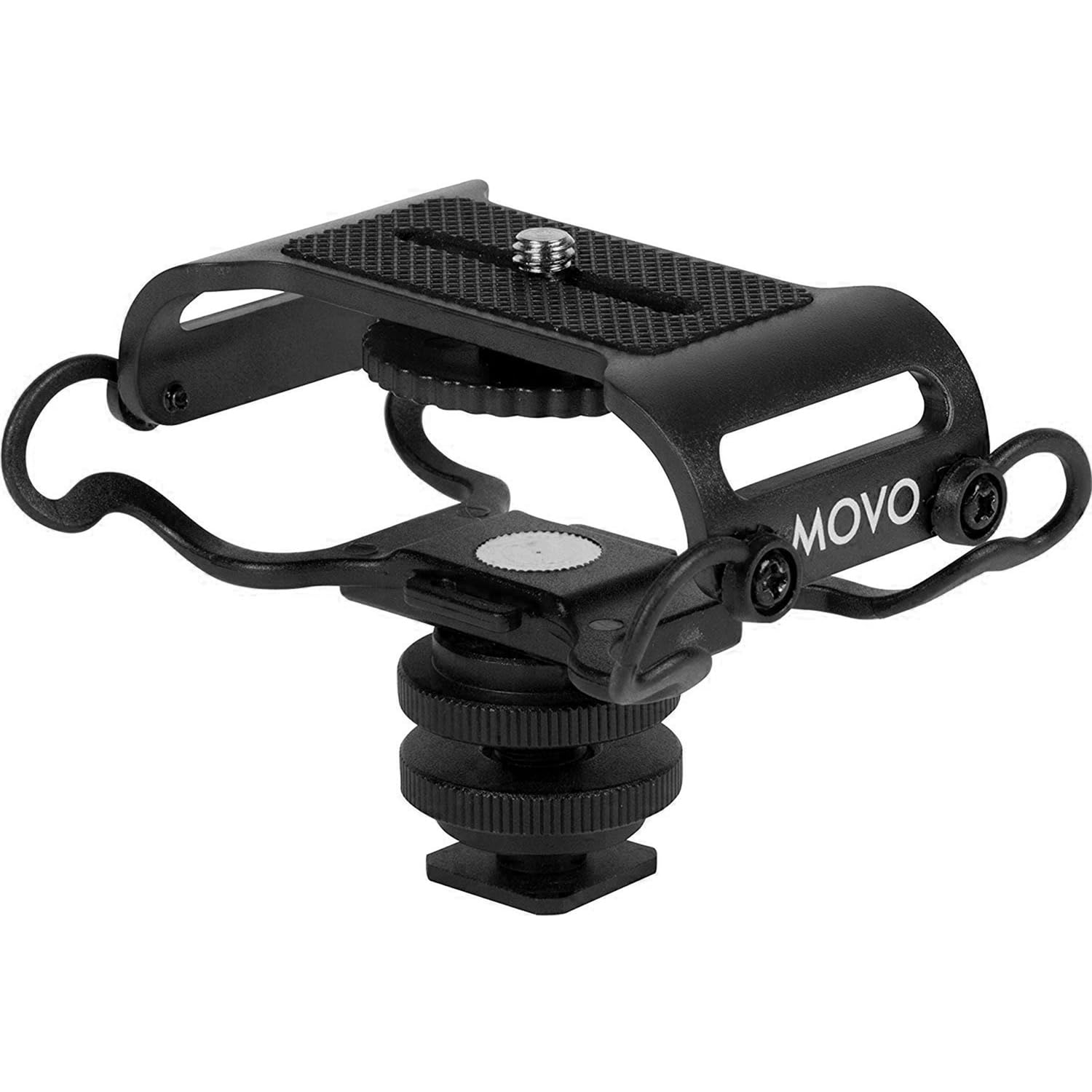
Movo SMM5-B Shock Mount

88 /100
LBD Score Excellent

Key details

Material
ABS
Mounting
Hot shoe or 1/4-inch thread
Item Weight
1.95 oz
Recorder Fit
Five Zoom H-series and three Tascam DR-series recorders
View on Amazon

The Movo SMM5-B is not really a microphone mount; it is a recorder mount, and that is exactly why it earns a place. It puts a Zoom H-series or Tascam DR-series recorder on a hot shoe or a 1/4-inch thread and suspends it away from the camera or tripod.

At 1.95 ounces, it barely changes the balance of a small camera, and the low-profile ABS frame keeps the recorder's screen and controls visible. The hot shoe and 1/4-inch thread cover the common mounting points, and the elastic suspension takes the edge off handling noise when you walk with the rig.

It is a simple accessory, but the simplicity is the point. There is no clamp to adjust and no cage to assemble; you set the recorder on the mount and get on with the shot. For interviews, street audio, or a small documentary rig, that speed matters.

We like it best as a leave-on accessory for a compact recorder, where its light weight and low profile do not fight the rest of the camera. The rubbery isolation is not a substitute for good mic placement, but it makes handheld recording less clattery. For the right rig, it is a quiet, practical fix.

Pros

  • Hot shoe and 1/4-inch thread
  • Very light at 1.95 ounces
  • Fits Zoom H-series and Tascam DR-series
  • Lowers handling noise

Cons

  • Can feel top-heavy with larger recorders
Our verdict

We like the Movo SMM5-B for compact Zoom or Tascam recorders, where its light hot-shoe mount takes handling noise out of handheld recording.

Check Latest Price

How We Chose and Tested 14 Shock Mounts

We started with spec sheets. Anything whose listed mic-body range or thread size ruled out the mics we already own — a wide-bodied USB condenser, a 46mm side-address condenser, a slim dynamic — got cut, as did mounts that only worked with a proprietary arm. That left 14, which we mounted and used for four months.

Fit came first: we seated each mic, tightened the collar, and tilted it 45 degrees to see whether it held its angle or crept downward over an hour. We threaded the included adapters on and off a dozen times to check for cross-threading, and noted whether a mount rotated on its own stud under the weight of a heavier mic. Adjustability got the same treatment — we changed angles one-handed mid-session and watched for slipping knobs and elastic that had gone slack.

The real test was an ordinary afternoon at the desk: typing on a mechanical keyboard, tapping the desktop, dropping a book, closing the door, walking past the stand. For each mount we recorded 30 seconds of silence at the same gain and listened on headphones for thumps, buzzes, and the hollow knock of a mic touching its cradle, then ran the same mic in a hard clip for comparison.

Because these live bolted to a stand, we left them there. Four months of daily recording and podcast sessions showed which elastic bands sagged, which knobs stripped, and which finishes flaked where the collar tightens. We also counted what came in the box — thread adapters, spare bands, a case — since a mount that needs a separately bought adapter isn't the bargain it looks like.

How to Choose a Microphone Shock Mount

Fit the cradle before anything else

A shock mount is a mechanical hand, and the wrong hand will either cover a switch or let the mic sag. Check the microphone body diameter, not just the grille, and look for clearance around USB ports, gain knobs, and cable jacks. A mount that lists 46-51 mm still may not suit a USB mic with a control ring; the Boseen universal's four bottom screws are useful because they let you match the thread to several bodies, but they do not make it universal for handheld mics.

If you use a model-specific microphone, a dedicated mount such as the Elgato for Wave mics or the AT8455 for the AT2020USB-X removes most of the guesswork. Measure the body, read the compatibility note, and prefer a mount that names your model over one that claims every microphone.

Match the mount to the rig

A studio boom arm, desk stand, camera cage, and portable recorder are four different jobs. For a desk or boom, prioritize a 5/8-inch thread or adapters and a cradle that leaves the microphone body accessible. For camera work, a cold-shoe mount with a low profile, like the SmallRig, keeps the rig balanced; for a portable recorder, the Movo's hot shoe and 1/4-inch thread are the relevant specs.

The mount should disappear into the rig rather than become another thing to hold. If you move between a stand and a camera, buy for the mount you use most and add an adapter for the other, instead of choosing a compromise that fits neither well.

Look at the bands, clamp, and hinge

Elastic suspension only works if the microphone actually floats. The bands need enough tension to hold the body without pulling the frame out of shape, and the clamp or hinge needs to keep the angle you set. Metal frames resist knocks better than plastic, but the bands and fasteners are still wear parts; spare bands are worth having.

A hinged mount with a built-in pop filter can save stand clutter, but only if the filter can be positioned where you need it. Judge the whole assembly, not just the suspension ring.

Threads, adapters, and weight limits

Most studio stands use 5/8-inch threads, while many boom arms and camera accessories use 3/8-inch; 1/4-inch shows up on cameras and small recorders. Adapters are easy to lose, so a mount with native threads for your main stand is less fuss. Respect the stated load: a 3.3-pound maximum is generous for a condenser, while a 2 kg rating suits a broadcast microphone.

A heavy microphone on an undersized mount will sag no matter how carefully you aim it. Check the load rating before you add a shock mount to a large body.

When a bundle is worth it

A shock mount plus pop filter can be a sensible first purchase if you are starting from nothing; the BTOOP set is the obvious example here. But a bundled filter does not fix bad microphone placement, and a model-specific mount can be a better long-term buy than a universal one that almost fits.

If you already have a pop filter, put the budget into the suspension and fit instead of duplicate accessories.

Frequently Asked Questions

Final Verdict

The Boseen universal mount is the one we recommend first for a mixed microphone locker. Its four bottom screws and metal cradle make it a practical default for large-diaphragm condensers, and the 3.3-pound capacity gives it room for a substantial mic. If you have an Elgato Wave, the Elgato mount is the cleaner fit and worth the narrower scope. For a camera rig, choose the SmallRig 1859; for a Rode Podcaster or Procaster, the PSM1 is the settled choice.