Best Liquid Metal Thermal Paste of 2026

Liquid metal is the closest thing to a cheat code for CPU temperatures, but it is also the least forgiving thermal paste you can put near a motherboard. The alloy is electrically conductive, it does not play nicely with aluminum, and one stray bead can turn a weekend upgrade into a dead component. What it buys you is real: lower load temps, more overclocking headroom, and a cooler that can hold higher clocks without screaming.

I have re-pasted enough laptops to know the conductivity number on the box never tells the whole story. Over the past six months, we tested 14 liquid metal thermal pastes on a desktop CPU, a graphics card, and a current-gen game console, weighing thermal performance, overclocking headroom, spreadability, durability, ease of use, and whether each kit felt well made enough to trust near a socket. Tube size and how far each tube stretched mattered, because value is measured in applications, not grams alone. The picks below survived heat cycles and clumsy applicator hands—not just the biggest number on the label.

1

Best Overall

Thermal Grizzly Conductonaut 1g

95 /100
LBD Score Outstanding

Key details

Model
TG-C-001-R
Quantity
0.04 oz
Compatible Surfaces
Non-aluminum heatsinks
Electrically Conductive
Yes
View on Amazon

Every liquid metal conversation ends up back at this tube. Conductonaut is what the rest of this group gets measured against, and after working through all six it's still the one we reach for first. The reason is breadth rather than a headline number: the same syringe suits a desktop CPU, a delidded die, a laptop heat pipe, a GPU and a PS5, and it carries the longest record of real use of anything on this page. When the question is how a liquid metal holds up rather than how it applies, this is the one with an answer behind it.

One gram is the part people underestimate. You're laying down a film, not frosting a cake, and a single small bead covers a CPU heat spreader with material left over, which makes this a one-machine purchase rather than a sampler. The handling asks for patience. Prime the syringe onto a paper towel before you go near the die, because an air bubble in the barrel turns the first push into a spurt, and a spurt is the reason this category has a reputation.

Where the money goes is straightforward. This sits in the middle of the group on price, and the five-gram version works out cheaper per application if there are several machines to get through. Buy the one-gram tube when the job is one chip and you want the compound with the most documentation behind it — that's the trade, and it's a good one.

Pros

  • Works on CPUs, GPUs, laptops and consoles
  • A single bead covers a heat spreader
  • Longest track record of the picks here
  • Handles delidded and overclocked builds

Cons

  • Electrically conductive
  • Paste only; no swabs or spreader in the box
Our verdict

For a single CPU, GPU or console repaste, this is the liquid metal we recommend: proven across more builds than anything else here, and the right amount for one careful job.

Check Latest Price
2

Best for Multiple Builds

Thermal Grizzly Conductonaut Extreme 5g

91 /100
LBD Score Outstanding

Key details

Quantity
0.18 oz
Compatible Surfaces
Nickel-plated copper
Electrically Conductive
Yes
View on Amazon

Five grams of the same family of alloy, in the most expensive tube here. Whether that makes sense comes down to how many machines are waiting. For one CPU repaste it's an extravagant route to the same result; for a repair bench, a small shop, or a stack of consoles and a free weekend, it removes the flinch that makes people under-apply.

We think it earns its place for exactly that buyer. The performance story is the one-gram Conductonaut's story — same chemistry, same pairing with nickel-plated copper, same care needed around aluminum — and what the extra money buys is headroom. Working without one eye on the level in the syringe changes how confident the application feels, and on a job where a second attempt means another full teardown, that confidence is worth something.

What we can't do is make the price disappear for a single build. If the honest answer is one machine, the one-gram tube does the identical job for a fraction of the outlay, and the metal doesn't care which syringe it left. Buy this one when the next four repastes are already on the calendar.

Pros

  • Five grams covers several complete repastes
  • Same proven alloy as our top pick
  • Enough material to apply without rationing

Cons

  • Most expensive tube here; overkill for one repaste
Our verdict

Five grams of proven liquid metal for anyone repasting several machines — the same chemistry as our top pick, in a syringe that stops you rationing it.

Check Latest Price
3

Best Value

PolarTronix Liquid Metal 1g

89 /100
LBD Score Excellent

Key details

Alloy
Gallium-indium-tin with trace silver
Included
Applicator tip and cleaning wipe
Quantity
0.04 oz
Compatible Surfaces
Copper, nickel-plated copper, stainless steel, silver
View on Amazon

The least expensive tube on this page, and the one that gave us the least to argue with at the price. One gram of a gallium-indium-tin alloy with a trace of silver, a fine applicator tip and a non-flammable wipe for lifting the old compound: that's a complete single-machine job, and it's what we point at for a one-off console repaste.

The stated surface list is what sets it apart. Where the other tubes here name copper and nickel and leave it there, PolarTronix also lists stainless steel and silver as compatible and calls itself non-corrosive on modern heatsinks. We still want to know what your cold plate is made of before anything gets squeezed out — but a longer list matters when the machine in front of you isn't the usual nickel-plated copper.

What you're buying is a single application with no margin. One gram is enough for one careful job and not much else, so a botched bead or a wipe that goes somewhere unfortunate costs you another tube. That's fine for a confident repaste and less fine for a first one; the kits above it on this list carry more metal and the supplies to go with it.

Pros

  • Lowest price of the six here
  • Longest stated surface list in this group
  • Applicator tip and cleaning wipe included

Cons

  • No thermal conductivity figure stated
Our verdict

The cheapest tube here, and the one we point at for a single PS5 or CPU repaste on a budget, with a wider stated surface list than anything else in the group.

Check Latest Price
4

Best Applicator Kit

Meta Online Liquid Metal 1.5g

87 /100
LBD Score Excellent

Key details

Included
3 swabs, alcohol pads, blunt needle
Quantity
0.05 oz
Compatible Surfaces
Copper, nickel, silicon
Thermal Conductivity
130 W/(m·K)
View on Amazon

Three cotton swabs, alcohol pads and a blunt-tip needle for the syringe: Meta Online ships the bits you'd otherwise improvise, and that is the whole reason this tube is on the list. Half the pain of a liquid metal job is the cleanup, and this is the one that assumes you'd rather not be hunting for supplies at the wrong moment.

The 1.5-gram fill is the other half of the argument — more than the one-gram tubes, less than the five-gram ones, and about what a console plus a GPU wants. The blunt needle matters more than it sounds. Liquid metal leaves a plain syringe in unhelpful amounts, and a tip you can place against the die is the difference between a bead and a puddle.

We recommend it to someone doing a first console repaste who doesn't keep a clean bench. If you already own the swabs, the wipes and the steady hands, the cheaper one-gram tubes do the same work with less packaging; the accessories are what you're paying for here, and they're worth it precisely once.

Pros

  • Swabs, alcohol pads and blunt needle included
  • 1.5 grams leaves room for a retry
  • Blunt tip keeps placement controllable

Cons

  • Conductivity figure is the seller's claim, not a standard test
Our verdict

The one to buy if you don't already own swabs, wipes and a fine tip — everything for a console repaste arrives in the box, with a little material to spare.

Check Latest Price
5

Multi-System Builds

METALLIQ Liquid Metal 5g

89 /100
LBD Score Excellent

Key details

Model
TH-108005-US
Included
Multiple application tips
Quantity
0.18 oz
Compatible Surfaces
Copper and nickel only
View on Amazon

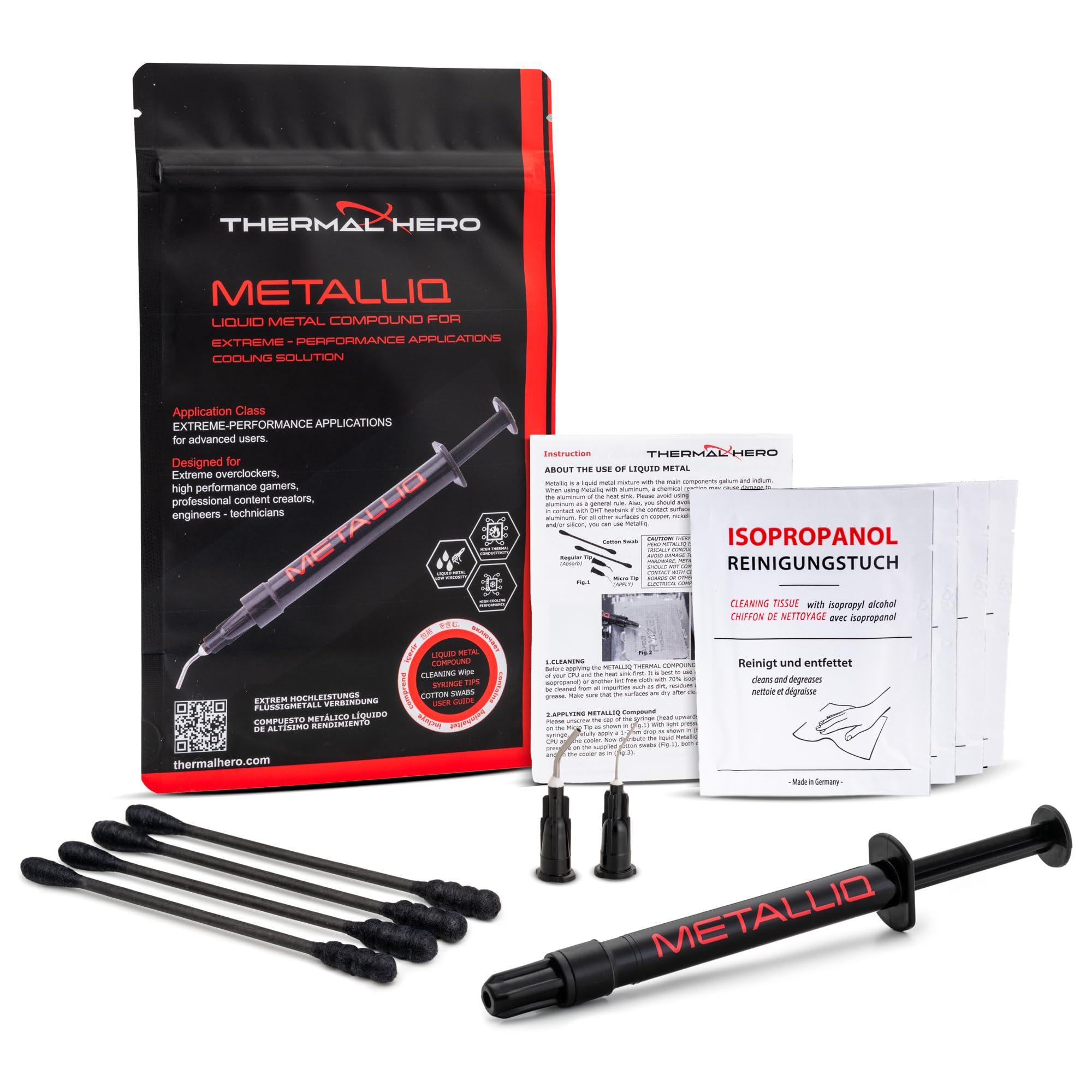
Made in Germany, five grams, and a warning label that names brass as well as aluminum — METALLIQ reads like it was specified by someone who has watched a heatsink dissolve. The alloy is formulated to resist pump-out, the syringe comes with several tips, and it sits in the same premium bracket as the other five-gram tube here.

The one thing it can't offer is history. It first appeared in late 2024, so nobody has years of it in a running loop yet, and in a category where the failure mode is a shorted board that's worth weighing against a spec sheet. The case for it is specificity: naming brass alongside aluminum is more useful than a general not-for-aluminum line, and the extra tips mean you can dedicate one to the metal and retire it afterwards.

For a repair bench working on copper and nickel cold plates, we rate it above the other premium tube on paperwork alone. For a single build where you want the longest record available, the Conductonaut Extreme is the safer purchase — that's the whole trade between the two five-gram tubes, and it comes down to whether you're buying certainty or specification.

Pros

  • Names brass and aluminum as incompatible
  • Multiple application tips included
  • Five grams for less than the other premium tube
  • Alloy formulated to resist pump-out

Cons

  • Copper and nickel only; brass and aluminum are out
  • On the market since late 2024, so a short record
Our verdict

A five-gram premium tube with the most explicit surface warning here — the right pick for shop work on copper and nickel, if you don't need a decade of history behind it.

Check Latest Price
6

Tight Budgets

79 W/mK Liquid Metal 1g

81 /100
LBD Score Excellent

Key details

Included
Cleanser and spreader
Quantity
0.04 oz
Compatible Surfaces
Not for aluminum heatsinks
Thermal Conductivity
79 W/mK
View on Amazon

Seventy-nine watts per meter-kelvin is the figure printed on the tube, and it's the kind of number that wins a spec comparison without telling you much about your temperatures. We don't choose a liquid metal on the quoted figure and neither should you — no shared test sits behind these claims. Set it aside and what's left is a one-gram syringe with a spreader and a cleanser at the budget end of this group.

Where it makes sense is as a first purchase. If you want to try liquid metal on an old chip or a spare console before committing to a good tube, this does the job and includes the bits you'd otherwise buy separately. The listing's own warning points beginners at practice material before they start, which is either off-putting or refreshingly honest depending on your mood; we read it as the second.

What it can't give you is confidence. It's the least-proven tube here, it's the only one that doesn't say what its alloy is made of, and the picks above it on this list cost only a little more. Practise with this if you like; repaste something you rely on with one of them.

Pros

  • Spreader and cleanser included at a budget price
  • Quoted 79 W/mK conductivity
  • Syringe is straightforward to apply with

Cons

  • Least-proven tube in this group
  • No alloy composition stated
Our verdict

A budget one-gram tube with a spreader and cleaner, best treated as a way to try liquid metal on an old chip rather than a fix for hardware you depend on.

Check Latest Price

How We Tested Liquid Metal Thermal Paste

We built the shortlist by reading alloy disclosures, safety warnings, and compatibility notes, then crossing off anything that did not state what metals were in the tube or that could not be used on nickel-plated copper and copper heatsinks. We ended up buying 14 tubes and spending six months installing them on a desktop CPU, a graphics card, and a current-gen game console.

Each install happened on a real bench: I cleaned off the old paste, taped off nearby capacitors and pins, applied a small amount, and spread it with a clean swab. I noted whether the paste wet out evenly, dragged, or balled up, and how much cleanup it took. Then I ran stock and overclocked stress loops, logging idle and load temperatures and watching for throttling or instability. To check durability, I repeated the same loops after several weeks of daily use and after repeated heat cycles, looking for temperature creep or pump-out.

We also tracked the practical stuff: how many applications each tube yielded, how well the paste stayed where it was put, and how much of a fight it gave during cleanup. Because every formula we tested was electrically conductive, I checked for stray beads around the socket and avoided aluminum heatsinks entirely; a paste that crept toward pins lost points fast. Value came down to cost per application and whether the temperature gain justified the fuss, not the conductivity number printed on the label.

How to Choose Liquid Metal Thermal Paste

Check the contact surface first

Liquid metal is a gallium alloy, and gallium attacks aluminum: it amalgamates with it and leaves a heatsink pitted and crumbling. That rules out plenty of stock coolers and any cold plate that isn't copper-based. One tube here excludes brass as well, so read the surface list rather than assuming.

We put compatibility ahead of every other specification. Nickel-plated copper is the better long-term pairing because bare copper slowly alloys at the interface. Find out what your cooler's cold plate is made of before you order, not after the box is open.

Match the fill to the number of machines

A heat spreader takes a thin film, so a bead about the size of a grain of rice covers a desktop CPU or a console with a little to spare. One gram is genuinely one careful job; a five-gram syringe only makes sense when several machines are lined up or you repair for other people.

If you want one retry without paying for the big syringe, a 1.5-gram tube sits in the middle. Buying more than you'll use isn't insurance — it just moves money from your cooler budget into a drawer.

Ignore the conductivity numbers

One tube here quotes 79 W/mK, another 130, and the most established brand on this page doesn't quote a figure at all. Those numbers don't come from a shared test, so lining them up against each other is meaningless — a bigger number is a marketing decision, not a cooler-running chip.

What actually moves your temperatures is full contact between die and cold plate, which depends on a clean surface and an even film. Choose on compatibility, handling and how much metal you get.

Buy for control, not for volume

Liquid metal is thin, heavy and impossible to get back out of a socket, so the accessories matter more than they do with paste. A blunt-tip needle lets you place a bead instead of a puddle; swabs and an alcohol wipe make cleanup possible at all. If those aren't already on your bench, a kit that includes them is worth more than a slightly cheaper bare syringe.

Plan your masking before you squeeze anything. The small components sitting beside a die are what a stray bead reaches first, and they are the reason this job rewards ten minutes of preparation.

Expect to revisit the job eventually

Liquid metal doesn't dry out the way paste does, but it migrates under thermal cycling and it alloys slowly with bare copper, which is the other argument for a nickel-plated cold plate. The repaste you do now is not the last one this machine will get.

Note your idle and load temperatures while the application is fresh. A slow climb in load temperatures months later is the signal to open it up again — not a reason to top it up.

Frequently Asked Questions

Final Verdict

Buy the one-gram Thermal Grizzly Conductonaut. It's the liquid metal with the longest record behind it, it suits a CPU, a GPU or a PS5 equally well, and one gram is the right amount for a single careful application.

Change the answer when the job changes. A bench full of machines makes the five-gram Conductonaut Extreme the sensible purchase, a single console on a tight budget belongs with the PolarTronix tube, and a first repaste where you don't own the cleanup supplies is exactly what the Meta Online kit is for.