Best Indoor Smart Gardens of 2026

Every January I buy a pot of supermarket basil, set it on the windowsill, and watch it collapse within a week. The light through that window is weaker than it looks, and a pot with no drainage has nowhere to go. An indoor smart garden removes both problems: a grow light sits a few inches above the leaves, and a pump or wick waters from a reservoir on a timer. You fill the tank, raise the light as plants stretch, and pick dinner.

I've grown herbs on kitchen counters for years, and pod count sells gardens while light quality decides whether you get a harvest. Over eight months my team tested 12 side by side, from compact countertop units to twelve-pod systems with adjustable panels.

What matters is less glamorous than app control: whether the light raises as plants grow, how loudly the pump runs in a quiet kitchen, and what replacement pods cost once the starter kit is spent. The gardens below earned their place on growth, durability, and how little babysitting they needed.

1

Best Overall

Ahopegarden 12-Pod LCD Garden

89 /100
LBD Score Excellent

Key details

Controls
Touch panel with two light modes
Reservoir
5 liters
Light Reach
Up to 17 in.
Growing Stations
12
View on Amazon

Seventeen inches is the number that decides this one. That's how far the light post rises above the deck, and it's the difference between a garden that only handles cut-and-come-again lettuce and one where basil, dill, and a compact pepper plant can get some height before the lamp sits on their tips. The iDOO stops at 11.3 inches; this Ahopegarden keeps going.

Add a 5-liter reservoir and 12 stations and you get the balance we recommend to most people. A full counter of herbs, refills spaced out enough that you're not babysitting it, and a touch panel running the two light modes and the timer without an app, an account, or your phone in the room. We noticed the panel is faster than any app for the two things you do daily: check the water, check the light.

Use the two modes deliberately. One leans toward leafy growth, the other toward flowering and fruiting plants, and the post lifts in steps as seedlings stretch. The body is 18 inches wide and 9 deep in matte black, with a shape that reads as a small appliance rather than a science project — a small thing that makes it easier to leave on the counter permanently.

The one thing we plan around is density. Twelve stations on an 18-inch bar fill in fast, so we stagger rounds of lettuce, basil, and cilantro rather than starting all twelve at once. That's a scheduling habit rather than a fault, and it doesn't change the recommendation for a first or only indoor garden.

Pros

  • Light post rises to 17 inches
  • 5-liter reservoir spaces out refills
  • Two light modes on a simple touch panel
  • Pump quiet enough for a kitchen

Cons

  • Light post tops out at 17 inches
  • Schedules live on the panel, not an app
Our verdict

We recommend this one to most people: 12 stations, a 5-liter tank, and 17 inches of light travel keep tall herbs growing instead of scorching.
Check Latest Price
2

Best App-Controlled

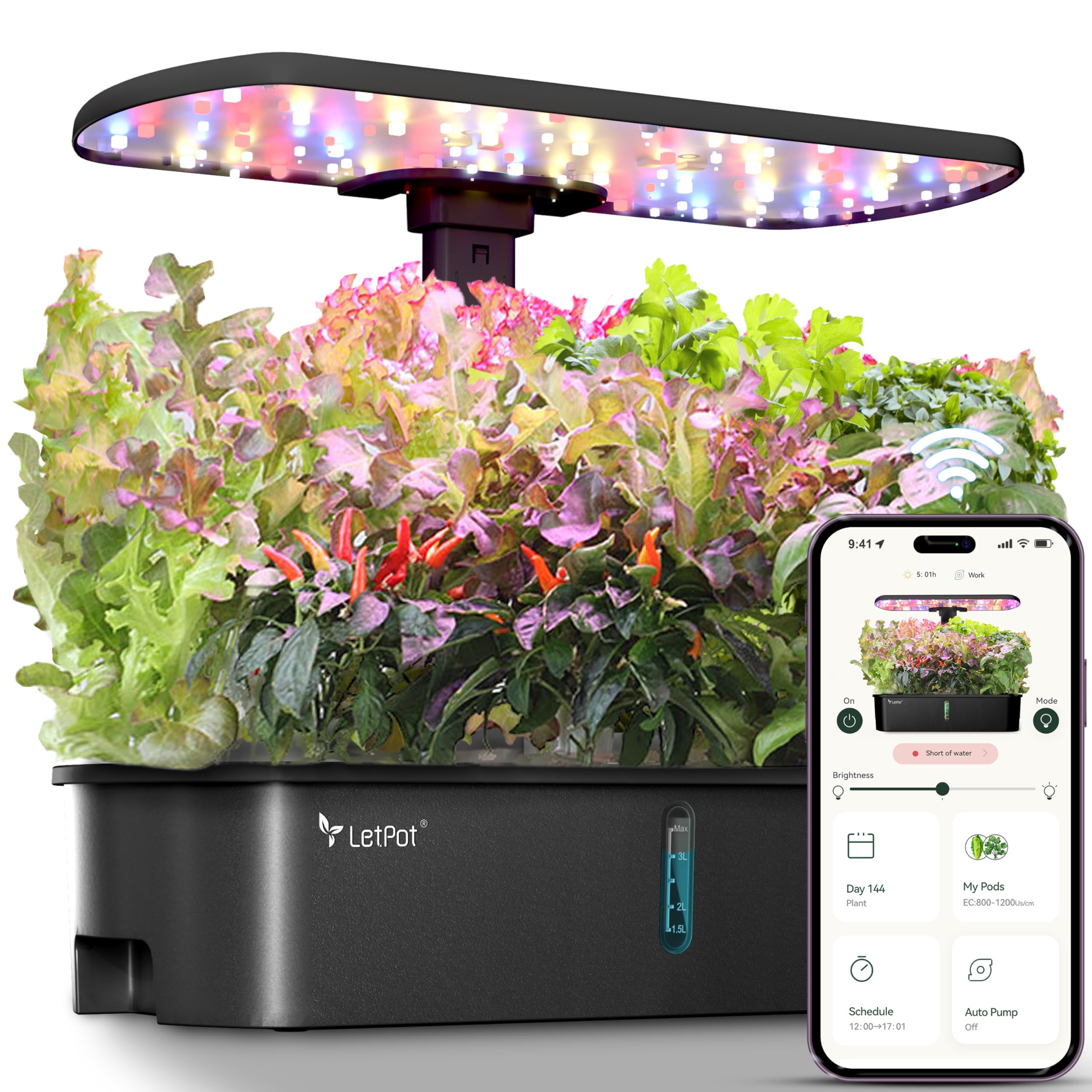
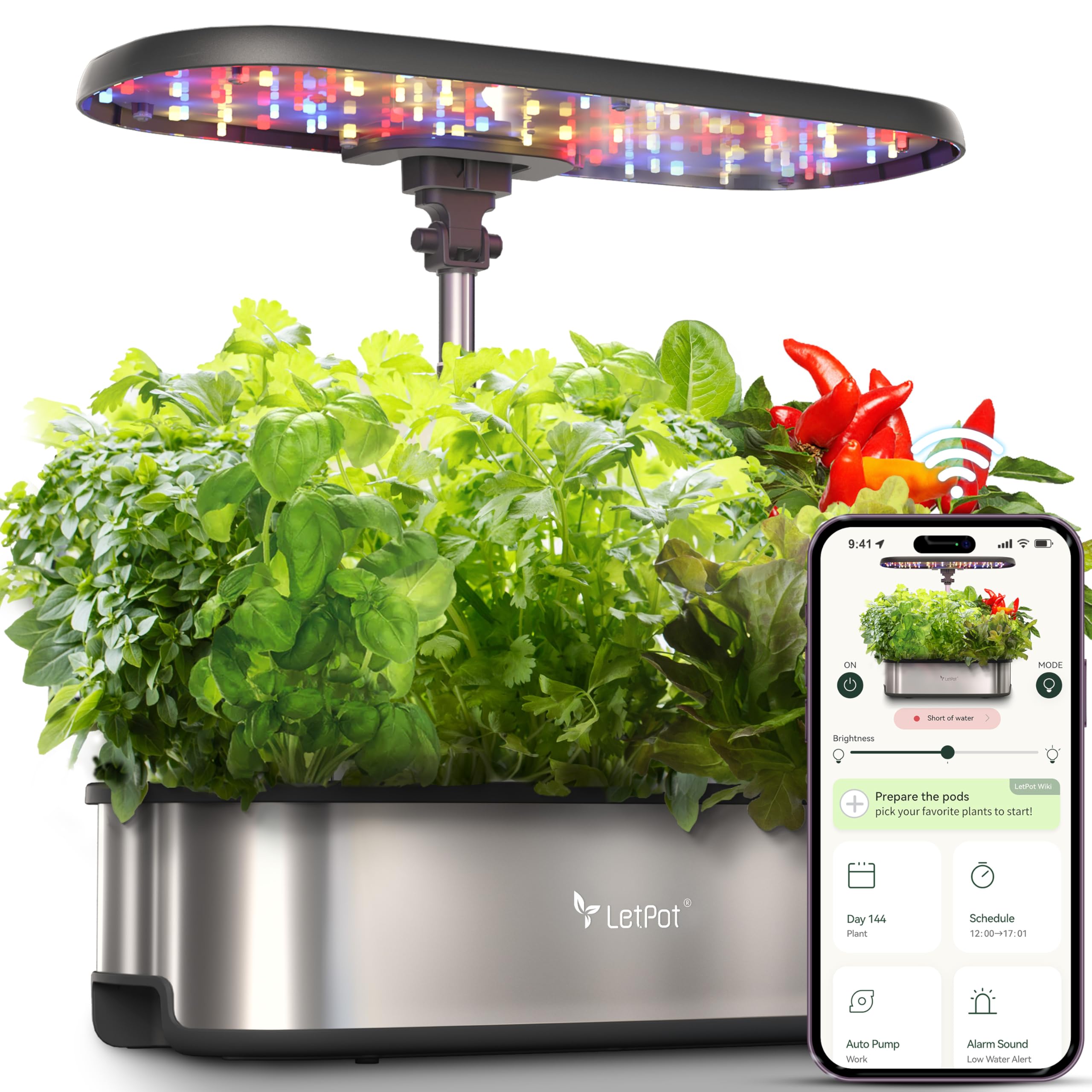
LetPot Senior 12-Pod

88 /100
LBD Score Excellent

Key details

Light
24-watt full spectrum, 180° adjustable
Controls
LetPot app over WiFi
Reservoir
5.5 liters
Growing Stations
12
View on Amazon

The app is what you're paying for here, and it does more than a timer. We set light hours by the hour, switched between the leafy and fruiting modes, and labeled each of the 12 stations — that last one is the feature that stops you guessing at three unmarked pods in week four. The stainless-steel face and resin inner wall also make this the best-looking unit in the group, the one that doesn't need explaining when guests see it.

Underneath sits a 5.5-liter tank, the largest here, a 24-watt full-spectrum light on a 180-degree adjustable head, and a low-water reminder that we came to rely on more than we expected. Twelve stations, baskets, sponges, covers, and A&B nutrient all come in the box, so the first planting is a half-hour job.

The light is the part to check on arrival. If a LetPot disappoints, it's usually the lamp arriving dead rather than the tank or the pump, so run the cycle the day it lands. Buy it for the scheduling, the reservoir, and the finish; if none of those three matter to you, the Ahopegarden grows the same herbs for less.

Pros

  • Hour-by-hour light scheduling in the app
  • 5.5-liter tank, the largest here
  • Stainless-steel body with easy-clean inner wall
  • Lower-water reminder built in

Cons

  • Premium price against the other 12-pod units
Our verdict

We think the app and the 5.5-liter tank justify the premium here: hour-by-hour scheduling and the biggest reservoir in the group.

Check Latest Price
3

Best for Beginners

iDOO 12-Pod Garden

91 /100
LBD Score Outstanding

Key details

Extras
Built-in fan, 22-watt LED
Reservoir
4 liters
Light Reach
Up to 11.3 in.
Growing Stations
12
View on Amazon

The iDOO is the only garden here with a fan built into the light hood. It pushes air across the seedlings, which keeps the humid pocket under the lamp from sitting still and, later, helps anything that flowers set fruit. Pair that with a 22-watt full-spectrum light on an automatic timer and a pump aerating the 4-liter tank, and the unit runs its own cycle with almost no input from you.

Setup is three steps and no tools — baskets and sponges in, water and nutrient in, light on — which is the reason it's our pick for a first garden. The water window reads at a glance, the 12 stations leave room to experiment, and the square footprint tucks neatly against a backsplash.

Headroom is where it gives ground. The light stops at 11.3 inches, so plan on herbs, lettuce, and seedlings rather than anything determined to get tall, and expect the middle of the bar to be the brightest spot while plants at the ends stretch toward it. Nothing here matches the Ahopegarden's adjustability; what it offers instead is a fan, the simplest setup in this group, and a very forgiving first season.

Pros

  • Built-in fan moves air under the hood
  • Three-step setup, no tools
  • 12 stations with an easy-read water window
  • Automatic light timer

Cons

  • Light stops at 11.3 inches
  • Power supply has failed within months on some units
Our verdict

This is the garden we hand to beginners: a fan, a three-step setup, and an automatic timer do most of the work.

Check Latest Price
4

Best Pod-Based Garden

Click & Grow 3-Pod Herb Garden

92 /100
LBD Score Outstanding

Key details

Watering
Wick-based, no pump
Footprint
Windowsill size
Plant Pods
3 basil pods included
Light Cycle
16 hours on, 8 off
View on Amazon

Nothing here needs balancing. Click & Grow replaces the pump and the nutrient routine with wicks that pull water up into three pre-seeded pods, a lamp that switches itself on for 16 hours and off for 8, and a float that shows you when to top up. Drop the pods in, fill it, plug it in — that's the whole installation.

For basil on a windowsill, that simplicity is the point, and it's why this is the garden we suggest to people who already know they won't fuss. Basil reaches full size in one to two months, a pod keeps producing for two to three, and the white body with its little water indicator is genuinely nice to look at — the appearance is a big part of why it stays on a counter instead of migrating to the spare room.

Three pods is the honest limit: this is a garnish-and-pesto supply, not a salad bar, and the pods themselves are where the money goes over a year. If you want to grow from your own seed packets, or keep eight herbs going at once, one of the sponge-and-basket units here is the better machine.

Pros

  • Wick watering with no pump to fail
  • Light runs 16 on, 8 off by itself
  • Pods arrive pre-seeded and ready
  • Looks good enough to leave out

Cons

  • Only three pods at a time
  • Light output is modest
Our verdict

This is the one for anyone who wants basil with no pump, no timer to set, and no reservoir to balance.

Check Latest Price
5

Best for Small Counters

LetPot Air 10-Pod

89 /100
LBD Score Excellent

Key details

Light
24-watt full spectrum
Controls
LetPot app over WiFi
Reservoir
4 liters
Growing Stations
10
View on Amazon

Fifteen inches wide and five deep, the Air is a bar rather than a box, and that's the reason to look at it. On a counter shared with a coffee maker and a toaster, five inches of depth is what lets a garden sit back along the backsplash instead of claiming the working space.

It runs the LetPot app: light hours by the hour, a label for each of the 10 stations, and a nudge when the 4-liter tank runs low. Connecting it took a couple of minutes, and the pump sits below the noise floor of a kitchen — we stopped registering it after the first evening.

Ten stations and 4 liters is a workable ratio for herbs — basil, parsley, chives, and a couple of experiments — and this is the unit we suggest when counter depth, not pod count, is what rules the decision. For a kitchen where the garden has to earn its inches, that's the trade worth making.

Pros

  • 15-inch footprint fits narrow counters
  • App scheduling and per-station labels
  • Pump runs quietly
  • 24-watt full-spectrum light

Cons

  • 4-liter tank needs frequent topping up
  • Narrow bar is tight for heads of lettuce
Our verdict

For counters where depth is the constraint, this is the garden we point to: 15 inches wide, app-controlled, and quiet.

Check Latest Price
6

Water-Level Alerts

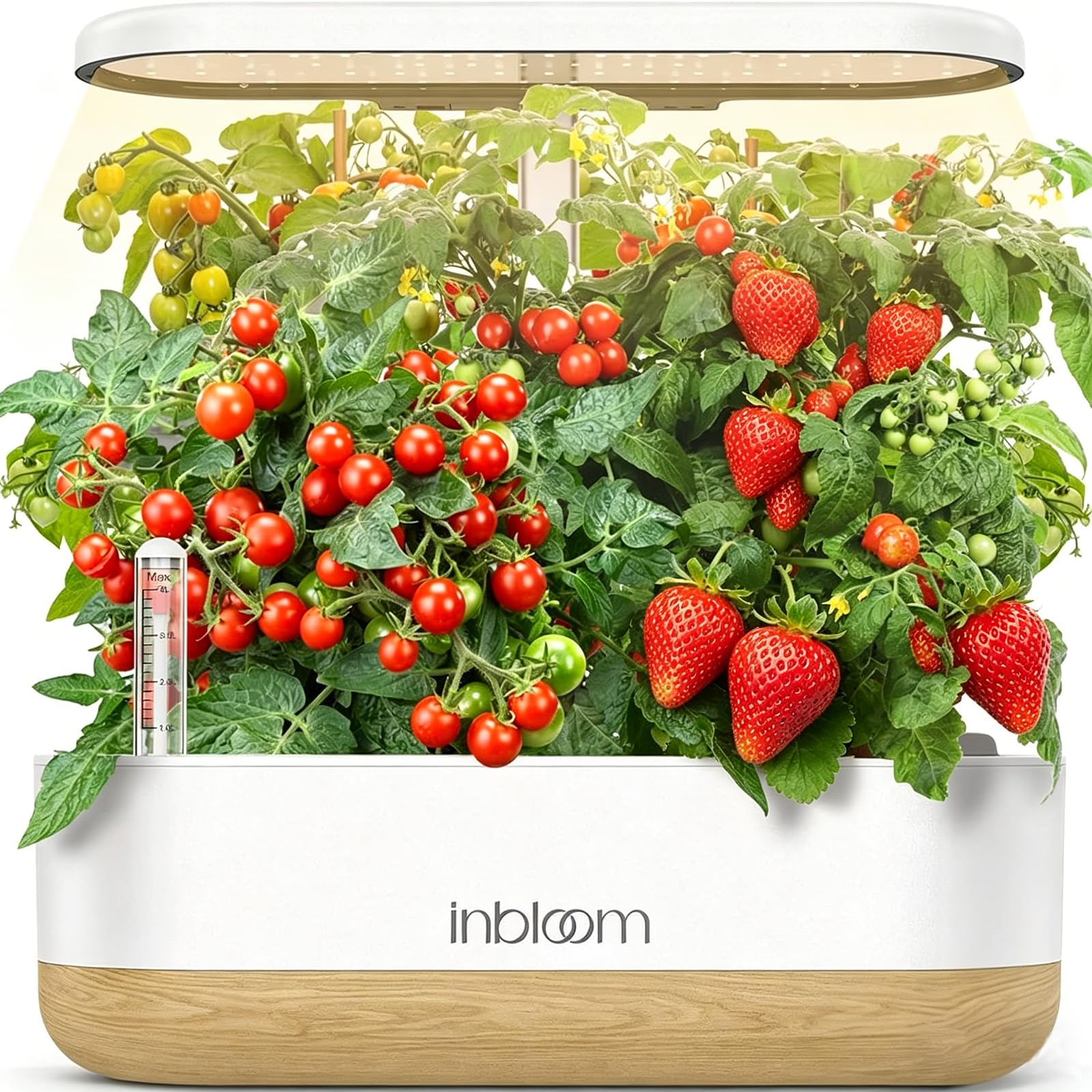
inbloom 12-Pod Garden

87 /100
LBD Score Excellent

Key details

Reservoir
4.2 liters
Light Cycle
16 hours on, 8 off
Low-water Alarm
Triggers below 700 ml
Growing Stations
12
View on Amazon

A low-water alarm is the feature we didn't expect to care about and now look for. inbloom's triggers when the 4.2-liter tank falls below 700 milliliters, early enough that the pump isn't pulling air yet. On a garden you'll leave for a long weekend, that's worth more than an extra light mode.

The rest is conventional and well done: 12 stations, a 24-watt LED array on a fixed 16-hours-on, 8-off cycle, a silent circulation pump, and a white body about 16 inches wide. Nothing to program, nothing to connect, nothing to remember except the water.

What it doesn't do is reach as far or switch modes. If the alarm is the thing you're after — and for a household that travels, it's a fair thing to be after — this is your unit. If you want light that climbs to 17 inches and two growing modes as well, the Ahopegarden covers both.

Pros

  • Low-water alarm below 700 milliliters
  • Fixed 16-on, 8-off light cycle
  • Silent circulation pump

Cons

  • Light is thin for fruiting plants
  • 4.2-liter tank with 12 stations
Our verdict

The low-water alarm earns it a place: it warns you before the pump runs dry, and that's the check most people forget.

Check Latest Price
7

Tight Spaces

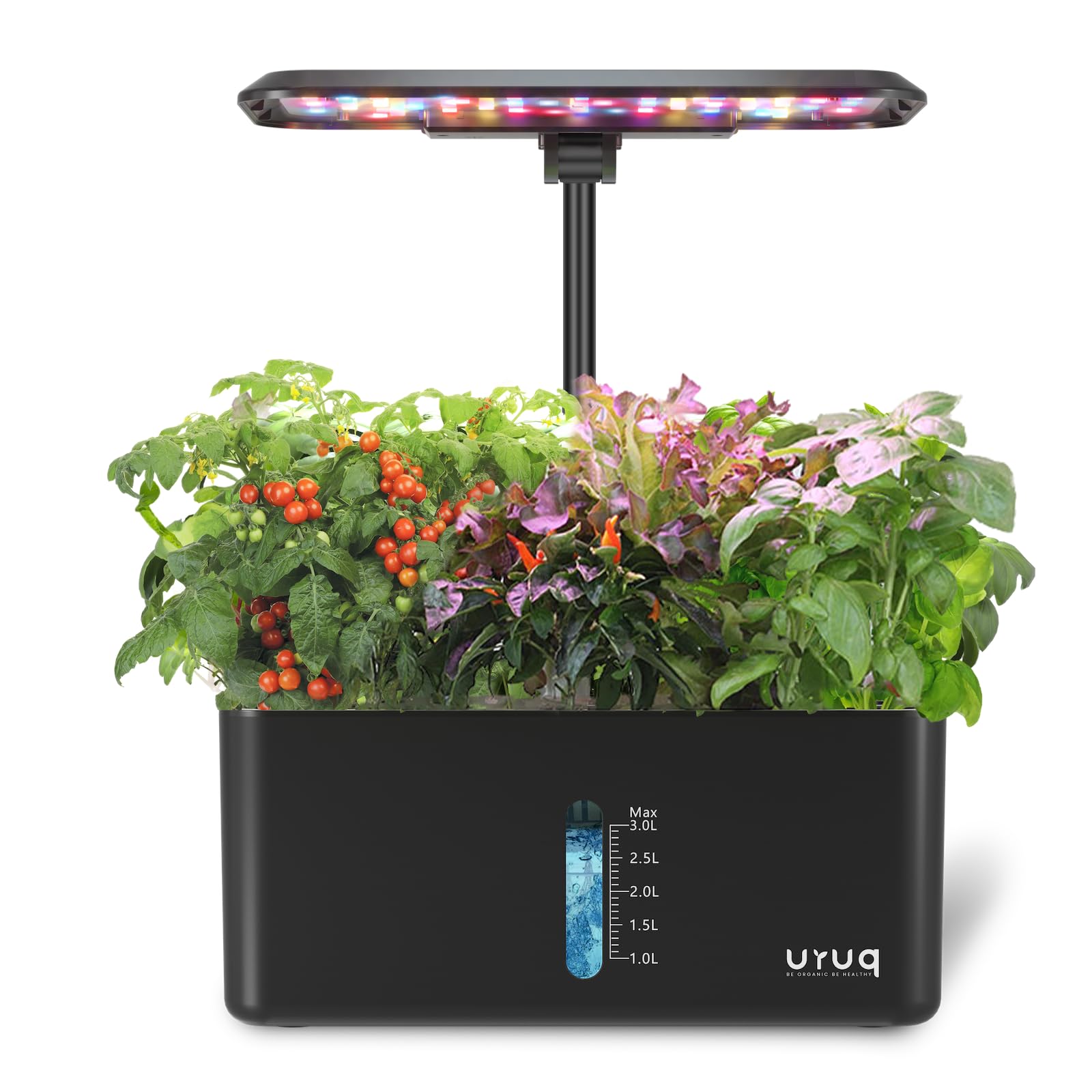
URUQ 8-Pod Garden

88 /100
LBD Score Excellent

Key details

Pump
Circulates every 30 minutes
Light
24-watt LED, detachable pole
Reservoir
3 liters
Growing Stations
8
View on Amazon

Eight pods and a 3-liter tank is the smallest commitment in this group, and for a first hydroponic garden — or a second one for the herbs the main unit doesn't have room for — that's the right size. Not everyone needs twelve stations and a salad harvest.

The pole detaches, which matters more than it sounds: unplug it, lift it off, and the tank is suddenly open enough to rinse properly instead of dabbing around a light arm. The 24-watt LED rides on that pole and adjusts in height, and the pump circulates every 30 minutes on a cycle quiet enough to sit through dinner.

Three liters is the real constraint. With eight plants drinking, plan on checking the level more often than on the 5-liter units here, and plan on herbs rather than anything that wants a deep root run. Neither is a problem if the counter is small and the ambition is basil, parsley, and chives.

For the tight-counter case it earns its spot: manageable size, a pole that makes upkeep easier than most, and room in the budget for seeds and nutrient. Give it an 18-inch run of counter, though, and the 12-station Ahopegarden is the better long-term buy.

Pros

  • Eight-pod footprint suits small counters
  • Detachable, height-adjustable light pole
  • Quiet pump cycles every 30 minutes

Cons

  • Pump or light can fail within the first months
Our verdict

Eight pods and a detachable light pole make it our choice for a first, small garden on a tight counter.

Check Latest Price

How We Tested 12 Indoor Smart Gardens

We started by gathering every indoor garden with a built-in grow light and an automatic timer, then narrowed the field to units with a light that could be raised as plants grew, a reservoir that wouldn't need refilling every few days, and pods that are reasonably easy to restock. That left 12 gardens, which we assembled, planted, and ran for eight months.

Each one went onto a real counter: a dim north-facing kitchen wall, a bright south windowsill, and a windowless office desk, so we could see how much the built-in light was actually doing. We timed setup out of the box, counted how many steps it took before the first pod went in, and then checked every garden twice a week, recording days to sprout, height, leaf color, and whether the low-water alarm fired before the reservoir ran dry.

Light got the closest scrutiny. We measured the gap between the panel and the tallest seedling and raised it as plants stretched, watched for scorched or bleached leaf tips, and compared the results against basil started on an ordinary windowsill. We also listened to each pump from a chair two feet away, cleaned every reservoir between rounds, and checked whether the timer held its schedule after being unplugged.

Last, we tracked cost per harvest, because a cheap garden with pricey pods is not a bargain. Durability showed up in small ways: a cracked lid, film in the tank, a pump that got louder by month six.

How to Choose an Indoor Smart Garden

Light reach comes before pod count

Every unit here is built around a lamp on an arm, and the arm's travel is what limits your crops. A post that stops near 11 inches is fine for lettuce, microgreens, and herbs you cut back hard; a post that extends to 17 inches, as the Ahopegarden's does, lets basil, dill, and compact peppers put on height before the lamp is scorching the tips.

Wattage barely separates these gardens — 22 to 24 watts is the going rate — because at this size, distance from the lamp matters more than raw output. Check the maximum height and whether it adjusts at all; a fixed lamp turns the garden into a one-crop system.

Match the reservoir to the number of plants

The tank is the chore you'll do most often. Five liters feeding 12 stations and three liters feeding eight are doing comparable work per plant; the difference shows up the week you're away. If you travel or you forget, weigh that higher than an extra station or two.

Low-water indicators and alarms turn a guess into a glance: inbloom's flashes below 700 milliliters, and the LetPot units push a reminder to the app. It's a small feature that decides whether a garden survives a busy month.

Decide whether the app earns its place

Wi-Fi control buys hour-by-hour light schedules, a label for each station, and alerts on your phone; the two LetPot units here are the app-driven picks. It costs a setup step and a dependency on your router.

If your routine is a glance on the way past the counter, the touch panel on the Ahopegarden runs the timer and both light modes with nothing to configure and less to go wrong. Pay for the app only if you'll actually open it.

Weigh pod systems against seed-and-sponge kits

Click & Grow's pre-seeded pods are the least fussy route: drop three in, add water, and the pods become the recurring cost. The hydroponic kits here ship with baskets, sponges, domes, and nutrient, and you supply the seeds — cheaper per plant and open to any variety you like, at the price of a little more setup and germination you can't blame on anyone else.

Choose pods for convenience and a fixed menu, sponges for range and lower running costs.

Plan for light, noise, and placement

A 16-hour light cycle is bright — bright enough that these gardens don't belong in a bedroom or a room you watch television in after dark. A kitchen counter, a utility shelf, or a home-office corner works.

Pump noise is the other daily cost. Most units here are quiet enough to forget, but listen for it in the room where the garden will actually live, and give the raised light post vertical clearance before you commit the space.

Frequently Asked Questions

Final Verdict

We recommend the Ahopegarden 12-pod garden to most people. Seventeen inches of light travel and a 5-liter tank solve the two problems that end indoor gardens — tall herbs hitting the lamp and constant refilling — and the touch panel keeps the daily routine to a glance.

If you want the schedule on your phone and a better-looking body, the LetPot Senior is the upgrade, with the largest tank here. If you want basil with no pump and nothing to program, Click & Grow's three-pod wick system is the one.