Best GPS Dog Collars of 2026

The first time my dog backed out of her collar at a trailhead, I spent forty minutes calling her name while she treated it as the best game ever invented. A microchip only helps once someone finds her — what you want in that moment is a live dot on your phone. That's the promise of a GPS dog collar, and it's also where the category gets complicated.

My team and I have spent the past eight months living with 11 trackers and training collars: around the block, on weekend hikes, and through more than one unsupervised jailbreak out the back gate. The differences show up fast. A collar that refreshes every three minutes is perfectly fine for a dog circling the yard and useless for one heading toward a road, and the subscription you didn't notice at checkout can cost more than the collar itself within two years.

Some of the picks below are built for escape artists, some for wide-open range, and some for the dog who never leaves the yard but keeps you awake anyway.

1

Best Overall

Dogtra Pathfinder2 Mini Compass

86 /100
LBD Score Excellent

Key details

Dog Size
25 lbs and up
Subscription
None required
Tracking Range
Up to 4 miles
Location Updates
Every 2 seconds
View on Amazon

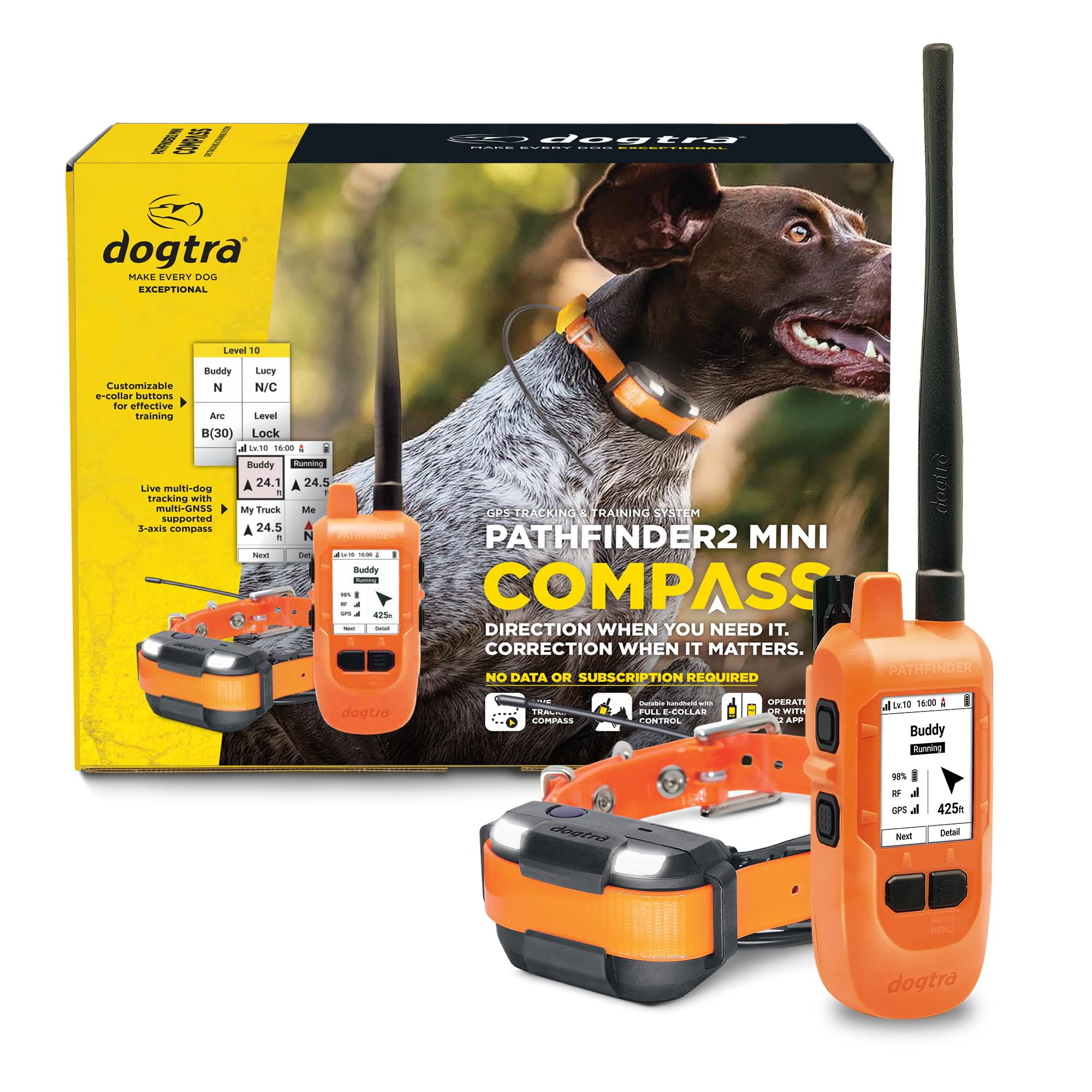
Nothing on the walk has to come out of your pocket. The Pathfinder2 Mini Compass runs off its own handheld, a 2-inch screen with a built-in compass, so tracking your dog never depends on your phone's battery, an app that has to load, or a bar of cell service. That independence is why it takes the top spot: the dog stays on the screen whether or not your phone cooperates.

The numbers back it up. Four miles of range, a location fix every two seconds, and an IPX9K rating that survives a wet dog shaking off in the back of the truck. We paid close attention to the update interval, because a two-second refresh is what turns a dot on a map into a dog you can walk toward; a minute between fixes is a guess. Training functions live on the same handheld, with buttons you can assign per dog, so correcting a recall does not mean switching screens mid-stride.

The free app is the second half of the system, and there is no subscription to keep it running. Satellite and offline maps, a fence boundary, history — all of it available without a monthly charge, while the handheld does the work in places with no signal at all. Up to 21 dogs with four on screen, and existing Pathfinder2 receivers pair with it, which matters when you are adding a dog rather than starting over.

The long antenna is the one design detail that bothers us: it swings loose against the collar when a dog runs. It does not affect tracking at all, but it is the piece we notice every time we put the collar on, and the difference between a system that feels finished and one that feels assembled.

Pros

  • Tracks with no phone or signal
  • Two-second updates at four miles
  • No subscription fees at any point

Cons

  • Four-mile range, short of the Pathfinder 2's nine
  • Rated for dogs 25 pounds and up
Our verdict

The one we reach for when a dog disappears into cover: a handheld that tracks without a phone, a signal, or a monthly bill.

Check Latest Price
2

Best for Long-Range Work

Dogtra Pathfinder 2

86 /100
LBD Score Excellent

Key details

Phone
Required for tracking
Subscription
None required
Tracking Range
Up to 9 miles
Dogs Per System
Up to 21
View on Amazon

Nine miles of range is the headline, roughly double what the Mini Compass delivers, and this system costs less. The catch sits in the design: Pathfinder2 is phone-first, so the maps, the dog list, and most of the controls live on the screen you already carry.

For most people with a phone in their pack, that is a fair trade. The free app brings satellite, terrain, and offline maps, a boundary you draw yourself, and history you can scroll back through, and there are no monthly fees at any point. Up to 21 dogs, a locate light, tone, vibration, and nick or continuous stimulation all run from the app, or from buttons on the GPS connector itself. That last part is what we appreciated most, since a correction does not require unlocking anything.

Two routines come with the setup. The app has to be paired each session, which eats phone battery, so a power bank belongs in the bag next to the collar charger. And this is a working collar rather than a tag: on a small dog the receiver sits heavily, and the strap and housing are noticeably more hardware than a clip-on tracker. In open country, that bulk is what the range costs.

Pros

  • Nine-mile range with no monthly fees
  • Free app with satellite and offline maps
  • Corrections from the connector or the app

Cons

  • No tracking without a paired phone
  • Charge failures can leave a collar dead
Our verdict

Nine miles of range for less money than our top pick, if you are willing to run the whole thing through your phone.

Check Latest Price
3

Best All-In-One Collar

Fi Series 3+ Smart Collar

80 /100
LBD Score Excellent

Key details

Sizes
XS to XL
Battery
Up to 3 months
Membership
Required
Water Rating
IP68/66K
View on Amazon

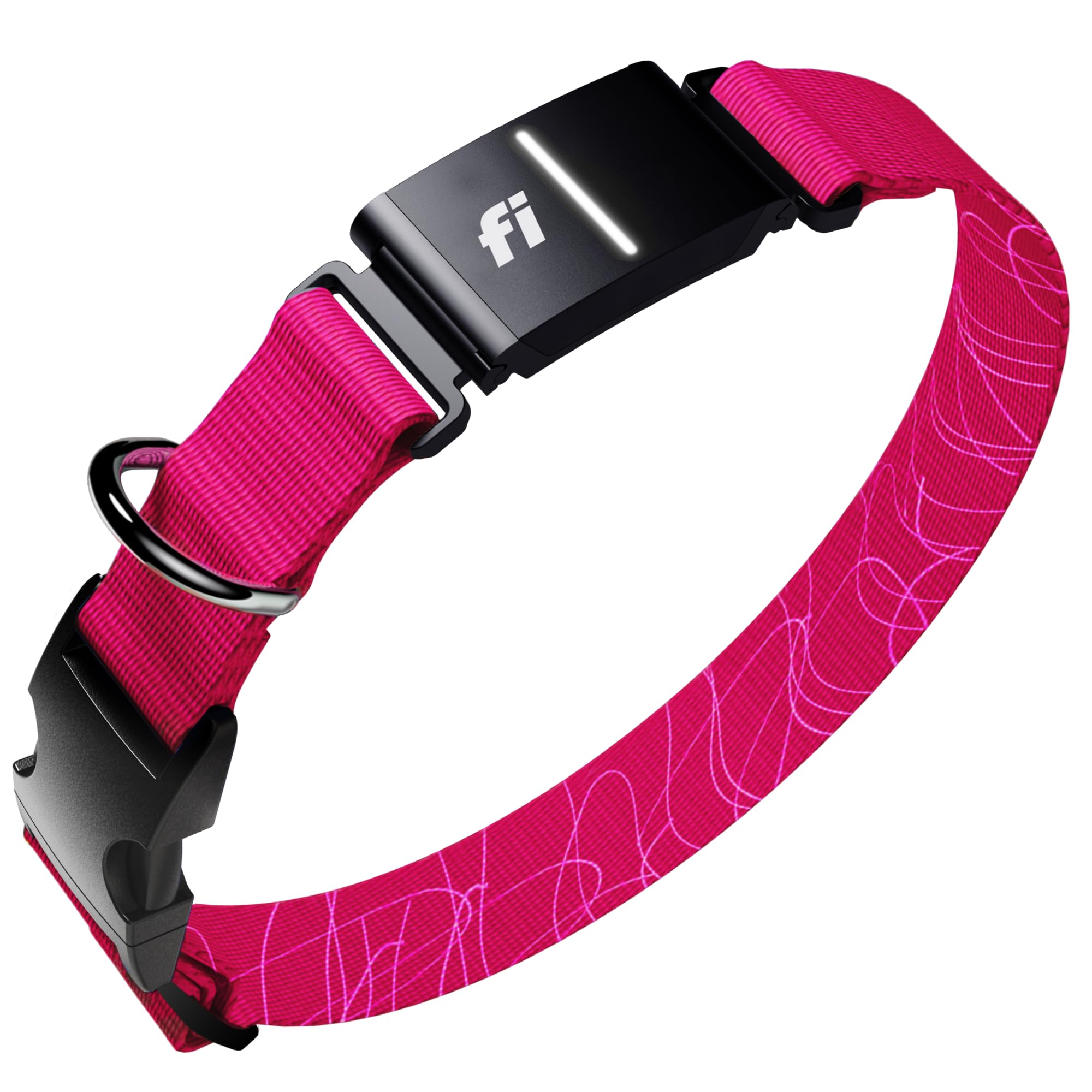
Three months on a charge is the number that caught our attention, because charging is what quietly kills trackers: a collar left on the kitchen counter locates nothing. Fi pairs the claim with a charging base you drop the collar onto, plus a stainless frame and an IP68/66K rating that shrug off mud and rain. The base is the part that makes the claim usable — no cable to hunt for, no port to line up on a wet evening.

The membership buys live location with unlimited range, safe zones that notify you when they are crossed, and an activity stream covering steps, scratching, licking, sleeping, and barking, the kind of pattern that is hard to notice in a dog you see every day. Sizes run XS through XL in several colors, the built-in LED is genuinely useful after dark, and other people who walk the dog can share the membership at no extra cost, which matters in a household where three people watch one dog.

Accuracy, not capability, is our hesitation. Live updates can trail where the dog actually is, so a safe-zone alert can arrive after the dog is already down the street; this is a locating aid for a door left open, not a fence. If your dog's escape route is the front door, that is plenty. If it is a treeline that swallows a phone signal, a radio system is the better answer.

Pros

  • Up to three months per charge
  • Real collar in sizes XS to XL
  • Activity and health patterns in one app

Cons

  • Membership fee comes on top of the collar
  • Battery falls well short of three months with live tracking
Our verdict

A real collar that tracks, watches activity, and goes months between charges, as long as you are ready for a membership.

Check Latest Price
4

Best Budget Buy

Tractive Smart Dog GPS Tracker

82 /100
LBD Score Excellent

Key details

Battery
Up to 14 days
Dog Size
8 lbs and up
Subscription
Required
Location Updates
Every 2–3 seconds
View on Amazon

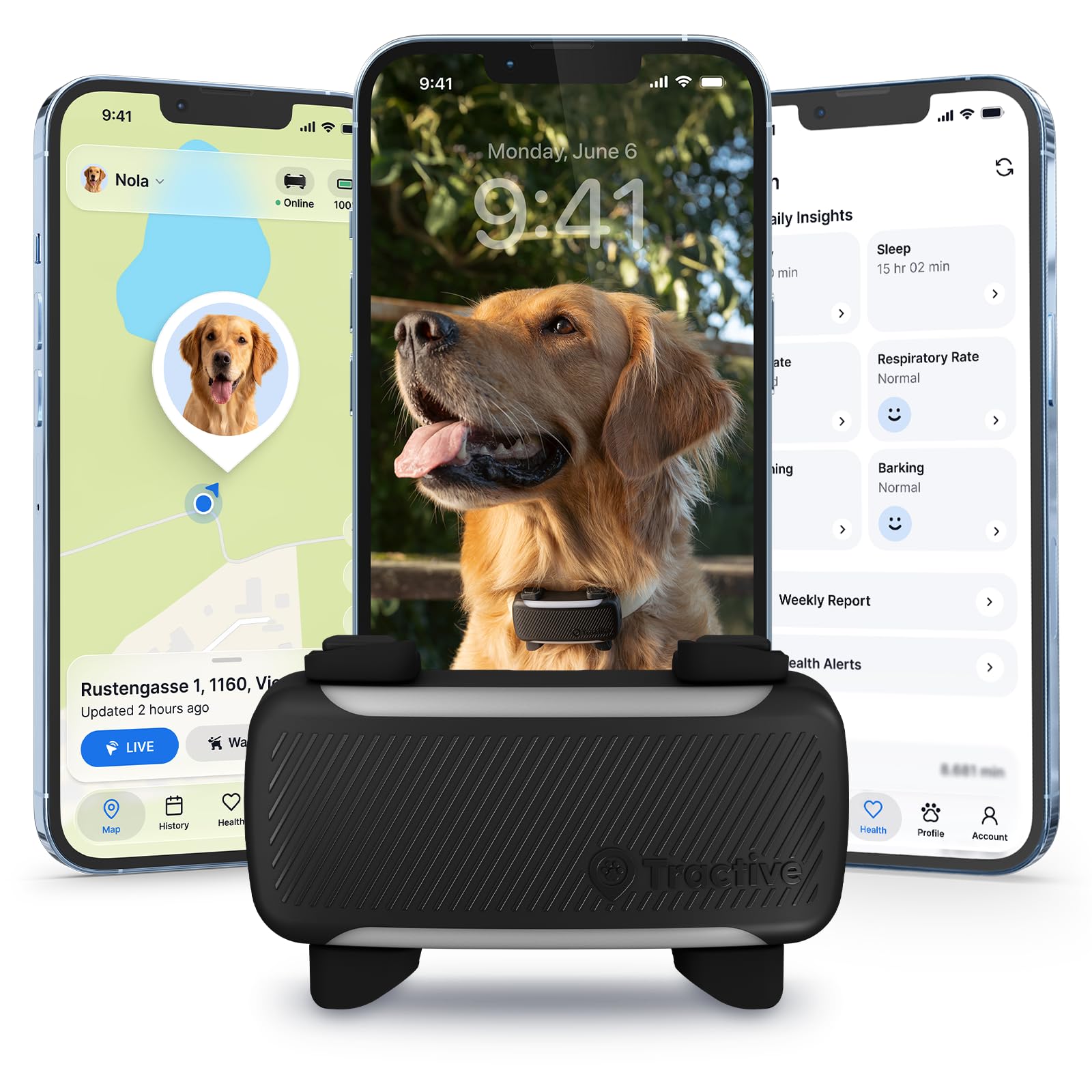
Eight pounds is the number that decides this one. Tractive rates the standard tracker for dogs down to eight pounds, and it clips onto the collar your dog already wears rather than replacing it, so a nine-pound terrier is not hauling a full-size collar and a receiver around the block. For small dogs, that alone is the argument.

The tracking earns its place too. Live updates land every two to three seconds over cellular, which means no range limit between you and the dog: it can be three streets or three towns away and the map still fills in. Draw a virtual fence around the yard or the park and you get a notification when it is crossed, and the history shows the route afterward. Heart and respiratory rate monitoring, barking alerts, and a waterproof housing round out a package that runs up to 14 days per charge with normal use.

The hardware is where the money went elsewhere. The housing is plastic, and the mounting clips are the parts to watch on a dog that pushes through hedges. This is a tracker you check now and then, not one you forget about for a season.

For a first tracker on a small dog, this is the one we hand to a friend. The Fi is the upgrade if remembering a weekly charge is the thing you know you will fumble.

Pros

  • Fits dogs from eight pounds
  • Live updates every two to three seconds
  • Clips onto any existing collar

Cons

  • Subscription required for tracking
  • Updates stop where cellular coverage does
Our verdict

The cheapest way into live tracking, and one of the few here rated for a dog as small as eight pounds.

Check Latest Price
5

Best for Backcountry

Garmin Alpha 300i Bundle

89 /100
LBD Score Excellent

Key details

In The Box
Handheld, collar, five accessories
Dogs Tracked
Up to 20
Tracking Range
Up to 9 miles
Satellite Messaging
inReach SOS and texts
View on Amazon

With no cell signal at all, this is the system that still works, and it does one thing nothing else here can. The Alpha 300i handheld carries inReach satellite messaging, so an SOS or a text home goes out from a ridge with no bars, from the same device that is showing you where the dog is.

The tracking half holds up on its own. Nine miles of range, up to 20 dogs, and a touchscreen handheld that keeps the maps on board, with Garmin's TT 25 collar included, the same collar sold on its own further down this list. Add the USB adapters, power bank, and travel bag and it is a complete kit rather than a starter you spend a season completing. We are convinced by the design; the price is the part that needs justifying.

That justification is distance from help. If your weekends involve trail riding, hunting, or dogs worked well beyond a road, the satellite link is the feature you are buying and everything else is support. Budget an evening for the topographic map downloads before the first trip — the least friendly part of an otherwise straightforward kit.

Pros

  • Satellite SOS and texts without cell service
  • Nine-mile tracking for up to 20 dogs
  • Complete kit with handheld and collar

Cons

  • Costs more than any other system here
  • Topographic map downloads take patience
Our verdict

When there is no cell service at all, this is the system that still gets a message out, and it tracks nine miles doing it.

Check Latest Price
6

Large-Breed Tracking

Tractive XL Smart Dog Tracker

81 /100
LBD Score Excellent

Key details

Battery
Up to 6 weeks
Dog Size
Over 44 lbs
Subscription
Required
Health Monitoring
Heart and respiratory rate
View on Amazon

The XL exists for one reason: a big dog can carry a bigger battery. Rated for dogs over 44 pounds and up to six weeks between charges, it is the version of Tractive we point large-breed households to, since the standard model's 14 days is workable right up until you are the one who has to remember it.

Everything else is the Tractive system: live updates every two to three seconds over cellular, unlimited range, virtual fences and escape alerts, location history, heart and respiratory rate monitoring, and a waterproof housing. At 70 grams it disappears on a dog that size. What tempers our enthusiasm is the track record — the XL is the newer model, so there is far less of it than the standard tracker has, and we lean on the shared app as much as on this unit's own history.

Pros

  • Up to six weeks between charges
  • Rated for dogs over 44 pounds
  • Heart and respiratory rate monitoring

Cons

  • Subscription required for tracking
  • Signal weakens under heavy tree cover
Our verdict

For dogs over 44 pounds, this is the Tractive experience with a battery measured in weeks instead of days.

Check Latest Price
7

Light Everyday Monitoring

Petivity Smart GPS Tracker

77 /100
LBD Score Very Good

Key details

Weight
1.07 oz
Battery
Up to 30 days
Mounting
Any collar or harness
Subscription
Required
View on Amazon

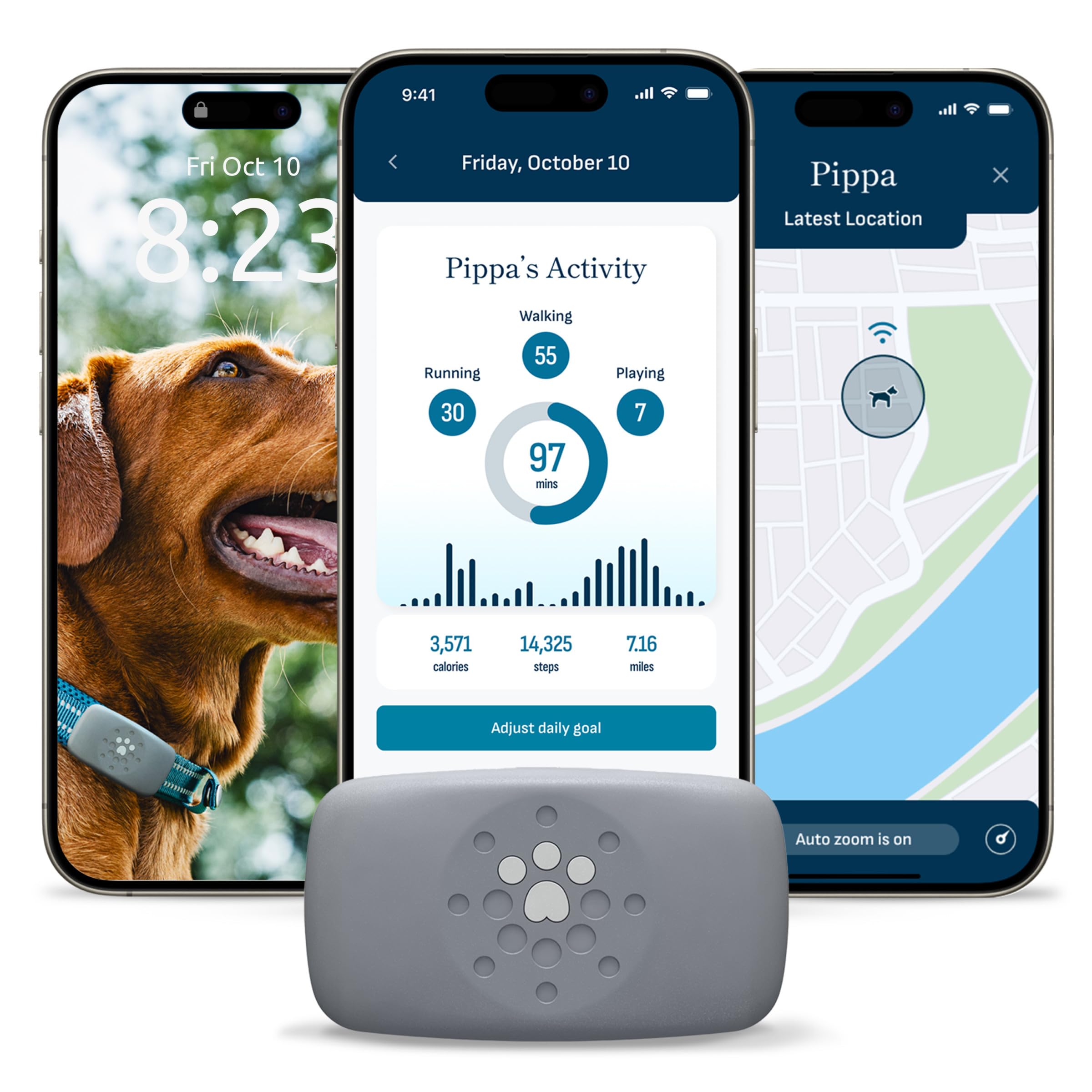
Just over an ounce is all this adds to a collar, and we think that matters more than it sounds. On a small or aging dog, a bulky tracker changes how they carry themselves; this one attaches to whatever collar or harness is already in use, so nothing gets refitted and nothing gets heavier.

The rest of the package is straightforward: live GPS location in the app, activity tracking with goals set for your dog, a waterproof housing, an SOS feature, and up to 30 days per charge. One practical note that saves an hour of troubleshooting: get it past 90 percent before pairing, or the app keeps failing to find it.

Where it fits is the everyday middle — the dog who slips the gate, the senior who wanders at dusk, the household that wants a location on a phone. It is the least expensive way into the category, and the one we suggest as a first tracker or as a second unit for a dog whose collar you would rather not replace.

Pros

  • Adds barely an ounce to a collar
  • Up to 30 days per charge
  • Fits any collar or harness

Cons

  • Subscription needed for live tracking
  • Rural coverage gaps stop updates
Our verdict

An ounce of tracker that disappears on a collar you already own, and the least intrusive way to know where the dog is.

Check Latest Price
8

Existing Garmin Handhelds

Garmin Alpha TT 25 Collar

90 /100
LBD Score Outstanding

Key details

Weight
1.3 oz
Handheld
Required, sold separately
Tracking Range
Up to 9 miles
Location Updates
Every 2.5 seconds
View on Amazon

Collar, strap, charging clip, cable, contact points, wrench, and no handheld. The TT 25 is the collar half of Garmin's Alpha system, and without a compatible handheld it sits in a drawer, so this is a purchase for someone already running an Alpha and adding to the pack.

Paired with one, it is serious gear: nine miles of range, position updates as often as every 2.5 seconds, and 18 levels of momentary or continuous stimulation plus tone and vibration for training. We liked the built-in light most — it is bright enough to pick a dog out of tall grass at dusk — and dynamic tracking slows the update rate when the dog is standing still, which is how the battery stretches.

At 1.3 ounces with a slim profile, Garmin sizes it for both large and small breeds, and the flex band is user-replaceable, so a chewed strap does not retire the electronics. Contact points come in short and long versions with a wrench, letting you match them to a coat rather than fighting a thick one.

If there is already an Alpha handheld in the truck, adding another dog to the screen costs far less than starting over with a second brand, and everything lands on the display you know. Order a spare charging clip with it: the clip is small, easy to misplace, and the one thing standing between a dead collar and a morning hunt.

Pros

  • Nine-mile range with a compatible handheld
  • Slim, 1.3-ounce receiver
  • User-replaceable flex band

Cons

  • Handheld required and sold separately
  • Charging clip is small and easy to lose
Our verdict

Not a standalone purchase: buy it when you already own a compatible Garmin handheld and want another dog on the screen.

Check Latest Price

What Eight Months of GPS Collar Testing Taught Us

We started by pulling every tracker and training collar we could find that was actually in stock and sized for dogs from roughly 10 pounds up, then cut anything whose advertised range, battery claim, or subscription requirement didn't survive a close read of the spec sheet. That left 11 units, which we ran for eight months with a rotating cast of dogs from a 12-pound terrier to an 80-pound shepherd mix.

Testing happened where the dogs already go: the fenced backyard, a handful of wooded trails with patchy cell service, the dog park, and the back seat of the car. We staged gate escapes to see how long an alert took to reach a phone and how far off the pin landed, and we walked each dog past a known landmark to time how often the map actually refreshed rather than trusting the number on the box. Setup was timed too, from unboxing to a working map with a phone in one hand.

Battery life we measured by running live tracking until each unit died, then repeating the drain with the collar sitting in standby on the counter — the gap between those two numbers was usually the real story. We hosed down and dunked every waterproof claim, kept the apps open for a month to see whether geofence alerts fired when they should and whether connectivity held on rural roads, and did the two-year math on plan fees against sticker price, since a cheap collar with a monthly bill isn't cheap.

How to Choose a Gps Dog Collar

Cellular or Radio, Decide This First

A cellular tracker locates your dog anywhere it has a signal, with no distance limit between the two of you, and you pay for that with a subscription. A radio system talks directly between the collar and a handheld, holds for four to nine miles, needs neither coverage nor fees, and stops working at the edge of its range. Suburban escape artists are better served by cellular; dogs worked off-leash in open country need radio.

The tell is what you carry. A radio system means a handheld in your hand on every outing, which is exactly why the Pathfinder2 Mini Compass earns its keep. A cellular tracker is a phone in your pocket and a map that keeps working from another state.

Budget for the Plan, Not the Collar

On most cellular trackers the hardware is the smaller number. The device only locates a dog while its plan is active, and that plan is a monthly or annual charge for as long as you keep the collar, so the cheapest tracker to buy can become the most expensive to own. Work out two or three years of service before you compare what you are paying up front, and check whether the plan is priced per dog or per account.

The no-fee systems, like the Dogtra Pathfinder2 and the Garmin Alpha, cost more once and nothing after. That math is the whole argument for spending up on radio if you plan to keep tracking for years.

Match the Hardware to the Dog

Every tracker here has a weight floor, and it is the specification most likely to rule one out: Tractive rates its standard tracker from 8 pounds, the Dogtra Mini Compass from 25, and the Tractive XL from 44. A clip-on unit leaves your dog's own collar in place; a full collar replaces it, so you are fitting a strap as well as a device.

Weigh the whole assembly before it goes on a small dog. An ounce is nothing on a Labrador and a lot on a terrier, and a tracker that shifts around the neck is one the dog will work at with a back foot.

Treat Battery Claims as Best-Case

Quoted battery life describes the quietest use. A tracker sending a position every two or three seconds drains far faster than one reporting every few minutes, which is how a collar rated for three months can run out in days when live tracking is on all afternoon. The practical question is the routine you will keep, not the number on the box.

A charging base makes a weekly top-up easy, as on the Fi; a bare cable needs a habit. Charge on the same day each week rather than waiting for the app to nag, and keep a spare cable or clip in the vehicle if the collar travels with you.

Frequently Asked Questions

Final Verdict

For anyone who works a dog off-leash, the Dogtra Pathfinder2 Mini Compass is the pick. A handheld that updates every two seconds, four miles out, with no subscription and no phone in the equation; it is the one system here whose usefulness does not depend on a cell tower.

If your dog is under 25 pounds, or never leaves a cellular footprint, buy the Tractive Smart Dog GPS Tracker instead. It fits dogs from eight pounds, updates every few seconds, and asks far less up front. The trade is a monthly plan, plus coverage you should check where you actually walk before committing.