Best Electronic Drum Sets for Kids of 2026

The first question every parent asks about a kids' drum set is how loud it's going to be. Fair question, easy answer: with mesh pads and headphones, the rest of the house hears nothing. The harder question is whether anyone still plays it two months from now. A good electronic kit gives a kid pedals, cymbals, and a throne to sit on without a garage or a soundproofed room — and keeps practice quiet enough that you won't be the one asking them to stop.

That's the bar we tested against. Over eight months, my team lived with 11 kids' sets in bedrooms and basements, from roll-up pads a four-year-old can unroll on the rug to compact mesh kits a nine-year-old grows into. Pad material is the real fork in the road: rubber is cheaper but loud and stiff under the stick, while mesh gives a little and keeps the peace.

The rest hides in details you can't see online — floor space, rack wobble during a fast fill, pedals that reach short legs, enough kits to stay interesting past week three. Everything below survived actual kids.

1

Best Overall

Donner DED-80

88 /100
LBD Score Excellent

Key details

Sounds
180+
Included
Throne, headphones, sticks
Drum Pads
4 x 6.5 in mesh
Expanded Size
42.52 x 18.11 x 39.37 in
View on Amazon

A box with four 6.5-inch mesh pads, two pedals, a throne, headphones, and sticks is the DED-80's opening argument. It is a youth-size kit rather than a tabletop pad, so it asks for a corner of a room and a child who is ready to sit at a kit. The frame and connections are straightforward to assemble, and the whole thing folds down when it needs to disappear.

The completeness is what earns it a place over the cheaper roll-ups. The mesh pads give a more realistic rebound than silicone, and we appreciate that the included headphones turn quiet practice into the default rather than an add-on. The 180 sounds and 30 accompaniment tracks are enough to keep a beginner exploring, and the drum coach is more useful than a folder of demo beats.

The limit is size. At 6.5 inches, the pads suit a 7- to 11-year-old; a tall 12-year-old will feel the kit shrink around them, and the youth stand will sit low. The DED-200 is the better answer for that child. For everyone else, the folding frame is what makes the DED-80 easy to live with in a small house.

Pros

  • Complete kit includes throne, headphones, and sticks
  • Quiet mesh pads with headphone output
  • Youth-size frame folds down for storage
  • Drum coach and 30 play-along tracks

Cons

  • No Bluetooth for wireless app play
Our verdict

The DED-80 is our pick for most families: a complete youth-size mesh kit with headphones, throne, and sticks included.

Check Latest Price
2

Best for Older Kids

Donner DED-200

91 /100
LBD Score Outstanding

Key details

Sounds
450 sounds, 31 kits
Included
Throne, headphones, sticks
Drum Pads
5 pads, 3 cymbals
Connectivity
USB MIDI
View on Amazon

The DED-200 is the DED-80 after a growth spurt: five mesh pads, three cymbals, and an eight-piece layout that gives an older child room to move. We think it is the right upgrade for a teenager who has outgrown a tabletop pad or a youth-size kit, not for a 6-year-old who is still learning to reach the hi-hat.

The sound set is broad: 450 sounds, 31 kits, 50 play-along songs, and a sequencer. USB MIDI lets the kit drive a computer, and the headphone output keeps practice private. The included throne and headphones also separate it from the Alesis Nitro Max, which leaves those for you to supply.

The trade-off is floor space. This is a real kit with a rack, a kick pad, and three cymbals, so it needs a corner and some patience at assembly. The onboard sounds are solid for practice, though a serious player will eventually want a VST; the headphones are the better way to listen until then.

Pros

  • Five mesh pads and three cymbals
  • 450 sounds and 31 kits
  • USB MIDI and 50 play-along songs
  • Includes throne and headphones

Cons

  • Included bass pedal and throne are basic
  • No Bluetooth for app play
Our verdict

We see the DED-200 as the upgrade for a teenager who has outgrown a small pad: bigger mesh pads, three cymbals, and USB MIDI.

Check Latest Price
3

Best for Younger Kids

VTech Kidi Star

92 /100
LBD Score Outstanding

Key details

Age
5 years and up
Power
4 AA batteries
Drum Styles
20
Connectivity
Bluetooth, headphone jack
View on Amazon

The Kidi Star is the one that feels like a toy in the best sense: 20 drum styles, 30-plus songs, three games, and a Coach mode on a tabletop pad. For a 5- or 6-year-old who is not ready to sit at a full kit, the games are the way in.

The Bluetooth connection is for streaming a playlist, not for MIDI, and the built-in speaker or headphone jack carries the sound. We like that the pad can sit on a table and be put away, and the 20 styles give it more staying power than a single demo beat.

The caveat is longevity. The electronics are the part to watch, so test every pad, game, and the headphone jack during the return window. If it works, it is a genuinely engaging first instrument for a younger child; if your child is 8 or 9 and wants stick control, the DED-80 is the better path.

Pros

  • Games, Coach mode, and 30+ songs
  • Bluetooth audio and headphone jack
  • 20 drum styles
  • Compact tabletop design

Cons

  • Runs on four AA batteries
Our verdict

We think the Kidi Star is the right first pad for a 5- to 7-year-old who wants games and songs more than a realistic kit.

Check Latest Price
4

Best Portable

PAXCESS Drum Set

92 /100
LBD Score Outstanding

Key details

Pads
7 pads, 2 pedals
Weight
2.4 lb
Battery
2000mAh, up to 10 hours
Connectivity
USB MIDI, 5-pin MIDI
View on Amazon

A roll-up pad is not a substitute for a full kit, and the PAXCESS does not pretend to be one. What it does is put seven pads, two pedals, a battery rated for up to 10 hours, and MIDI into something that folds up and goes in a bag.

We think that makes it the best travel pick here, especially for a child who wants to keep drumming at a grandparent's house or in the car. We like the headphone jack and the 5-pin MIDI output; the built-in speakers are fine for a bedroom, but headphones are the better way to play without an audience.

The pads are small, and that is the point. They keep the footprint down, but they will not teach full-size rebound or give a teenager room for fills. The pedals are compact foot pedals rather than a kick pad, so this is a practice pad with drum-kit sounds, not a kit for learning posture. For travel and quiet practice, that trade is easy to accept.

Pros

  • Rolls up for travel and storage
  • Seven pads and two pedals
  • Rechargeable battery rated to 10 hours
  • USB and 5-pin MIDI

Cons

  • No stand or throne included
Our verdict

The PAXCESS is our travel pick: seven pads, MIDI, and a battery in a package that folds into a bag.

Check Latest Price
5

Bluetooth Practice

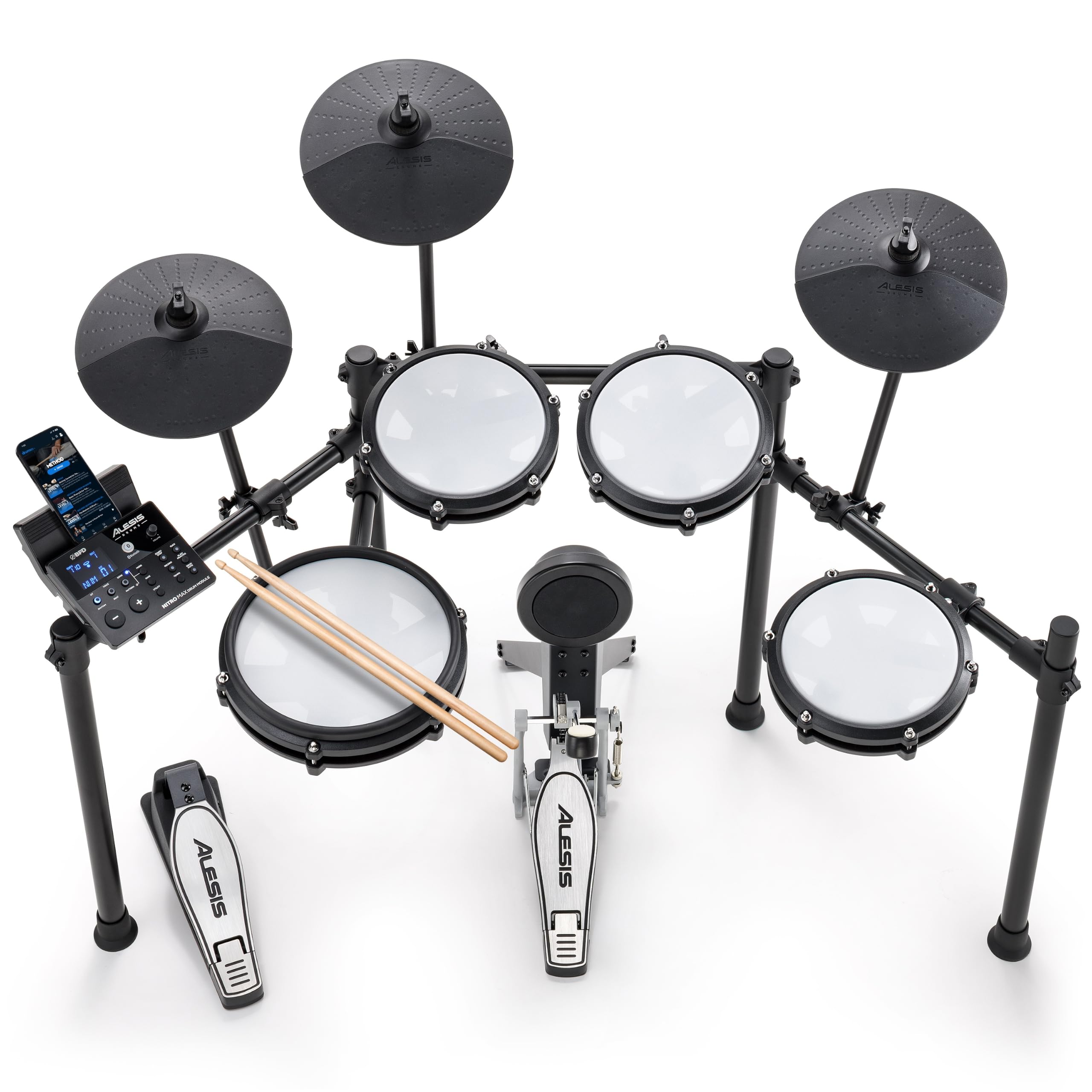
Alesis Nitro Max

88 /100
LBD Score Excellent

Key details

Toms
3 x 8 in mesh
Snare
10 in dual-zone mesh
Cymbals
3 x 10 in
Connectivity
Bluetooth, USB MIDI
View on Amazon

The Nitro Max is the roomiest kit here for a teenager: a 10-inch dual-zone snare, three 8-inch mesh toms, and three 10-inch cymbals. The bigger snare is the part that changes the feel, and the three cymbals give a kid somewhere to go beyond the basic hi-hat and crash.

We like the Bluetooth and 440-plus BFD sounds. The module can stream music for play-alongs, and the Drumeo card adds lessons; USB MIDI covers computer work. Bluetooth is the feature that separates it from the Donner kits, and it is the strongest card.

The rack is the fussy part. It takes more care to assemble than the Donner kits, and it can wobble on carpet or when the clamps are not tight. That does not make the Nitro Max unplayable, but it is the first thing to check before a child starts practicing.

For a teenager who wants the bigger snare, Bluetooth, and the roomiest pad layout here, the Nitro Max earns a look. The DED-200 is the safer build for most families; if the kit stays in one room and can be set up carefully, the Alesis rewards that patience.

Pros

  • 10-inch dual-zone mesh snare
  • Three 10-inch cymbals
  • Bluetooth and 440+ BFD sounds
  • USB MIDI and Drumeo lessons

Cons

  • No throne or headphones included
Our verdict

We see the Nitro Max as a teen kit with the biggest pads here, provided the rack gets a firm floor and careful setup.

Check Latest Price
6

Ages 5-9

ROCKSOCKI 7-Pad

90 /100
LBD Score Outstanding

Key details

Pads
7 pads, 2 pedals
Battery
2000mAh, up to 10 hours
Included
Headphones, sticks, pedals
Suggested Age
5-9 years
View on Amazon

The pair of headphones in the box is the detail that makes the Rocksocki the easiest gift for a younger child: quiet practice is there on day one, not as an extra purchase. The seven-pad roll-up is rated for ages 5 to 9, and it weighs 1.7 pounds.

We like it as a first kit for a child who wants to play along without turning the house into a rehearsal room. The 2000mAh battery is rated for up to 10 hours, the dual speakers are fine for a bedroom, and USB MIDI lets it talk to a computer. It rolls up into a backpack.

The pads are compact and close together, which suits small hands but will not fit a 10-year-old for long. The headphones are a starter pair. Against the PAXCESS, the Rocksocki gives up 5-pin MIDI but gains the included headphones; that is the trade that makes it the better bundle for a younger child.

Pros

  • Headphones included for quiet play
  • Seven pads and two pedals
  • 10-hour rechargeable battery
  • Lightweight roll-up design

Cons

  • No stand included
Our verdict

The Rocksocki is our budget travel pick for ages 5 to 9 because the headphones are included and the whole thing packs away.

Check Latest Price
7

Tight Budgets

EKEMOND 9-Pad

89 /100
LBD Score Excellent

Key details

Pads
9 pads, 2 pedals
Sounds
7 tones, 10 demo songs
Battery
Up to 10 hours
Power Adapter
5V 2A, not included
View on Amazon

Nine pads for less than most of the seven-pad roll-ups is the pitch, and the EKEMOND backs it up with two crash cymbals and a ride. For a kid who wants more targets to hit, the extra pads are the fun part.

The trade-off is in the sound set. Seven tones and 10 demo songs run out faster than the Donner's 180 sounds, so this is a first pad, not a long-term practice module. The two pedals and sticks are in the box.

We think it is the best pick here for a tight budget and a child who wants a packable pad with more zones. The small pads still make it a toy-first choice, and the battery is the feature that keeps it useful away from an outlet. The extra crash and ride pads are the part kids gravitate to, and that is worth something in a first instrument.

Pros

  • Nine pads with two crashes and a ride
  • Up to 10 hours per charge
  • Two pedals and sticks included
  • Compact roll-up design

Cons

  • 5V 2A adapter not included
Our verdict

For the tightest budget, we like the EKEMOND's nine pads, two pedals, and 10-hour battery in a packable first kit.

Check Latest Price

How We Tested Kids' Electronic Drum Sets

We started with roughly 40 sets sold in the U.S. and narrowed the list by reading specs and customer reviews, dropping anything with no headphone jack and anything pairing rubber pads with a mesh-kit price. That left 11 sets, which we assembled ourselves, solo and with a timer, to see what a non-handy parent is actually in for on a Saturday morning.

Then they went into homes. Each set spent at least three weeks in a bedroom or playroom, with kids aged 4, 7, and 10 plus one teenager taking turns; the roll-ups went on road trips and got folded into backpacks. We taped the footprint out on the floor, checked whether the smallest player could reach both pedals without sliding off the throne, and stood at the doorway with a sound meter while the pads were hit as hard as a kid hits them.

Stability showed up during fast fills — we watched which racks crept across the rug and which kick pedals wandered. With headphones on, we listened to each set's snare and cymbal to hear which sounded like a recorded drum and which sounded like a keyboard demo. Durability got checked at the end: loose wing nuts, frayed cables, mesh heads still holding tension. For functionality, we ran USB MIDI into a laptop, spent two weeks in each set's lesson app, and counted how many kits the kids cycled through versus scrolled past.

The final measure was enjoyment, which is hard to fake: we noted which module got switched on unprompted in week six and which one needed a parent to suggest it. Value came down to what was in the box — throne, headphones, sticks, pedals — against what the set cost.

How to Choose an Electronic Drum Set for Kids

Start with the child's stage, not the age on the box

A roll-up pad is a packable first taste; a tabletop toy adds games; a stand-mounted mesh kit teaches posture and stick control. Pad size matters: 6.5-inch pads suit small hands, 8-inch pads give older kids more room, and a 10-inch snare is the start of a teen-size kit. If the child is turning 12 or already tall for their age, skip the youth-size set and look at the DED-200 or Nitro Max. Measure the corner before you order.

Headphones first, mesh second

A headphone output is the feature that makes an electronic kit livable. Mesh heads reduce stick noise and feel better under the sticks; they do not stop the kick pedal from thumping through the floor. Put the kit on a rug and use headphones for late practice. A roll-up is quieter through the pads but still makes stick noise. If quiet is the main reason for buying, we prefer mesh plus headphones over a silicone pad alone.

Check the rack, pedals, and jacks

We care more about a stable rack and reliable pedals than a long preset list. A wobbly stand or a pedal that cuts out will end a practice session faster than a thin drum sound. On full-size kits, check the rack clamps and the kick pedal; on roll-ups, the pedal jacks and pad edges are the weak points. Set the kit up as soon as it arrives, play every pad and pedal, and keep the packaging until you know it works.

Budget for what is not in the box

Add up what is missing before you compare prices. A throne, headphones, sticks, and a power adapter can turn a cheap pad into a more expensive purchase. The DED-80 and DED-200 arrive as complete kits with a throne and headphones; the Alesis and several roll-ups do not. The EKEMOND 9-Pad also does not include its 5V 2A adapter. If you already own headphones and a stool, a bare kit can be the better value; if this is a gift, the complete box is worth the premium.

Frequently Asked Questions

Final Verdict

For most families, the Donner DED-80 is the set to buy. It is a real mesh kit, it fits a 7- to 11-year-old, and the throne, headphones, and sticks are in the box. That combination is why it beats the cheaper roll-ups and the bigger kits for a first purchase.

If your child is already a teenager, the DED-200 is the better long-term buy for the bigger pads and three cymbals. For a 5- or 6-year-old who wants games more than technique, the VTech Kidi Star is the one to choose.