Best Car Stereos of 2026

A new car stereo is one of the few upgrades you have to install before you can judge it, which is why so many people put it off — you picture a dashboard in pieces and a car that ends up sounding worse than the factory radio did. Done right, the payoff is obvious: hands-free calls people can actually hear, clean volume that outruns road noise at highway speed, and controls that don't fight you every time you change stations. A good unit makes an older car feel five years newer; a bad install makes a good one feel broken.

We've spent the past six months driving with 12 of them, from single-DIN radios that drop into an old truck's dash to double-DIN touchscreens, and two things stood out. A screen only fits if there's depth behind the dash, and the wattage printed on the box is peak power, not the number that decides how loud a radio plays cleanly. Value is stranger than it looks, too — the brand-name premium buys nicer buttons more often than it buys better sound. Here's what earned a permanent spot in the dash.

1

Best Overall

SJOYBRING JOY-W022

85 /100
LBD Score Excellent

Key details

Camera
Rear-view camera included
Output
240 watts, 4.2-channel
Screen
7-inch QLED, 1280 x 720
Phone Integration
Wireless CarPlay & Android Auto
View on Amazon

The first thing we look for on a touchscreen head unit is a volume knob, and the JOY-W022 has one sitting right beside the glass. Reaching for a dial instead of hunting a slider is the difference between a glance and a lane drift at 60 mph, and it's the detail we kept appreciating long after the screen stopped being novel. Around it: a 7-inch QLED panel at 1280 x 720, wireless CarPlay and Android Auto, and a rear-view camera with its cable in the box.

For most people replacing a factory radio in a car that predates screens, this is the one we point to. Wireless CarPlay and Android Auto keep the phone in a pocket — maps, messages and podcasts are up by the time you've backed out of the driveway, with no cable to plug in. The display stayed legible in direct sun, and the touch response kept pace with map panning and app switching, which is exactly where inexpensive big screens usually come apart.

Sound holds up its end. The unit is rated at 240 watts across a 4.2-channel layout, with front and rear speaker outputs plus two subwoofer preouts, so a small sub goes in without another box of electronics. Treat that wattage as the headline number it is; on stock speakers the thing gets loud before it gets harsh, and there's real crossover and EQ work behind the screen for anyone who wants to go deeper. Steering wheel buttons can be wired in, and you can load your own startup logo so the screen doesn't advertise a brand your car never wore.

The one thing we can't vouch for is time. This isn't a legacy car-audio name, and there aren't a decade's worth of these sitting in dashboards yet. Nothing we've seen points to trouble, but read the warranty terms before you order and keep the receipt.

Pros

  • Wireless CarPlay and Android Auto, no cable
  • Bright QLED screen that stays readable in sun
  • Rear-view camera and cable included
  • Volume knob beside the touchscreen

Cons

  • Fits double-DIN dash openings only
Our verdict

Our pick for most factory-radio upgrades: wireless CarPlay and Android Auto, a bright screen that keeps up, and a rear camera in the box.

Check Latest Price
2

Best for CD Collections

Pioneer DEH-S4220BT

90 /100
LBD Score Outstanding

Key details

Media
CD, USB, aux, Bluetooth
Output
50W x 4
Faceplate
Detachable
Preamp Outputs
Hi-volt RCA
View on Amazon

There's a CD slot across the front, and that is honestly why this receiver made the list. Plenty of people still keep a binder of discs in the car, and every other pick here will stare back blankly when you hand one over. The DEH-S4220BT plays them, and it takes USB, aux and Bluetooth streaming as well.

It isn't a stripped unit with a disc drive bolted on. You get 50 watts across four channels, hi-volt RCA preouts for anyone running an amplifier, voice control, and Pioneer's Smart Sync app, which moves the deeper tuning onto your phone instead of making you code it in through a single knob. It reads FLAC, and the button illumination can be color-matched to the rest of your dash.

Sound is where it earns its keep. It's the best-liked sound in this group — clean over Bluetooth, and it holds together with upgraded speakers instead of folding when you turn it up. We're also fond of the detachable face: a single-DIN receiver sitting in an older car is an easy target, and pulling the panel off takes about ten seconds.

The controls take some learning. Menus run through a knob and a couple of buttons, and the settings you actually want sit a few layers down, so use the app instead of stabbing at it in traffic — it's the least painful way into most of it, and once your curve is set you rarely go back.

Pros

  • Plays CDs, USB, aux and FLAC
  • Best-liked sound in this group
  • Hi-volt preouts for amplifier builds
  • Detachable faceplate deters theft

Cons

  • No CarPlay or Android Auto
Our verdict

The receiver to buy if your music still lives on discs: it plays them, it's the best-liked sound here, and the faceplate comes off when you park.

Check Latest Price
3

Best Budget

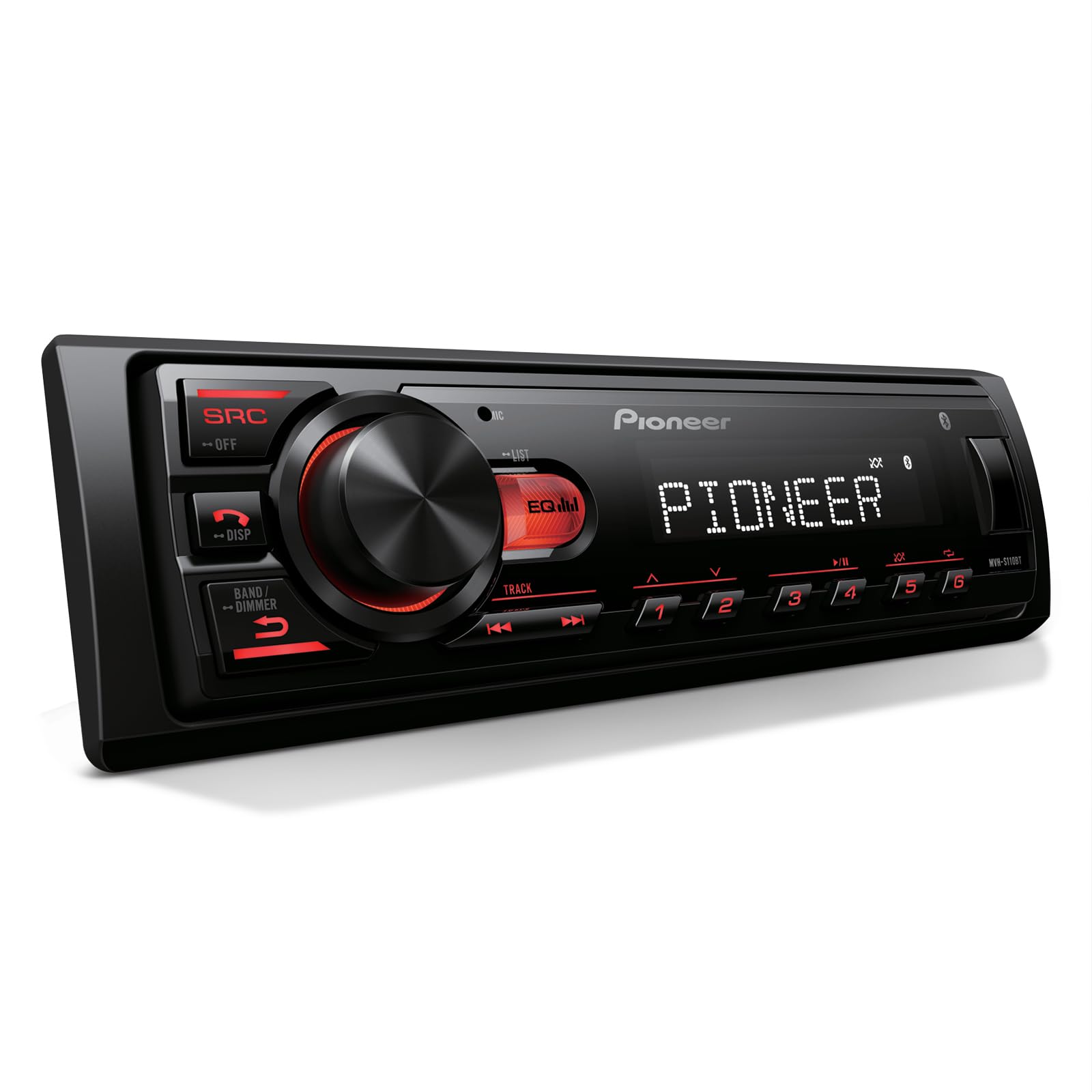
Pioneer MVH-S110BT

86 /100
LBD Score Excellent

Key details

Inputs
Front USB, Bluetooth
Output
50W x 4
Chassis
1-DIN, 3.87 inches deep
Preouts
Front and subwoofer
View on Amazon

The case behind this faceplate is only 3.87 inches deep, which is the kind of figure that means nothing until you're fitting a radio into a 1990s dash with a heater box pressed against the back of the slot. Pioneer built the S110BT short for exactly that problem, and it's why this one sits flush where a full-depth receiver refuses to.

For a budget receiver, the list runs longer than we expected: Bluetooth for calls and streaming, a front USB port that reads FLAC, MP3 and WMA, AM/FM radio, and 50 watts across four channels with front and subwoofer preouts. Bass, treble and balance live on dedicated keys rather than inside a menu, which sounds like a small thing until you're doing 70 and want less bass.

We were surprised by how little it gives up in sound. It's not a tuning tool — there's no deep equalizer, and the display is basic — but the output is clean and the install is about as straightforward as car audio gets. It also keeps a period interior looking period, which is more than most inexpensive receivers manage.

Pros

  • Short 3.87-inch chassis fits shallow dashes
  • Clean sound for a budget receiver
  • Dedicated bass, treble and balance keys

Cons

  • No aux input anywhere on the unit
  • Bluetooth pairing can take a couple of tries
Our verdict

If the dash is shallow and the budget is tight, this is the single-DIN we recommend — Bluetooth, USB and clean sound with nothing to configure.

Check Latest Price
4

Simple Hands-Free Calls

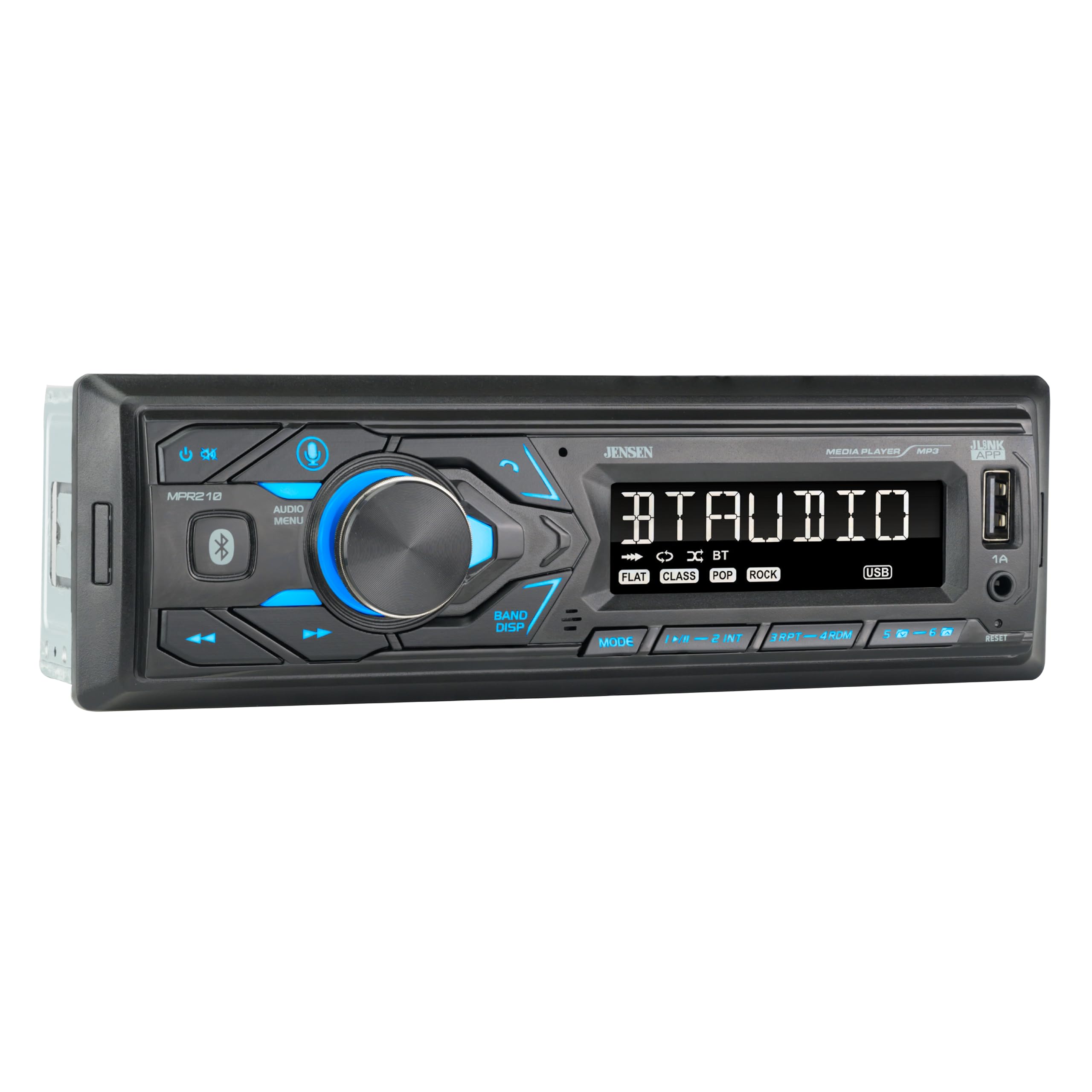
Jensen MPR210

86 /100
LBD Score Excellent

Key details

Voice
Push-to-talk assistant
Inputs
USB, 3.5mm aux
Display
7-character LCD
Warranty
2 years, 4 with registration
View on Amazon

Two years of warranty, stretching to four if you register the thing — no other receiver here comes close, and in a category where inexpensive radios are a gamble, that coverage is the argument. Jensen's MPR210 backs it with a short, honest feature set rather than a long one.

The basics are handled well. It found a phone and started streaming quickly in our time with it, the volume knob is big enough to grab without looking down, and a push-to-talk button wakes Siri or Google Assistant so you can skip the voice menus entirely. The tuner even switches between U.S. and European spacing, which matters if the car is going to spend time on both continents.

Sound is where it's plainest: a two-band tone control and four presets, and that's the lot, so there's no shaping a system around this one — stock speakers are its natural home. The Bluetooth input also runs quieter than the radio, and the remedy sits on the phone: set its volume to maximum before you pair, then trim on the knob, or you'll be reaching for it at every source change.

Physically it's small and light, which makes it easy to bracket into a dash that was never designed for a modern radio, and the high-contrast seven-character LCD keeps the preset list readable without turning the cabin into a light show.

Pros

  • Two-year warranty, four with registration
  • Big volume knob and push-to-talk button
  • Pairs and streams quickly
  • Compact body brackets into old dashes

Cons

  • Engine whine and static can come through
Our verdict

The budget single-DIN we recommend for straightforward hands-free calling, backed by the longest warranty in this group.

Check Latest Price
5

Android Screen Mirroring

Kenwood DMX150BT

78 /100
LBD Score Very Good

Key details

Camera
Rear camera input
Screen
6.8-inch capacitive touchscreen
Equalizer
13-band graphic
Phone Integration
USB mirroring for Android
View on Amazon

Mirroring is the word that decides this one. The DMX150BT puts an Android phone's own screen on its 6.8-inch display over a USB cable, and it runs neither Apple CarPlay nor Android Auto. If you want your phone's apps up on the dash, that's the feature you're buying; if you want the polished, purpose-built car interface, this isn't it and our top pick is.

The rest of the package is solid. A capacitive panel is the responsive type — the kind you tap rather than press — and the 13-band graphic equalizer is the most detailed tuning control any of these receivers lists, which counts in a cabin that fights back against its own speakers. A rear camera input is waiting when you want to add one.

Understand what mirroring isn't. Your phone's interface was designed for a hand holding it, so buttons stay small and apps aren't reorganized for a driver; you'll be prodding at stoplights. An iPhone gets nothing from the wired mirroring at all, which leaves Bluetooth streaming and a large screen — still more than an old factory radio gives you.

Pros

  • 13-band graphic EQ for detailed tuning
  • 6.8-inch capacitive touchscreen
  • Rear camera input ready for a backup camera

Cons

  • No Apple CarPlay or Android Auto
Our verdict

For an Android driver who wants a big screen, a camera input and a 13-band EQ, it's a sound buy — CarPlay people should keep walking.

Check Latest Price

How We Tested the Best Car Stereos

We started with roughly 40 radios and cut the list using the things that actually decide whether one works in your car: single- or double-DIN fitment, whether a dash kit and wiring harness existed for common models, price, and the features people touch every day — Bluetooth, USB, a rear-camera input, and preamp outputs for anyone adding a sub. That left 12 units, which we bought and installed ourselves over six months.

Every unit went into one of three vehicles — a sedan with a double-DIN opening, an older pickup with a single-DIN slot, and a hatchback — and we timed each install. We noted whether the harness was plug-and-play or needed splicing, whether the trim sat flush, whether the microphone cable reached the A-pillar, and how long it took to work out the menus without the manual.

Then we drove. Same three tracks at matched volume in each car, listening for muddy bass, background hiss at low volume, and whether the sound stayed clean near the top of the dial. For hands-free calling, we phoned from the highway with the windows cracked and asked the person on the other end how we sounded.

We paired both an iPhone and an Android to each radio, timed how quickly they reconnected each morning, and walked away from the car to find where the wireless signal broke. Rear cameras got checked in a dim parking garage at night, and we plugged a small amp and sub into the preamp outputs to see how much control the crossovers gave. Finally, we added up the radio plus the dash kit and harness to judge value — a cheap unit with a fiddly interface rarely turns out to be one.

How to Choose a Car Stereo

Measure the opening before you fall for a screen

Two standards cover almost every car. Single-DIN is a slot roughly 7 inches wide and 2 inches tall; double-DIN doubles the height to about 4 inches. A double-DIN receiver won't squeeze into a single-DIN hole without a dash kit and, often, trimming, so measure the faceplate of the radio you're pulling out rather than trusting the year and model.

Depth is the quieter trap. Older cars often have a heater box sitting close behind the radio, and a full-depth receiver simply won't sit flush. Short-chassis units exist for exactly this, and the ones here that make a point of it measure under 4 inches front to back. Measure the cavity with the old unit out, then add an inch for the cables.

Decide how your phone gets on the screen

Bluetooth alone covers calls and streaming, and nothing else. Wired CarPlay or Android Auto adds maps, messages and voice control but keeps a cable in the car; wireless versions do the same job with the phone in your pocket and put more strain on the battery on a long drive.

If you use navigation most days, the integration is worth paying for. If the car is a weekend runabout, a Bluetooth receiver with a decent knob does the job and costs less. There is a third path — mirroring an Android phone's screen over USB — but a mirrored phone interface was designed for a hand, not a dashboard.

Read the power figures, then look at the preouts

Head units advertise 50 watts by four, and those are peak numbers, not what four speakers actually receive continuously. That's fine: the practical gain over an old factory radio comes from cleaner power and a real equalizer, not from the headline figure.

If you plan to add an amplifier or a subwoofer, the preouts matter more than the wattage. Look for front, rear and subwoofer outputs, and hi-volt preouts if you're chasing a low noise floor. A receiver with a two-band tone control and no preouts can't grow with a system later.

Budget for the parts that aren't in the box

A new receiver rarely drops straight into a factory hole. Plan on a vehicle-specific wiring harness adapter so you don't cut the factory plug, a dash kit so the unit sits flush, and a steering-wheel-control module if you want the buttons on the wheel to keep working. A backup camera adds a cable run from the tailgate to the dash.

Price those items before you compare receivers. A unit that ships with a camera and its cable, or one that fits without a dash kit, can work out better value than a cheaper box that needs three extras to install cleanly.

Controls you can actually work while driving

A touchscreen is lovely standing still and maddening in traffic. Volume is the control you use most, and it's worth having on a physical knob — at least one of these keeps a dial beside the glass for exactly that reason. Check the rest of the layout the same way: can you change source or skip a track without looking down?

Ask about night dimming, too. A panel that stays bright after dark is worse than one with fewer features, and some receivers tie brightness to the dash lighting while others need setting by hand each evening.

Frequently Asked Questions

Final Verdict

The SJOYBRING JOY-W022 is the stereo we point most people to, because it solves the three things an older car actually lacks: a screen you can see, wireless CarPlay and Android Auto, and a camera to help you park. Add a real volume knob beside the glass and the decision gets easy.

If your music still lives on discs, the Pioneer DEH-S4220BT is the better buy and the better-sounding one. If the budget is the whole story, the Pioneer MVH-S110BT adds Bluetooth and USB for less and fits a shallow dash that won't take anything deeper.