Best Car Amplifiers of 2026

The first time you push a factory stereo past about two-thirds volume, you hit a ceiling you can hear: the bass goes soft, the vocals thin out, and the whole system starts to sound tired. An amplifier is what fixes that — it hands your speakers and subwoofer clean power instead of a clipped signal, so they play louder without falling apart. The catch is that the biggest number on the box is peak wattage, while what your sub actually feels is RMS power, usually a fraction of it.

I've wired amps into my own cars for years and I still read the RMS rating first. Over the past six months my team and I installed 12 amplifiers in our own vehicles, from palm-sized monoblocks to full-size four-channel Class AB units, and the differences came down to things you only notice after living with them: how hot the heatsink runs on a summer drive, whether the bass knob is actually within reach from the driver's seat, and how much of the price went into parts you can see and touch.

The picks below are sorted by the job you're asking one to do — driving door speakers, feeding a sub, or both — and every one of them earned its spot over months of driving, not a spec sheet.

1

Best Overall

Pioneer GM-A6704

85 /100
LBD Score Excellent

Key details

Filters
High- and low-pass
Channels
4
Max Power
1,000W
Dimensions
8.5 x 14 x 2.38 in
View on Amazon

The 1,000-watt figure on the Pioneer GM-A6704 is the first thing most shoppers notice, and it is also the first thing to get straight: that is a maximum rating, not a 1,000-watt continuous four-channel number. The real story is the four channels, the high- and low-pass filters, and the bridgeable design. That combination lets you run four door speakers, or bridge two channels into a modest sub when you want a single amp to do more than one job.

We made it our top pick because it fits the most common upgrade: a car with four factory speakers and a factory radio that needs cleaner, louder sound. The filters are genuinely useful—you can keep bass out of small door speakers and send low frequencies to a sub—and the Class AB layout is simple to tune. The case is 14 inches long, so measure under-seat space before you commit.

The trade-off is that this is not a big-bass amplifier. If you want to drive a pair of 12-inch subwoofers, a monoblock makes more sense. For a first system, though, the GM-A6704 gives you room to grow without asking for a huge electrical upgrade.

Pros

  • Four channels with high- and low-pass filters
  • Bridgeable for a modest subwoofer
  • Simple Class AB tuning
  • Low 2.38-inch profile

Cons

  • 1,000W is a max rating
  • Not a high-power sub amp
Our verdict

For most four-speaker upgrades, the GM-A6704 is the sensible first amp: flexible, bridgeable, and easy to live with, as long as you read the power rating honestly.

Check Latest Price
2

Best Compact Subwoofer Amp

CT Sounds CT-1000.1D

88 /100
LBD Score Excellent

Key details

Footprint
11.68 x 5.62 x 2.18 in
Impedance
1, 2, or 4 ohms
RMS Power
1,000W at 1 ohm
Protection
4-way circuitry
View on Amazon

The CT-1000.1D earns its place with its footprint: 11.68 by 5.62 by 2.18 inches, small enough to tuck into a corner or behind a seat panel where a full-size amp won't go. We like that it doesn't make you choose between a compact case and real subwoofer power. The 1-ohm rating is 1,000 watts RMS, with 650 watts at 2 ohms and 350 watts at 4 ohms.

That 1-ohm figure is the one to plan around. If your subwoofer wiring lands at 2 or 4 ohms, you can still use the amp, but you won't get the headline power. The four-way protection circuit covers high voltage, low voltage, over-current, and high temperature, which is the right safety net for a small Class D amp. MOSFET power supply and the heat-dissipation design are aimed at keeping it cool in tight spaces.

We see this as the sub amp for a daily driver, not a competition build. It is efficient enough that you aren't forced into 1/0 wiring, and the compact size makes installation easier. The catch is that full output depends on a 1-ohm final load, so check your sub's voice coils before you buy.

Pros

  • 1,000W RMS at 1 ohm
  • Compact 2.18-inch-tall chassis
  • Four-way protection circuitry
  • Efficient Class D design

Cons

  • Full output needs a 1-ohm load
Our verdict

For a compact subwoofer install that can be wired to 1 ohm, the CT-1000.1D is our pick: small, efficient, and genuinely powerful.

Check Latest Price
3

Best Budget

BOSS R1100M

89 /100
LBD Score Excellent

Key details

Max Power
1,100W at 2 ohms
Dimensions
10.43 x 9.21 x 2.25 in
Configuration
Monoblock
Amplifier Class
Class AB
View on Amazon

The BOSS R1100M is the low-cost entry point in this group, and it gets the basics right: a small metal case, speaker-level inputs, a remote bass control, and a six-year dealer warranty when bought through the right seller.

Power is where the fine print matters. The 1,100-watt rating is a 2-ohm maximum, and at 4 ohms the amp is rated at 550 watts max. This is a Class AB design, so it warms up under a load, and the compact case doesn't leave much extra room for heat to escape. Mount it with air around it and keep the gain sane.

We think it makes sense for a single modest sub, especially in a truck or older car where you want more low end without rebuilding the electrical system. The remote control is handy, though it can be inconsistent; the amp still works without it. This is not the amp for a high-output sub build, but it is an easy way to add bass for not much money. The six-year dealer warranty is the reassurance that matters most here.

Pros

  • Low-cost route to extra bass
  • Speaker-level inputs simplify install
  • Remote bass control included
  • Six-year dealer warranty

Cons

  • 1,100W is a 2-ohm max
  • Remote control can be inconsistent
  • Runs hot under long play
Our verdict

For a modest sub on a tight budget, the R1100M delivers useful bass and simple installation—just don't expect the 1,100-watt badge to be continuous power.

Check Latest Price
4

Best 2-Channel

Pioneer GM-A5702

85 /100
LBD Score Excellent

Key details

Channels
2
Max Power
1,000W
Bridgeable
Yes
Dimensions
8.5 x 14 x 2.38 in
View on Amazon

A two-channel amp is the right tool when you have one pair of speakers to drive or one sub to bridge, not a whole system. The Pioneer GM-A5702 keeps that job simple: two Class AB channels, a variable low-pass filter, bass boost, and a bridgeable design. It is 14 inches long and 2.38 inches tall, so it fits the same kind of space as the four-channel Pioneer.

We like it for a front-stage build or a small bridged sub because it doesn't ask you to pay for channels you won't use. The filter and bass boost give you enough control to blend a sub without a separate processor. It is not a powerhouse, and the 1,000-watt figure is a maximum rating rather than a continuous two-channel number.

The obvious limit is flexibility: two channels mean no front/rear fade, and bridging leaves you with one channel for a sub. If you want to run four door speakers and a sub from one amp, the four-channel GM-A6704 is the better fit. For a simple pair of speakers or a single sub, the GM-A5702 is an easy, honest choice. It leaves the four-channel work to the GM-A6704.

Pros

  • Simple two-channel layout
  • Bridgeable for a sub
  • Variable low-pass filter and bass boost
  • Low 2.38-inch profile

Cons

  • No front/rear fade
  • 1,000W is a max rating
Our verdict

For a simple front-stage or bridged-sub system, the GM-A5702 is a clean, compact choice—just don't ask it to run four speakers.

Check Latest Price
5

Best High-Power

Taramps Smart 3 Bass

88 /100
LBD Score Excellent

Key details

RMS Power
3,000W
Dimensions
9.37 x 9.45 x 2.8 in
Fuse Rating
200A
Impedance Range
0.5 to 2 ohms
View on Amazon

The Smart 3 Bass is built around one big idea: multi-impedance operation from 0.5 to 2 ohms. That range lets you wire a subwoofer for the load you have and still use the same amp, which is a real advantage if you change subs or add another voice coil later.

The rated output is 3,000 watts RMS, and the amp is set up for serious current: 4 AWG minimum, 1/0 AWG maximum on the power and ground, and a 200A fuse. The case is about 9.4 inches square and 2.8 inches tall, so it needs a real mounting location, not a crevice. The built-in fans and protection circuits are there because this much power makes heat.

We like the flexibility most. A 0.5-ohm load is not for every sub, but the amp meets you where your wiring lands instead of forcing a rebuild. The trade-off is electrical demand: this is not an amp you drop into a stock electrical system and forget. Plan for upgraded wiring, a fuse, and probably a battery or alternator conversation.

Our judgement is that it earns its place for a high-output sub build with the electrical to support it. If you are running a single 500-watt sub, the smaller CT or Skar amps make more sense. If you are chasing big bass and already planning the electrical upgrade, the Smart 3 Bass is the most flexible power plant here. The 200A fuse is the first thing to check against your charging system.

Pros

  • 0.5- to 2-ohm multi-impedance operation
  • 3,000W RMS rating
  • Built-in fans and protection
  • Accepts up to 1/0 AWG wire

Cons

  • Needs upgraded electrical support
Our verdict

For a high-output sub build with the electrical to feed it, the Smart 3 Bass is the most flexible big-power amp here.

Check Latest Price
6

Best for Single-Sub Builds

Skar RP-800.1D

90 /100
LBD Score Outstanding

Key details

RMS Power
800W at 1 ohm
Peak Power
1,200W at 1 ohm
Remote Level
Included
Frequency Response
20Hz-250Hz
View on Amazon

The RP-800.1D makes the case that 800 watts is enough. It is a monoblock Class D amp rated at 800 watts RMS at 1 ohm, with a 1,200-watt peak rating, a 20Hz-250Hz frequency response, and a remote subwoofer level control. We like that it doesn't demand 1/0 wiring or a huge case.

The compact chassis and 4-gauge power terminals make it easier to install than the big bass amps, and the 1-ohm stability lets it pull strong power from a single sub. The bass EQ switch gives you +6 or +12dB at 45Hz, which is useful for a daily-driver system. At 1 ohm, check that your sub's final impedance matches before you wire it.

We think this is the sweet spot for one sub and a small amp. It won't drive a wall of 15s, and it won't give you the last word in output, but it keeps the install simple and the electrical demand reasonable. The 4-gauge terminals also leave room for a clean install.

Pros

  • 800W RMS at 1 ohm
  • Compact, easy-to-place chassis
  • 4-gauge power terminals
  • Remote level control included

Cons

  • 800W limits multi-sub builds
  • Full output needs a 1-ohm load
Our verdict

If you run one sub and want a small amp that doesn't need a huge electrical upgrade, the RP-800.1D is the sweet spot.

Check Latest Price
7

Factory-Radio Upgrades

Taramps TS 1200x4

87 /100
LBD Score Excellent

Key details

Inputs
RCA and high-level
Crossover
HPF, LPF, full
RMS Power
1,200W
Channel Power
4 x 300W at 2 ohms
View on Amazon

The Taramps TS 1200x4 is built for the car that still has its factory radio. High-level speaker inputs and automatic turn-on let it connect to an OEM stereo without a separate line-output converter, and RCA inputs are there if you later add a head unit. That makes it one of the easier 4-channel amps here to integrate.

Power is rated at 4 x 300 watts RMS at 2 ohms, or 2 x 600 watts bridged at 4 ohms. The 2-ohm figure is where the headline lives; at 4 ohms you get less. The full-range crossover has high-pass, low-pass, and full modes, so you can run door speakers, tweeters, or a small sub. The Class D design keeps the case smaller and cooler than a comparable Class AB amp.

We like the flexibility for a factory-radio upgrade, especially if you want to run four speakers and bridge two channels for a sub later. The fan can be audible, and the 2-ohm rating means you need to plan your speaker impedance. It is not the most refined amp here, but it is a practical one. The automatic turn-on is the detail that makes factory integration work.

Pros

  • High-level inputs for factory radios
  • 4 x 300W RMS at 2 ohms
  • Bridgeable to 2 x 600W
  • Full-range crossover

Cons

  • 300W rating needs 2-ohm speakers
  • Fan noise can be noticeable
Our verdict

For a factory-radio upgrade with four speakers and a small sub, the TS 1200x4 is the most flexible 4-channel here.

Check Latest Price
8

Budget 4-Channel

Orion CBA2000.4

82 /100
LBD Score Excellent

Key details

Channels
4
Max Power
2,000W
RMS Power
75W x 4 at 2 ohms
Dimensions
11 x 7 x 2.5 in
View on Amazon

The Orion CBA2000.4 has the biggest number on its box and one of the smallest continuous ratings in this group. The 2,000-watt figure is a maximum; the RMS rating is 75 watts x 4 at 2 ohms and 40 watts x 4 at 4 ohms. That is a budget speaker amp, not a subwoofer amp.

The Class AB design, 2/4-ohm stability, low- and high-pass filters, and bass boost are all sensible for powering four factory speakers. The case is 11 by 7 by 2.5 inches, so it fits in more places than the long 14-inch Pioneers. It is also simple to set up, with low-level RCA inputs and a MOSFET power supply.

We think the value depends on what you expect. If you want to wake up four modest speakers, 75 watts per channel at 2 ohms is enough, and the filter set gives you room to tune. If you want to drive a sub, the 2,000-watt badge will disappoint you. Read the RMS rating first.

Our judgement is that it is a decent budget 4-channel for speakers, not a bass amp. The low continuous power and the max-power marketing are the limits; the price is the reason to consider it. The 11-inch case leaves more mounting options than the long Pioneers.

Pros

  • Budget four-channel amp
  • 75W RMS x 4 at 2 ohms
  • High- and low-pass filters
  • Compact 11-inch case

Cons

  • 2,000W is max, not RMS
  • Only 40W RMS at 4 ohms
Our verdict

If you only need to wake up four factory speakers on a tight budget, the CBA2000.4 does that job—just ignore the 2,000-watt badge.

Check Latest Price
9

Value Big Bass

Skar RP-1500.1D

87 /100
LBD Score Excellent

Key details

RMS Power
1,500W at 1 ohm
Peak Power
1,900W at 1 ohm
Remote Level
Included
Frequency Response
20Hz-250Hz
View on Amazon

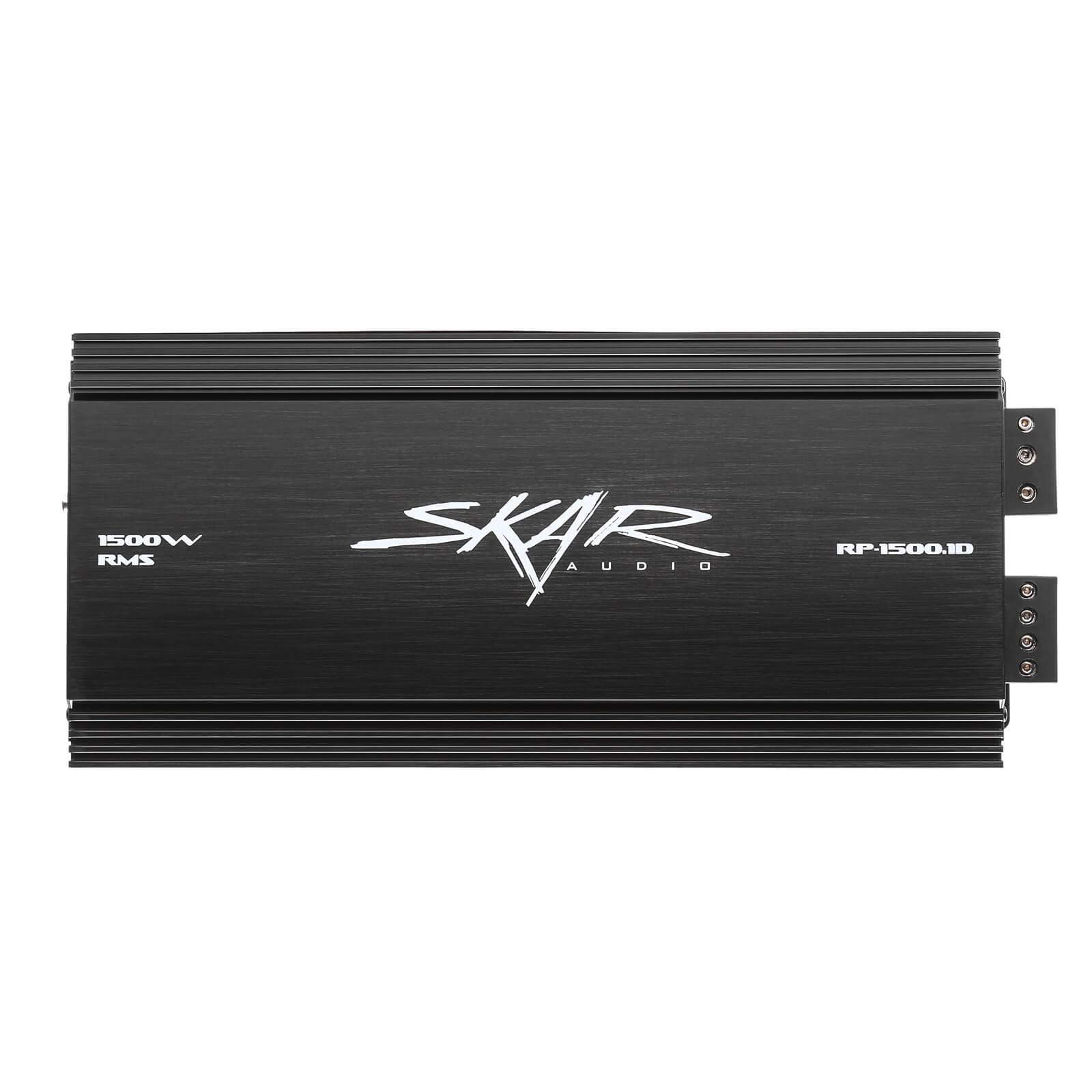
The RP-1500.1D sits between the compact RP-800 and the bigger bass amps here, and that middle ground is the point. It is rated at 1,500 watts RMS at 1 ohm, with a 1,900-watt peak, a 20Hz-250Hz response, and the same remote level control as the smaller Skar.

The 4-gauge power and ground terminals are a practical choice: they accept the wire most people already have and don't force a jump to 1/0. The amp is 19.5 inches long, so it needs a longer mounting run than the compact CT or RP-800. The bass EQ gives +6 or +12dB at 45Hz, which is enough to tailor a daily-driver sub.

We like the power-to-installation balance. It gives you a meaningful step up from 800 watts without the electrical demands of a 3,000-watt amp, and it stays with 4-gauge wiring. The catch is that 1,500 watts still wants a healthy electrical system, so plan for the Big 3 upgrade and a good battery if you push it.

The weak spot is long-term reliability. This is a value amp, and the durability story is not as clean as the best picks here. That doesn't make it a bad choice for a budget build, but it is a reason to buy from a seller with a clear warranty and to install it carefully.

Our judgement is that it is a strong value for a single big sub, as long as you accept the electrical work and the reliability risk. If you want the simplest install, the RP-800 is easier. If you want maximum power, the Smart 3 Bass is the next step.

Pros

  • 1,500W RMS at 1 ohm
  • 4-gauge power terminals
  • Remote level control included
  • Meaningful step up from 800W

Cons

  • Long-term reliability is the weak spot
  • Needs a healthy electrical system
Our verdict

For a single big sub on a budget, the RP-1500.1D delivers serious power without 1/0 wiring—just leave room for electrical upgrades.

Check Latest Price

Installs, Highway Miles, and Heat: How We Tested

We built the shortlist by pulling the amps that come up again and again in installer forums, car audio shop recommendations, and customer reviews, then filtering for the things that actually decide a purchase: believable RMS ratings, channel count that matches a real system, stable impedance, usable crossover filters, and a price that makes sense for what's in the box. That left 12 amps, spanning compact Class D monoblocks to full-size Class AB four-channels.

Each one went into a real vehicle — a daily-driven sedan, a hatchback, and a pickup — during weekend garage installs. We timed how long each took to mount and wire with one person, noted whether it fit under a seat or behind a trim panel, and checked how clearly the manual walked us through gain setting and wiring. Then the amps went to work on commutes, highway runs, and a couple of long road trips with the volume up.

On the road we listened for what specs don't tell you: alternator whine with the engine running and the stereo at zero volume, a thump at power-on, and hiss that points to a weak ground. For heat, we ran each amp hard for an hour and then checked the heatsink by hand. Remote bass knobs got mounted where a driver could reach them and adjusted mid-drive. Over the six months, durability showed up in small ways — power terminals that stayed tight, screws that didn't strip, amps that got swapped between vehicles without complaint — and we noted what shipped in the box, since missing hardware changes the real cost.

How to Choose a Car Amplifier

Start With Channels and the Job

A four-channel amp is the natural choice for four door speakers; bridge two channels and you can add a modest sub. A two-channel amp suits one pair of speakers or a bridged sub, while a monoblock is for subwoofers only. Count what you need to drive before you shop. The Pioneer GM-A6704 is the clearest four-channel example here, while the Skar RP-800.1D and CT-1000.1D show what a dedicated mono amp buys you. If you want one amp to do everything, a four-channel is more flexible than a two-channel, but it won't match a monoblock for sub output.

Read RMS Power, Not the Badge

Max power is a short-burst number; RMS is the one to match to your speakers and subs. A 1,000-watt max amp may make far less continuous power, and a 3,000-watt mono amp may need a 1-ohm load to hit its rating. Check the RMS figure at the impedance you will actually wire. The CT-1000.1D makes 1,000 watts at 1 ohm but 350 at 4 ohms; the Taramps Smart 3 Bass is rated for 0.5 to 2 ohms. Buy for your final load, not the biggest number on the box.

Plan for Heat and Electrical Demand

Class AB amps run warmer than Class D designs, and compact cases have less room to shed heat. Mount any amp with air around it, not in a closed panel. High-power amps also pull serious current: the Smart 3 Bass uses a 200A fuse and accepts up to 1/0 AWG wire, while the Skar RP-800.1D stays with 4-gauge. We prioritize a fuse at the battery, clean grounds, and wire sized to the amp's fuse rating. If you need a second battery or alternator upgrade, budget for it before you buy the sub.

Measure the Space and Check the Connections

Footprint matters more than a spec sheet suggests. The CT-1000.1D is 2.18 inches tall and easier to hide; the Skar RP-1500.1D is 19.5 inches long and needs a longer run. Factory-radio cars need high-level inputs or a line-output converter; the Taramps TS 1200x4 has high-level inputs and automatic turn-on. A remote bass knob is useful if you adjust sub level often, but it is not a substitute for setting gain correctly. Measure the mounting space before you choose.

Frequently Asked Questions

Final Verdict

The Pioneer GM-A6704 is our default because it handles the job most people actually have: four speakers, with the option to bridge two channels for a small sub. If bass is the whole point, choose the CT Sounds CT-1000.1D for a compact 1,000-watt sub amp, or the Taramps Smart 3 Bass when you have the electrical for 3,000 watts. Start with the speakers, then add bass power—not the other way around.