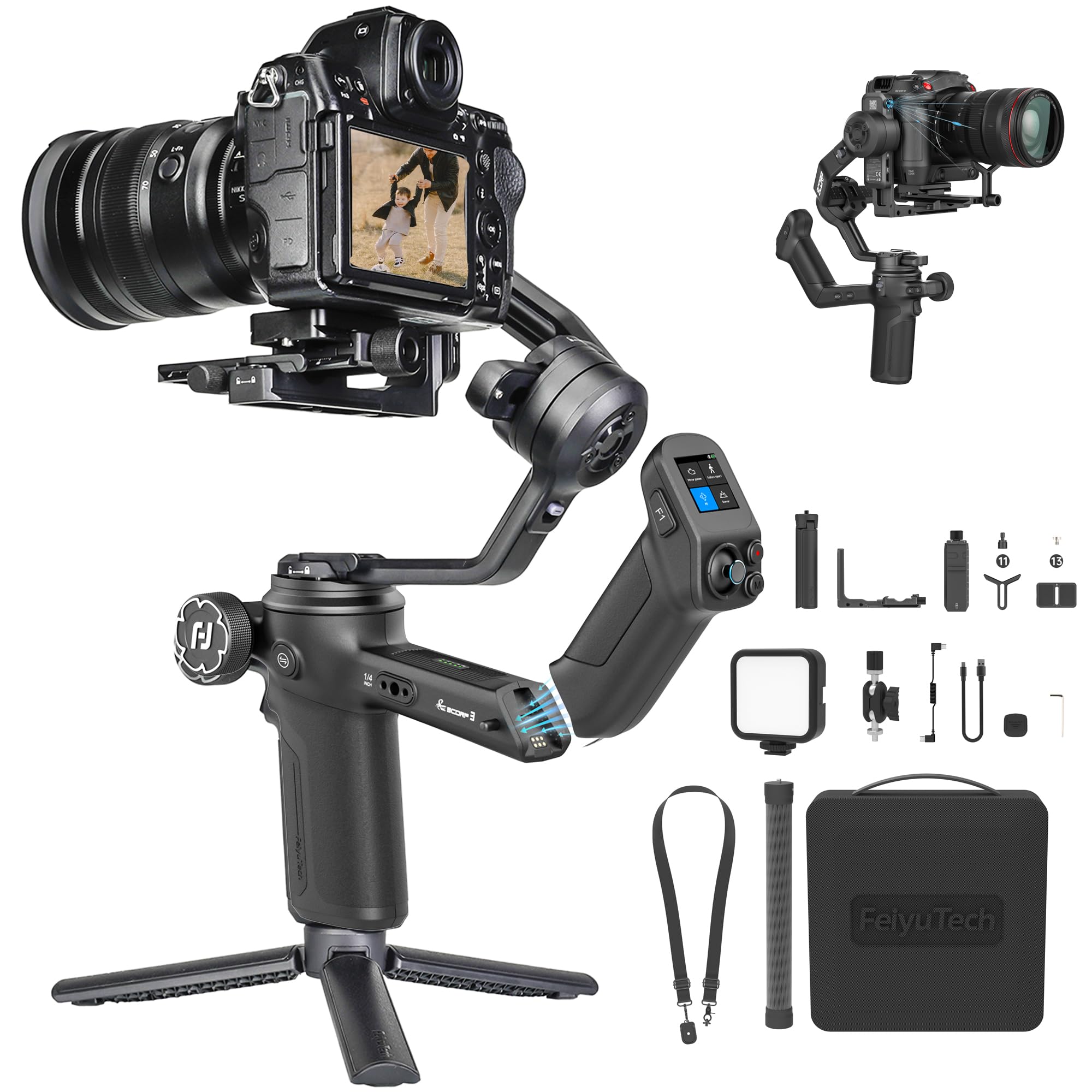
Best Camera Gimbals of 2026

A gimbal has one job: hold your camera steady while you move. Everything that separates a good one from a frustrating one happens before you press record — whether the arms balance without a fight, whether the motors hold a front-heavy lens, and whether switching to vertical means rebuilding your whole rig. My team and I spent six months carrying eight of them through weddings, hiking trails, and one very cramped kitchen, and the gap is wider than the spec sheets let on.

The newest models add subject tracking meant to follow a face or a moving car without a second operator, and it ranges from genuinely useful to a party trick. One thing I'd tell a first-time buyer: the payload figure on the box is optimistic. A rig that balances beautifully with a light prime can still sag once you mount a zoom.

You'll find stripped-down setups sized for a mirrorless body and heavier rigs built for a full-frame camera with a follow-focus motor. The ones that made the cut were judged on stability and smoothness first, everything else second.

1

Best Overall

DJI RS 4

89 /100
LBD Score Excellent

Key details

Folded Size
244.2 x 115.9 x 251.1 mm
Gimbal Weight
3.42 lb
Payload Capacity
3 kg (6.6 lbs)
Vertical Shooting
2nd-gen native vertical
View on Amazon

Three kilograms is where this one starts. That is the second-highest payload in this group behind the FeiyuTech SCORP 3's 3.5 kg, and it is enough headroom to balance a full-frame body with a fast standard zoom and still have room left for a cage. The tilt axis runs 8.5 mm longer than the previous generation, a figure that stops sounding like a rounding error the first time you hang a long lens on the plate and need the arm to travel.

Balancing is the part we kept coming back to. All three axis arms are Teflon-coated, and the difference shows the moment you slide a camera forward: the arm moves in small increments instead of sticking and then jumping, so you can find the balance point without overshooting it three times. The quick-release plate is Arca-Swiss and Manfrotto compatible, which means it drops onto most tripod heads without a plate swap in the middle of a scene change.

The controls are laid out for people who shoot rather than people who configure. The joystick switch flips between pan-follow, pan-tilt-follow and FPV, and FPV can be set to a 3D Roll 360 or a custom profile, so the modes you actually use sit one click apart. The 1.8-inch screen stays readable outdoors, the RSA port gives a follow-focus or a control handle somewhere to plug in, and the battery lives in a removable BG21 grip rather than sealed into the handle — the arrangement we prefer on a shoot that runs long.

Nothing here is free. At 1.55 kg the RS 4 is the heaviest gimbal in this group, and you feel it by the end of a day in a way you do not with the sub-1.1 kg bodies. The first balance with an unfamiliar lens is still a few minutes of sliding, not the instant setup that locks imply. Neither matters if you work out of a car or a case and want the payload headroom; both matter if the gimbal has to live in a day bag.

Pros

  • 3 kg of payload with room for a cage
  • Teflon-coated axis arms balance without sticking
  • Arca-Swiss and Manfrotto plate, no swap
  • Removable BG21 battery grip

Cons

  • Heaviest gimbal here at 1.55 kg
Our verdict

We recommend the RS 4 for anyone building a kit around a full-frame body and a real lens — 3 kg of payload, native vertical, and balancing that stays where you set it.

Check Latest Price
2

Best for Travel

DJI RS 4 Mini Combo

88 /100
LBD Score Excellent

Key details

Folded Size
9.29 x 2.52 x 12.44 in
Gimbal Weight
2.27 lb
Vertical Switch
About 10 seconds
Payload Capacity
2 kg (4.4 lbs)
View on Amazon

The auto axis locks are the first thing you notice, because they release on their own when the gimbal wakes. There is no hunting for three latches with a camera in one hand, and stowing it is the reverse: the arms clamp themselves for the walk to the next setup.

The arithmetic is what sold us. A 1.03 kg gimbal carrying up to 2 kg of camera, folded into 9.29 x 2.52 x 12.44 inches, is a stabilizer you drop in a shoulder bag next to a mirrorless body and two primes rather than a case you schedule around. The combo adds the RS Intelligent Tracking Module and a briefcase handle, and the 1.4-inch screen is big enough to change settings without squinting.

Switching to vertical takes about ten seconds, and it is the plate that moves rather than the camera — the difference between shooting a vertical cut and meaning to shoot one later. The tracking module holds a subject through an orbit and does the solo-filming job well, though it can lose the thread when a face turns away or someone crosses between you and the subject.

Two kilos is the honest limit. A full-frame body with a fast zoom sits at or past it, and that is the point where the RS 4 takes over. Below that line, the detail we kept appreciating was the briefcase handle: it turns low-angle walking shots into something your wrist survives.

Pros

  • Axis locks release and clamp themselves
  • 1.03 kg body folds into a shoulder bag
  • Tracking module and briefcase handle included
  • Vertical switch in about ten seconds

Cons

  • 2 kg ceiling rules out a full-frame body with a fast zoom
  • Tracking can lose a subject that turns away
Our verdict

For travel and solo shoots this is the gimbal we reach for: axes that lock themselves, a body just over a kilogram, and a tracking module in the box.

Check Latest Price
3

Best Payload for the Weight

ZHIYUN Weebill 3E

84 /100
LBD Score Excellent

Key details

Folded Size
12 x 8 x 2.8 in
Gimbal Weight
2.18 lb
Payload Capacity
3 kg (6.6 lbs)
Included Control Cable
Panasonic LN-UCUC-A02
View on Amazon

Read the box contents before you order. The Weebill 3E ships with one camera control cable, the Panasonic LN-UCUC-A02, so Canon, Sony, Nikon and Fujifilm shooters need to buy the matching cable at the same time or the record button on the handle does nothing.

What you get in exchange is the best payload-to-weight ratio in this group. The gimbal is 990 g and rated for 3 kg — the same ceiling as the DJI RS 4, which weighs 1.55 kg — and it packs down to 12 x 8 x 2.8 inches, about the footprint of a sheet of A4 paper. Native vertical shooting is a matter of moving the quick-release plate to the vertical arm with no extra bracket, and Bluetooth shutter control is supported for the bodies that handle it.

The sling mode is the design detail we appreciated most. A telescopic grip and a wrist rest let the gimbal hang in a sling carry with the weight braced against your forearm instead of pulling on your wrist, which is what makes a long handheld take tolerable. It is a small piece of shaping that does more for a shooting day than another page of menu options.

Where the money went is the motors, not the finish. Three kilos of payload on a sub-kilogram gimbal is the entire argument, and it holds up for anyone whose camera lives on a stabilizer with a real lens attached. Budget for the cable and this is the least expensive way here to carry a heavy rig.

Pros

  • 3 kg payload in a 990 g body
  • Sling mode braces the load on your forearm
  • Native vertical without an extra bracket

Cons

  • Control cable for other brands sold separately
Our verdict

Buy this one if payload matters more than polish — 3 kg of carrying capacity in the lightest full-size body here, once you add the right control cable.

Check Latest Price
4

Best Budget

FeiyuTech SCORP 2

83 /100
LBD Score Excellent

Key details

Touchscreen
1.3 in
Gimbal Weight
2.36 lb
Payload Capacity
5.51 lb
Subject Tracking
Built-in AI sensor
View on Amazon

Tracking usually arrives as an add-on — a module you clip on, a phone clamped to the handle, an app open in your other hand. The SCORP 2 puts the sensor in the body and answers to gestures, so following a subject doesn't require a second device.

It is the least expensive gimbal here, and it does not feel like the cheap one. You get 2.5 kg of payload, a 1.3-inch touchscreen that shows shooting status and settings, a multifunction knob for focus and parameter changes, and seven camera control cables in the box rather than one. For a mirrorless body with a compact zoom, that covers everything a first gimbal needs to do.

Handling is where it beats its price. The knob falls under a thumb without leaving the grip, the screen is legible in daylight, and the stabilization held up on walking shots, which is where an inexpensive gimbal usually shows its cost. We also liked that the payload is honest: 2.5 kg covered our test rig with a lens mounted and never left the motors hunting.

Two things to know before you commit. The 2.5 kg ceiling sits below the 3 kg bodies, so a full-frame camera with a fast telephoto is out of reach. And the deeper settings live in the Feiyu SCORP app rather than the body, which is fine at a desk and less fine on a rooftop. Neither is a problem for the kit this gimbal is built for.

Pros

  • AI tracking built into the body
  • 1.3-inch touchscreen and thumb-friendly knob
  • Seven control cables included
  • Lowest price here with tracking included

Cons

  • 2.5 kg ceiling below the 3 kg bodies
  • Deeper settings only in the app
Our verdict

Our pick for a first gimbal or a tight budget: tracking built into the body, a clear touchscreen, and steady footage for less than the DJI bodies.

Check Latest Price
5

Heavy Rigs

FeiyuTech SCORP 3 KIT

82 /100
LBD Score Excellent

Key details

Kit Includes
Carrying case, extension pole, shoulder strap
Remote Range
39 ft
Gimbal Weight
2.2 lb
Payload Capacity
3.5 kg (7.72 lbs)
View on Amazon

The detachable handle is why we kept picking this one up. It lifts off the gimbal and works as a wireless remote with a 39-foot range, so you can set the rig on a tripod or a slider, walk into frame, and adjust the framing from where you are standing — the difference between needing a second person and not.

Under the trick handle is the largest payload in this group: 3.5 kg on extended axis arms, with a quick-release plate and a repositionable mount that take a bigger body-and-lens combination than the 3 kg gimbals. The vertical switch rotates the camera and slider together as a unit — about a second, no tools — and the body itself weighs 1 kg. AI tracking is built in rather than sold as a module.

The kit is what makes it a working package: a carrying case, a carbon fiber extension pole and a weight-reducing shoulder strap. The strap earns its place on a long handheld day, and the pole gets the camera above a crowd without dragging a monopod along. We noticed both most when the alternative was holding a loaded rig at eye level.

This is the newest gimbal of the five and has the shortest field record behind it, so buy it for what you can verify — the payload, the remote handle, the kit — rather than for a reputation it hasn't built yet. If your rig stays under 3 kg, the RS 4 is the safer version of the same idea.

Pros

  • 3.5 kg payload, the most here
  • Detachable handle doubles as a 39-foot remote
  • Kit adds case, pole and shoulder strap

Cons

  • Bulkier to pack than the compact picks
Our verdict

Worth it if your rig passes 3 kg or you shoot alone and want the handle to work as a remote; otherwise the RS 4 is the safer buy.

Check Latest Price

How We Chose and Tested These Camera Gimbals

We started with spec sheets — published payload, the camera bodies each maker lists as compatible, and whether the arms lock down for transport — and cut the field to eight. Anything whose payload couldn't plausibly carry a mirrorless body with a mid-size zoom was out, and so were models whose companion app hadn't been updated in over a year, since that's usually where tracking and firmware fixes live.

Each gimbal was balanced from scratch with a mirrorless body and a 24–70mm lens, stopwatch running. We counted how many arm adjustments it took, whether the axis locks held while we mounted the camera, and whether the index markings made the process repeatable when we swapped to a 50mm prime. Then we handed it to a colleague who had never used a gimbal and timed her from bag to first stable shot.

For stability we walked the same hallway, stairwell, and gravel path at 35mm, then watched the footage for jitter at the edge of frame, footstep bob, and whether a slow pan came out smooth or stepped. For tracking, a subject walked behind a pillar and across the frame while we noted how fast the gimbal reacquired and whether it drifted off-center. Bluetooth shutter control and cable connections were checked against bodies from four different mounts.

We ran every gimbal until its motors shut off on a full charge, timing runtime and noting whether it would charge over USB-C while shooting. At the end of six months we checked each one for arm play, motor whine, and horizon drift, and counted what came in the box — briefcase handle, mini tripod, case, follow-focus support — against what it cost. The ones that held up are the ones below.

How to Choose a Camera Gimbal

Match the Payload to Your Heaviest Lens

Add up the camera body, the lens, the quick-release plate and anything else that rides along, then look for a rating above that total rather than level with it. The spread in this group runs from 2 kg on the DJI RS 4 Mini to 3.5 kg on the FeiyuTech SCORP 3, and the step from 2 kg to 3 kg is the one that decides whether a full-frame body with a fast zoom is usable at all.

A zoom that extends as you shoot also shifts the balance as you shoot, which is why arm travel matters as much as the headline number. The RS 4's tilt axis is 8.5 mm longer than the previous generation for exactly this reason.

The Gimbal's Own Weight Decides How Often You Use It

Every gimbal here stabilizes well; the difference is whether it goes with you. The compact bodies run between 990 g and 1.07 kg, while the DJI RS 4 is 1.55 kg before a camera touches it. That half-kilo buys payload headroom, and it is worth paying if you drive to locations and work out of a case.

If you shoot on foot, in cities, or on trips, weigh the carrying decision as heavily as the capacity one. Folded size tells the rest of the story: the RS 4 Mini packs to 9.29 x 2.52 x 12.44 inches, small enough to live in a shoulder bag beside a body and two primes.

Setup Speed Is a Feature, and the Marketing Oversells It

The locks, Teflon-coated arms and fine-tuning knobs on the newer gimbals genuinely shorten a repeat setup. The DJI RS 4 Mini releases its axes on power-up, and the FeiyuTech SCORP 3 rotates into vertical without tools.

What none of them do is balance an unfamiliar lens instantly. Slide the plate until the camera holds still with the motors off, then note the arm positions. The second setup with that lens takes seconds; the first one never does, whatever the listing promises.

Vertical Video and Tracking: Decide What Lives in the Body

If you cut vertical for social, native vertical shooting earns its keep: the DJI bodies, the Weebill 3E and both FeiyuTech models switch without an extra bracket, and the RS 4 Mini and SCORP 3 are the quickest about it.

Tracking is a separate decision. The SCORP 2 and SCORP 3 have sensors built into the body, the RS 4 Mini Combo bundles DJI's tracking module, and the RS 4 keeps its accessories on the RSA port instead. Pay for tracking only if you film yourself or work alone.

Check the Cable and the App Before Anything Else

A gimbal can balance perfectly and still not start or stop recording from the handle. Camera control is brand- and model-specific, and the box contents vary widely: the FeiyuTech SCORP 2 includes seven control cables, the DJI bodies include a USB-C multi-camera cable, and the ZHIYUN Weebill 3E includes only the Panasonic cable.

Look your camera up on the maker's compatibility list before ordering, then check whether the app is needed for activation or firmware. Ten minutes of that saves an hour of troubleshooting on the first shoot.

Frequently Asked Questions

Final Verdict

The DJI RS 4 is the gimbal we recommend to most people: 3 kg of payload, native vertical shooting, Teflon arms that make balancing predictable, and the most solid build in this group. It is the one that carries a full-frame body and a fast zoom without argument, and it is why the other picks are variations on a theme rather than replacements.

If the gimbal will travel in a day bag, take the RS 4 Mini Combo instead — you trade a kilogram of capacity for a body you'll actually carry. On a tight budget, the SCORP 2 gets you built-in tracking and steady footage for the least money here. Choose on your heaviest lens first; everything else is preference.