Best Camera Flashes of 2026

A flash is the cheapest upgrade in photography and the easiest one to get wrong. Aim one straight at someone's face and you get the hard shadow and raccoon eyes that convince a lot of people to just crank the ISO instead. What fixes that is control: a head you can tilt and swivel, output you can dial down, and the ability to fire the thing off-camera without dragging a bag of cables along.

My team and I have spent the past eight months with 12 speedlights, from bare-bones manual units to brand-dedicated TTL guns, and they all got used the same way: weddings, family dinners, and a lot of product photos in a dim spare room. Guide number is the figure shoppers fixate on, but what actually separates these lights is whether the shoe talks to your camera, how long a full-power recycle takes, and whether the head still holds its angle after the twentieth tilt. What follows is what I'd hand to a friend, sorted by who each one is really for.

1

Best Overall

Godox TT600

92 /100
LBD Score Outstanding

Key details

Wireless
Built-in 2.4G, 100 m
Guide Number
GN60 (m, ISO 100)
Power Source
4 AA batteries
Exposure Control
Manual, S1/S2 slave
View on Amazon

Guide number 60 at ISO 100 is the headline, and it decides most of what this flash can do: enough light to bounce off a high ceiling, enough to reach a group at the far end of a room. What makes that output matter is where it sits — on a plain single-contact hot shoe that does not care whether the body underneath says Canon, Nikon, Sony, Fuji or Pentax. That combination is why it is our top pick, and why it is the flash we point people to when they have not committed to a system, or when they shoot two.

The wireless is what turns it from a starter flash into a keeper. Godox builds its 2.4G X receiver into the unit, so a compatible transmitter on the camera is all you need to move the TT600 onto a stand, with a claimed range of 100 meters. There are S1 and S2 optical slave modes as well, so another flash can trip it in a pinch, which is useful when you are adding a third light to a kit you already own.

Recycle time lands between 0.1 and 2.6 seconds, and Godox quotes roughly 230 full-power pops from four AAs — a realistic night's work rather than a spec-sheet flourish. What you give up is automatic metering, so you pick a power level and adjust as the light changes. For portraits at a set distance or a multi-light setup, that steadiness is an advantage: every frame gets identical output. At a reception where the light keeps moving, it is work.

Pros

  • GN60 output at ISO 100
  • Built-in 2.4G X receiver, 100 m range
  • 0.1–2.6 sec recycle, about 230 full-power flashes
  • Fires on any standard hot shoe

Cons

  • No TTL, so power is set by hand
  • No battery level indicator
Our verdict

We recommend the TT600 first to anyone building a lighting kit on any camera: full-size output, wireless built in, and no mount to outgrow.

Check Latest Price
2

Best for Sony

Godox V100 S

90 /100
LBD Score Outstanding

Key details

Output
100Ws
Weight
1.51 lb
Exposure Control
TTL and manual
Full-power Burst
70 consecutive flashes
View on Amazon

Godox rates the V100 S at 100Ws and 70 full-power consecutive flashes, and it is the second number that tells you who it is for. A wedding, a conference, a party where the flash fires near full power for hours is exactly the workload that makes smaller units stall and cool down; this one is built to keep firing.

On a Sony body it behaves like part of the camera: TTL metering, high-speed sync and second-curtain sync, all driven from a 2.3-inch touchscreen that is quicker to work than a button grid in a dark room. The lithium-ion pack charges over USB-C, which we count as the most useful thing on this flash after the output — one cable in a hotel room and you are set for the next day. Sony's global-shutter bodies get specific treatment too: on an A9 III the flash wants high-speed sync in TTL, which is worth knowing before you assume it drops straight in.

Firmware first. Godox asks you to update the flash before the first shoot, and skipping that step is how a new unit gets blamed for a problem it does not have. After that it is straightforward: power and mode are a tap away, and you can change output without taking your eye off the subject.

Pros

  • 100Ws with 70 consecutive full-power flashes
  • TTL and high-speed sync on Sony bodies
  • 2.3-inch touchscreen control
  • USB-C charging lithium-ion pack

Cons

  • 685 g on the hot shoe
  • No weather sealing
Our verdict

For Sony shooters who need full power frame after frame, the V100 S is the flash we recommend: TTL, high-speed sync and a battery that outlasts the reception.

Check Latest Price
3

Best Canon Native

Canon Speedlite EL-10

86 /100
LBD Score Excellent

Key details

Mount
Canon multi-function shoe
Power Source
4 AA batteries
Head Movement
90° up, 150°/180° swivel
Exposure Control
TTL and manual
View on Amazon

If you shoot a Canon R body, the EL-10 is the least complicated way into flash. It mounts on the multi-function shoe, the camera recognises it, and TTL metering simply happens — which is the entire argument for a first-party unit over a universal manual one.

The head does more than most. It pulls back to 90 degrees for a ceiling bounce and swivels 150 degrees to the left and 180 to the right, so you can throw light at a wall behind your own shoulder without moving your feet. Canon builds in control for up to 15 additional Speedlite units, which quietly turns one flash into the start of a system, and it runs on four AAs.

We rate it the best native option here for Canon mirrorless, and the reason is boring in the best way: it works with the camera every time, with no adapter and no compatibility chart to interpret. Compare it with the manual picks and you are paying for that disappearance — the TT600 gives you more raw output and makes you do the thinking. For a first flash on an R body, the thinking is the part worth handing over.

Pros

  • Native TTL metering on EOS R bodies
  • Head swivels 150° left and 180° right
  • Controls up to 15 additional Speedlites
  • Simple setup with no adapter

Cons

  • Canon R bodies with the multi-function shoe only
  • Four AA batteries, no rechargeable pack
Our verdict

Canon R shooters who want the camera to handle the metering should start here; it is the least fiddly flash in this group and it grows into a multi-light setup.

Check Latest Price
4

Best for Nikon

Nikon SB-700

92 /100
LBD Score Outstanding

Key details

Weight
12.7 oz
Guide Number
92/28 (m/ft, ISO 100, STANDARD)
Power Source
4 AA batteries
Exposure Control
i-TTL and manual
View on Amazon

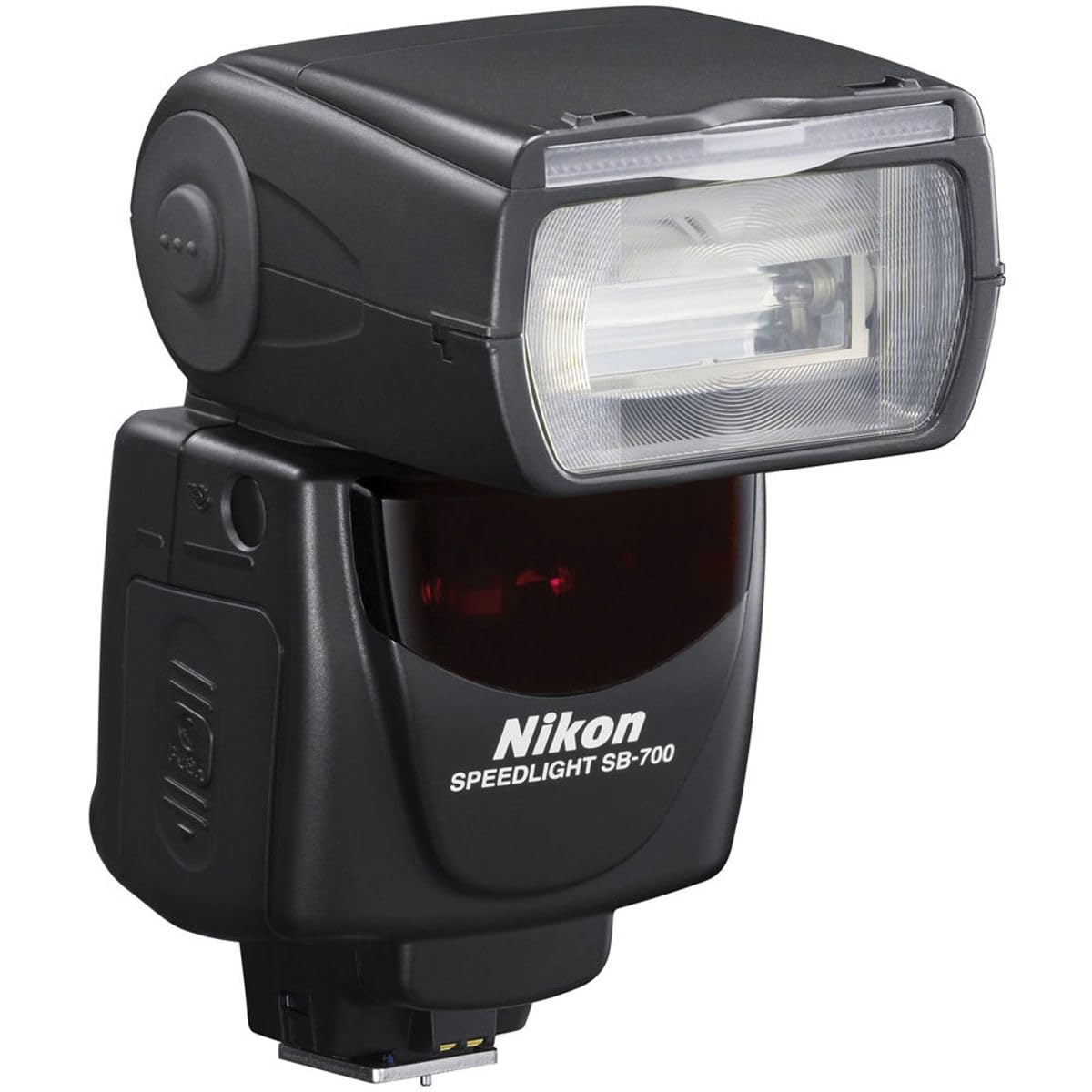
Set the SB-700 beside the manual flashes here and the difference is what happens between shots: it meters through the lens, balances fill against the ambient, and adjusts as your subject moves from a window to a wall. That is why it is our Nikon pick, and why a photographer covering an event will pay for it over a cheaper manual unit.

The head is the other half of the argument. Nikon gives it full positioning freedom, so it bounces off a ceiling, a side wall or over your shoulder without a bracket, and the whole unit weighs 12.7 ounces — light enough that a long handheld evening does not turn into a wrist exercise. Four AAs run it, and wireless control lets it command or join a multi-flash setup with other Nikon units.

Output is the compromise. At a guide number of 28 meters (92 feet) at ISO 100 it puts out noticeably less light than the Godox TT600, which matters when you are bouncing into a high ceiling across a big room. In a living room, or a portrait at a few feet, you will not notice. The menus, meanwhile, are among the friendliest here, with a slider for the beam pattern that you can find by touch.

Pros

  • i-TTL metering that handles mixed light
  • Full head tilt and swivel for bounce
  • Wireless control of other Nikon flashes
  • Light at 12.7 ounces

Cons

  • Battery door can crack and cut power
Our verdict

For Nikon shooters who want the camera to meter each frame, the SB-700 is the flash we recommend — accurate, light on the shoe, and quick to change mid-shoot.

Check Latest Price
5

Best Budget

Neewer TT560

89 /100
LBD Score Excellent

Key details

Wireless
Optical pulse
Guide Number
GN38 (ISO 100)
Power Source
4 AA batteries
Exposure Control
Manual, 1/128–1/1
View on Amazon

The TT560 makes sense in multiples. One is a serviceable manual flash; two or three are a lighting kit, and that is the calculation it is built for — the unit you can put behind a subject as a rim light without wincing at the idea of buying another.

The numbers are ordinary and honest: guide number 38 at ISO 100, eight manual power levels from 1/128 to full, a 5600K color temperature that stays close to daylight, and a recycle time of 0.1 to 5 seconds. It runs on four AAs and has optical slave triggering, so it fires when it sees another flash go off. Set the camera to 1/200 sec or slower — faster shutter speeds leave a black band across the frame, and that is a design limit rather than a fault in your copy.

We recommend it as the inexpensive way into multi-light work, on one condition: put it on your own camera in the first week and shoot a hundred frames. Compatibility with Canon bodies in particular is uneven, and a unit that works all night or not at all is much easier to judge while the return window is still open.

Pros

  • GN38 with eight manual power levels
  • Optical slave triggering for multi-flash setups
  • Fires on a standard single-contact shoe
  • The least expensive way here to own several flashes

Cons

  • Can miss the occasional frame
Our verdict

If you want several lights rather than one good one, this is our budget pick — just test it on your body while you can still swap it.

Check Latest Price
6

Best Mini

Ulanzi SL03

85 /100
LBD Score Excellent

Key details

Weight
1.52 oz
Charging
USB-C
Guide Number
GN8
Color Temperature
6500K, CRI 97
View on Amazon

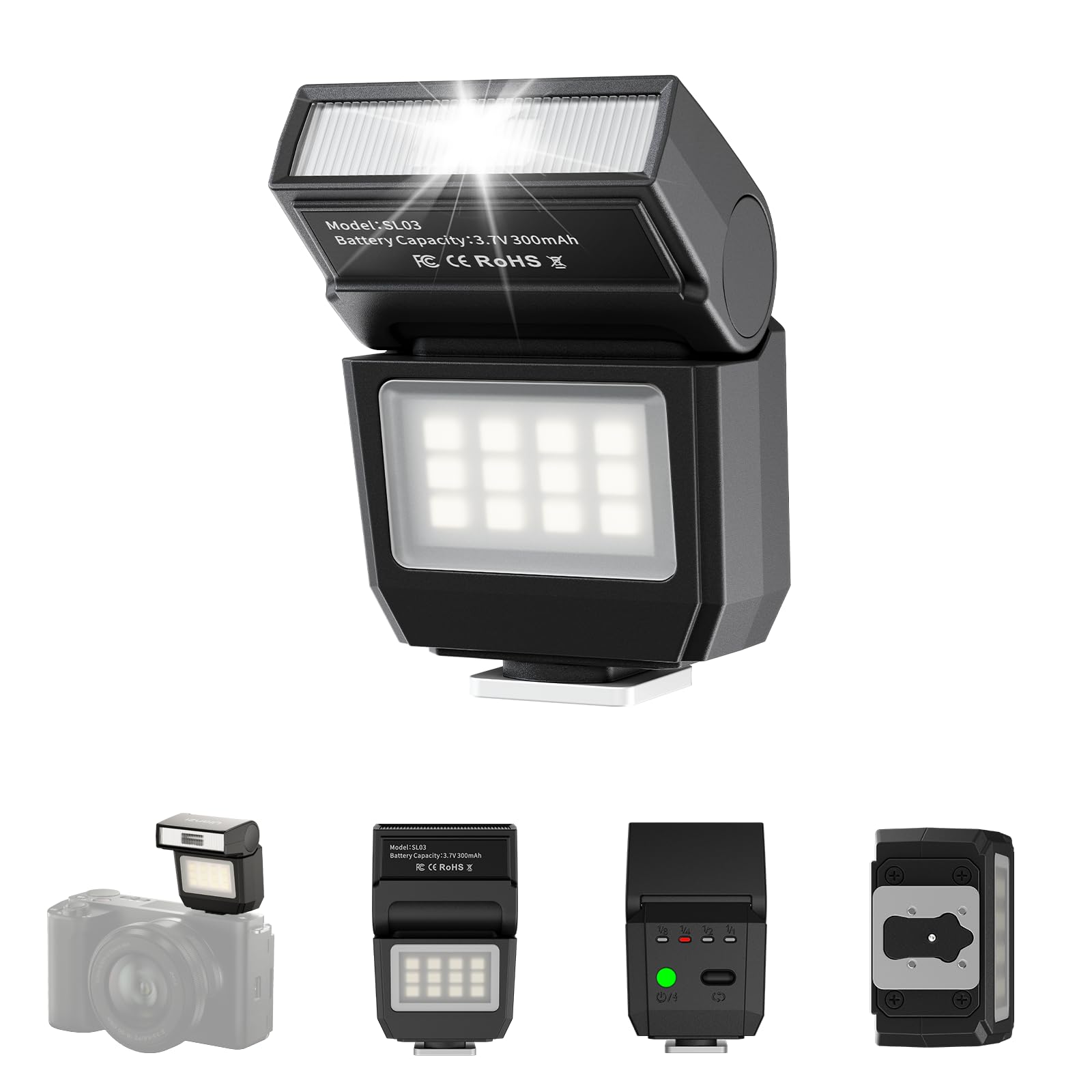
At 43 grams the SL03 is barely there on the shoe, and it is small enough to live in a jacket pocket without a second thought. It slides onto a single-contact hot shoe, tilts through 90 degrees, and charges over USB-C, so there is no pack of AAs to remember before you leave the house.

The output is GN8 at 6500K with a CRI of 97, which makes it a color-accurate, slightly cool light — flattering for close portraits and product shots, less so mixed with warm indoor bulbs. There is no TTL and no automatic mode. You choose a power level, fire, and look at the frame, which for a fill light at arm's length is a fair trade rather than a hardship.

Compatibility is where this one needs care. Ulanzi publishes an unusually specific list, and the exclusions matter more than the inclusions: the Sony ZV-1F and A9 III, the Canon R50 and 200D II, and Fuji's X-A3, X100F and X100T will not work with it. Fuji shooters who are covered have one more step — the camera's flash sync setting has to be switched to M before the SL03 will fire. We appreciate that Ulanzi prints all of this plainly instead of leaving it to the return department.

For a dim restaurant, a friend's gig or a walk where you want a little fill and nothing more, this is the flash that earns its place in a pocket. Just do not ask it to light a room: GN8 at f/4 is roughly two meters of usable reach, and the light falls away fast beyond that.

Pros

  • 43 g and small enough for a pocket
  • CRI 97 at 6500K
  • USB-C charging
  • Head tilts 90 degrees

Cons

  • GN8 output only covers a few meters
  • Charge does not last a long shoot
Our verdict

For a flash you will actually carry every day, this is our pick — keep your subjects close and your expectations about output modest.

Check Latest Price
7

First-Timer Kits

Photoolex FK300

89 /100
LBD Score Excellent

Key details

Mount
Universal single-contact shoe
Guide Number
GN33
Exposure Control
Manual, S1/S2
Color Temperature
5600K ±200K
View on Amazon

A flash that ships with twelve color filters, a stand and a pouch is telling you what it expects you to do with it: experiment. The FK300 is a starter kit rather than just a starter flash, and the extras are the sort of thing you would otherwise mean to buy separately and never get around to.

Underneath it is a conventional manual unit: guide number 33 at ISO 100, eight power levels from 1/128 to full, a 5600K color temperature held to within 200K, and three modes — manual, plus S1 and S2 optical slave triggering for off-camera work. The hot shoe is metal, which not every flash at this level bothers with, and it will sit on Canon, Nikon, Sony, Fuji, Olympus or Pentax without an adapter.

The slave modes are the genuinely useful part. S1 fires the moment it sees another flash; S2 ignores a metering pre-flash and fires on the main burst, which is exactly what you need when the flash on your camera is doing TTL and the FK300 is your second light. That one setting is the difference between a budget second light working and refusing to cooperate.

For a first off-camera light, we think the bundle is the point: filters to play with, a stand to put it on, and a warranty that runs longer than most here. You will do all the exposure thinking yourself, and the flash is a chunky thing to hang on a small mirrorless body, but neither of those surprises anyone buying into manual lighting.

Pros

  • Twelve color filters, stand and pouch included
  • GN33 with eight power levels
  • S1 and S2 optical slave modes
  • Metal hot-shoe mount

Cons

  • Bulky and heavy for its output
  • Manual only, with no TTL
Our verdict

A starter kit rather than a single flash, the FK300 suits beginners who want filters and a stand in the box and do not mind setting exposure by hand.

Check Latest Price
8

Close-Range Fill

Neewer Z160 SE

87 /100
LBD Score Excellent

Key details

Output
20Ws, GN15
Recycle Time
2.8 sec
Exposure Control
Manual, 1/1–1/128
Color Temperature
6000K ±200K
View on Amazon

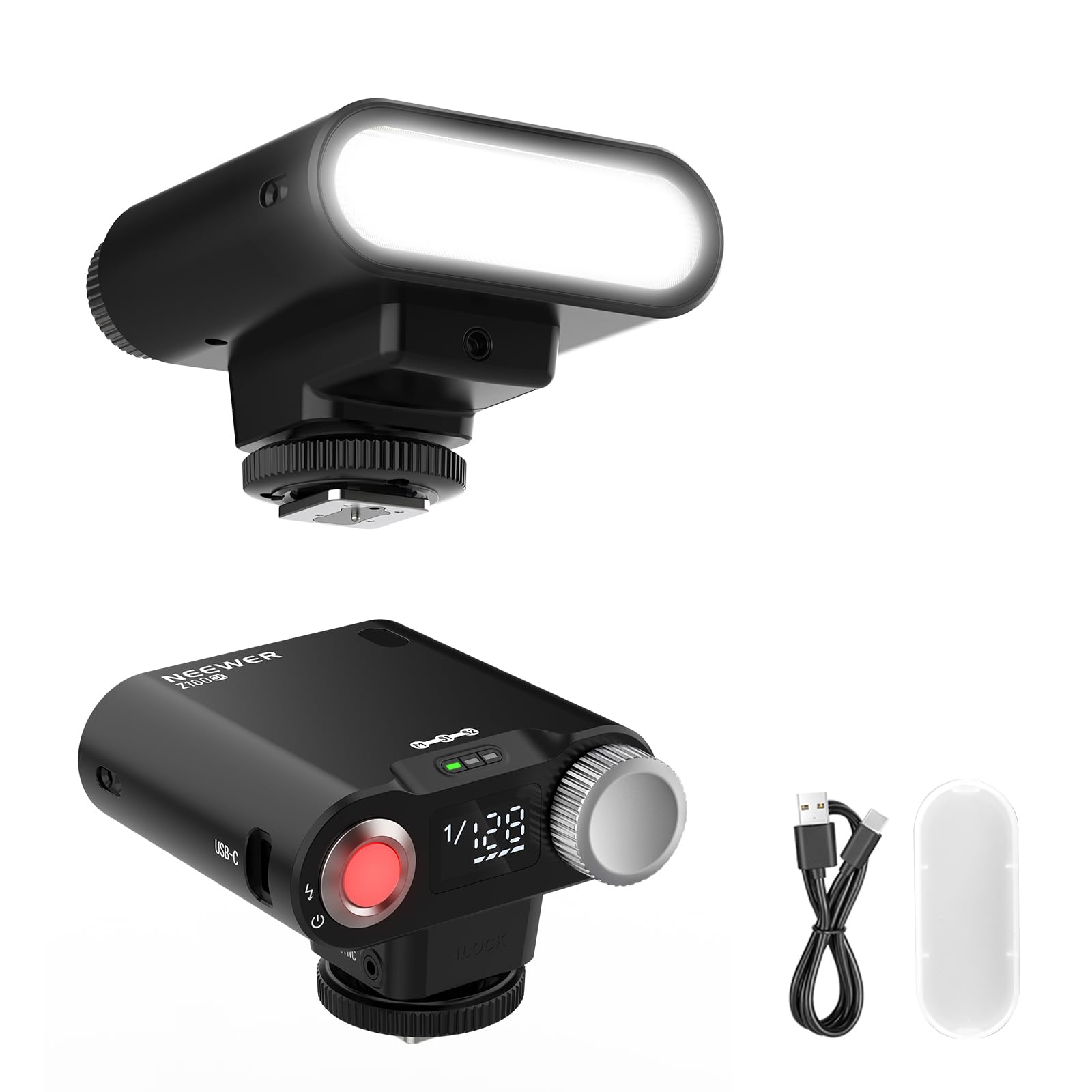
Two things set the Z160 SE apart from the other small flashes here: a rotary power dial on the side and a display that reads like a piece of vintage gear. The dial is not only styling — it steps you from full power down to 1/128 in visible clicks, so you can change output between frames without opening a menu.

Output is 20Ws at GN15 and 6000K, with fixed 35mm coverage and a 2.8-second recycle from its 1200mAh battery. We think that is the right specification for what this is: a small light for a portrait in a dim room, a product shot, or the bit of fill that separates a usable frame from a noisy one. It will not light a group, and it is not trying to.

Like every single-contact flash here it is manual only, so shutter speed stays at or below your camera's sync limit and there is no high-speed sync to lean on outdoors. Fuji shooters have one extra step: on bodies with both electronic and mechanical shutters, this flash only works in mechanical mode. Neither catches anyone who reads the manual first.

Pros

  • Rotary power dial with a clear display
  • 20Ws from a palm-sized body
  • Manual range from 1/1 to 1/128
  • Rechargeable 1200mAh battery

Cons

  • Fixed 35mm coverage with no zoom
Our verdict

If you want a small, dial-controlled light for close work and you are happy setting power yourself, the Z160 SE is an easy one to say yes to.

Check Latest Price

How We Tested a Dozen Speedlights

We started by pulling every speedlight a hobbyist or a working shooter might realistically buy, then narrowed by two things: the mount, since a universal single-contact shoe fires on nearly any camera while a dedicated one only speaks to its own brand, and whether the flash offered TTL, built-in wireless triggering, or neither. That left 12 units, from manual-only to brand-dedicated, and we bought them at retail. Testing ran eight months.

Each flash lived on camera bodies from at least two brands and got used the way I'd use one: bounced off a white living-room ceiling at a family dinner, fired as fill in a backyard at dusk, hauled through an evening reception, and set on a stand in a dim spare room for tabletop shots. We mounted every unit on Canon, Nikon, Sony, and Fujifilm bodies to see which ones fired the moment they hit a single-contact shoe and which needed a dedicated mount to do anything past full power.

Then we ran the unglamorous checks. We fired 200 full-power pops back to back, timed the recycle with a stopwatch, and counted how many shots each set of batteries gave before the wait stretched past a couple of seconds. At each power setting we shot the same subject at two feet and from across the room, which is where the brightest flashes separated from the merely bright. We tilted and swiveled every head twenty times to see whether it sagged, timed how long it took to drop from full output to 1/16 without opening the manual, and weighed each unit before carrying it on-camera for a two-hour stretch. Two arrived dead or misfiring out of the box, which we logged as a mark against reliability.

How to Choose a Camera Flash

Decide Between TTL and Manual First

TTL means the flash reads the scene through the lens and cuts itself off when the exposure is right; manual means you choose a power level and every frame gets the same output. If your subjects move between a dim hallway and a bright room, TTL earns its keep, which is why the Canon EL-10 and the Nikon SB-700 are built around it.

If you work at set distances, or you are assembling several lights on a budget, manual is steadier and cheaper. The Godox TT600 is the best example here: one output setting holds all evening, which is exactly why lighting kits get built from manual units.

Match the Shoe, Not Just the Brand

A flash that lists Canon, Nikon, Sony, Fuji and Olympus in the same breath is usually a single-contact manual unit: it will fire on all of them, but it will not meter, and your camera's flash menu will not see it. Brand TTL flashes are mount-specific and sometimes body-specific, so confirm your exact model appears on the maker's list.

Watch the newer shoes too. The Canon EL-10 needs a body with the multi-function connector, and Canon's R50 needs an adapter before a traditional hot-shoe flash will talk to it. Check the reverse as well: the Ulanzi SL03 publishes cameras it explicitly does not support, including the Sony ZV-1F.

Read the Guide Number as Reach

Guide numbers are quoted at ISO 100 and, on a zoom flash, at the longest setting, so a GN60 unit set wide is giving you less than the sticker suggests. The arithmetic is worth carrying around: guide number divided by aperture gives distance in meters at full power. A GN8 flash at f/4 reaches about two meters; the TT600 at GN60 reaches fifteen.

Bouncing off a ceiling or a wall costs another stop or two on top of that, so buy more output than the room you are shooting in seems to need.

Weigh Recycle Time, Batteries and Bulk

Recycle time is how long the flash takes to be ready again: 0.1 to 2.6 seconds on the TT600, up to five seconds on the Neewer TT560, and at an event that is the difference between shooting and waiting. Lithium-ion packs hold their output better over a long day, while AAs are easy to replace anywhere but fade as they drain.

Then there is what hangs off your camera. The V100 S weighs 685 grams, the Ulanzi 43, and a long handheld evening feels very different with each.

Frequently Asked Questions

Final Verdict

The Godox TT600 is the flash we tell most people to buy first. It fits any standard hot shoe, puts out GN60 of light, and carries its own wireless for the day it moves off the camera; in exchange you meter by hand, which is a fair trade for the reach and the flexibility.

Canon R shooters who want the camera to do the work should take the EL-10, Nikon users get i-TTL from the SB-700, and Sony shooters who need full power all evening should look at the V100 S.