Best Bluetooth Receivers for Stereo of 2026

A Bluetooth receiver is a small box with a big job: it catches the audio from your phone and hands it to the amplifier, speakers, or old stereo you already own. What separates a good one from a frustrating one rarely shows up in the first ten minutes of listening. It shows up a week later — a dropout every time you walk into the kitchen, a faint hiss underneath quiet passages, a box that has to be unplugged and replugged whenever you switch the amp on.

I've had one taped to the back of a vintage receiver for years, and the gap between a cheap adapter that works and one that doesn't is almost never the price. Over four months, we tested 15 of them, pairing each with an old stereo, powered bookshelf speakers, and a rotating cast of phones and laptops, then walking room to room to see where the signal dropped. The Bluetooth version printed on the box mattered far less than which codecs your phone and the adapter both speak, so that's how we sorted the winners below.

1

Best Overall

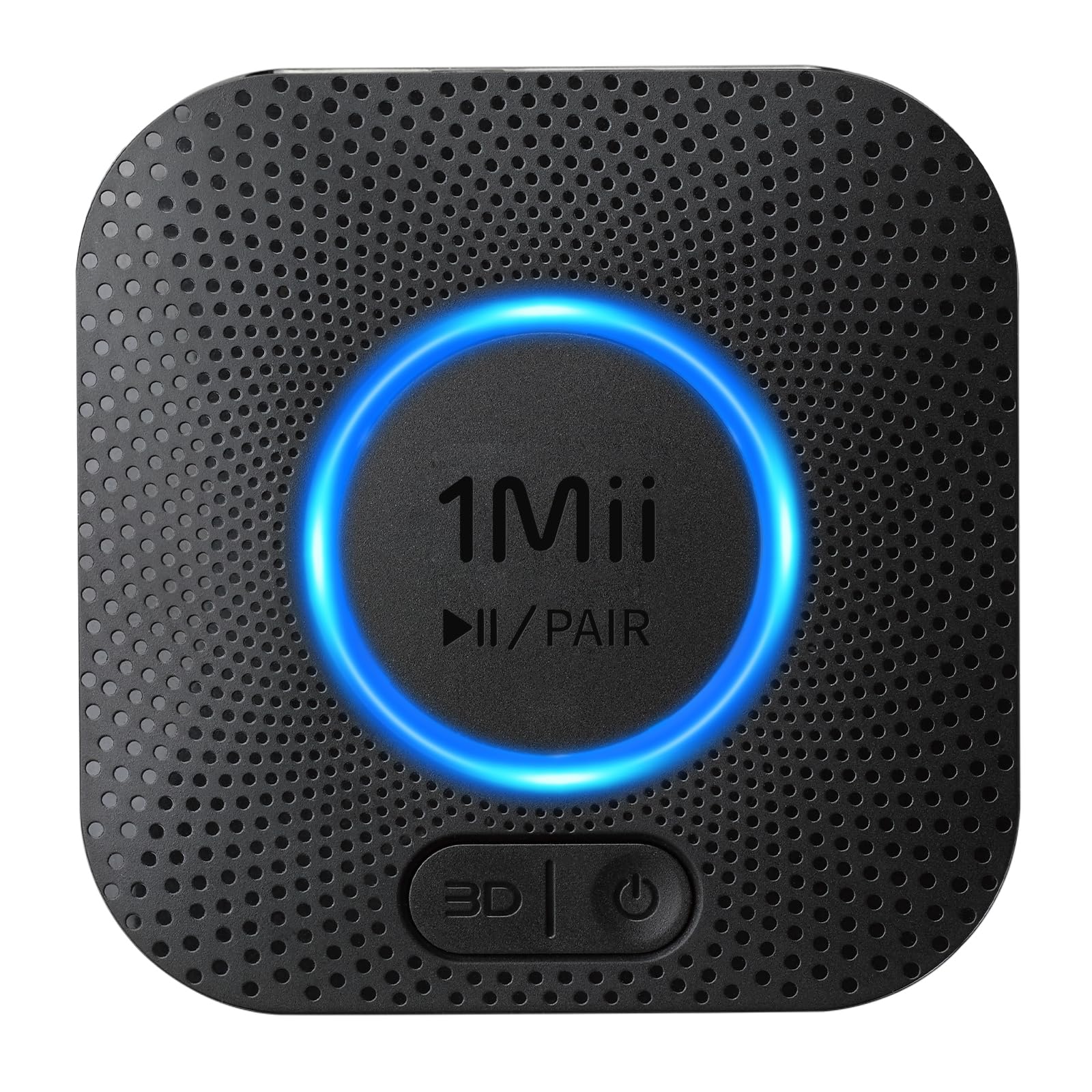
1Mii B06+ Bluetooth Receiver

89 /100
LBD Score Excellent

Key details

Power
USB power adapter included
Range
Up to 98 ft line-of-sight
Outputs
3.5 mm and RCA
Bluetooth
5.3 with aptX HD
View on Amazon

The B06+ lists up to 98 feet of line-of-sight range, and that number is the one that changes how you live with a stereo adapter: the phone can stay in the kitchen while the amplifier plays in the study, and nobody has to walk over to skip a track. Class 1 Bluetooth does that work. The rest of the spec sheet — Bluetooth 5.3, aptX HD, a 3D surround mode you'll probably leave off — is there for the sound, and 1Mii includes the USB power adapter rather than leaving you to find one.

What makes it the pick we point people to first is how little it asks of you. Plug it into a spare RCA pair or a 3.5 mm jack, press the button, pair once, and from then on it powers up with the stereo and reconnects on its own. There's a real off button too, so you can stop it answering when you don't want it to. Nothing about it is fancy, and the money over the cheapest boxes here goes into range and codecs rather than a screen or a battery.

Noise is where our enthusiasm cools. A faint static or hum turns up on some units and doesn't always stop when the music does, and the first thing worth trying is the RCA jacks rather than the 3.5 mm cable — that swap is the one that settles it. If your amp has both, start there. Otherwise this is a mid-priced adapter that does the one job and stays out of the way.

Pros

  • Range that covers a whole house
  • aptX HD and 3D surround modes
  • Power adapter and RCA cable included
  • Reconnects on power-up, with a real off button

Cons

  • No optical or coaxial output
Our verdict

We recommend the B06+ first: it has the range to reach across a house, the codecs to keep a decent system sounding decent, and a power adapter in the box.

Check Latest Price
2

Best for One-Room Simplicity

Esinkin Bluetooth Audio Adapter

91 /100
LBD Score Outstanding

Key details

Power
AC adapter or USB; no battery
Range
30 to 40 ft indoors
Outputs
3.5 mm and RCA
Bluetooth
4.0
View on Amazon

There's no power switch on the Esinkin, which sounds like an oversight until you've lived with it for a week: it comes on with the stereo, reconnects to the last phone it saw, and goes back to being invisible. The Bluetooth symbol in the middle is the only control — one press to pair — and that's the entire interface. In a house where one person does the streaming, that's exactly enough.

The box is a two-inch cube, small enough to sit behind a receiver or on a bookshelf without asking for space, and it feeds a stereo through 3.5 mm or RCA. Inside is Bluetooth 4.0 with no aptX or LDAC, and Esinkin rates the range at 30 to 40 feet indoors. Nothing here is audiophile-grade, and if that's the goal you're reading the wrong paragraph — but the phone does all the thinking and the adapter just plays, which is the whole appeal.

Being always on cuts both ways. It's ready the second you pick up your phone, and it will also grab whichever paired phone wanders into range first, which gets old in a shared house. Put it on a switched outlet and that stops. Longer term, the thing to plan for is that this model doesn't always age well — units quitting after a few weeks come up often enough that buying it somewhere with an easy return is worth the two minutes.

Pros

  • One-button pairing with nothing to configure
  • Two-inch footprint hides behind a receiver
  • Works over RCA or 3.5 mm

Cons

  • Bluetooth 4.0 only
  • 30 to 40 ft range keeps it in one room
Our verdict

If you want the simplest adapter going and one room is all you're covering, we think the Esinkin is the easiest one to live with.

Check Latest Price
3

Best for Hi-Res Streaming

UGREEN Bluetooth 6.0 LDAC Receiver

90 /100
LBD Score Outstanding

Key details

Battery
Up to 15 hours
Outputs
3.5 mm and RCA
Charging
USB-C, 2-hour charge
Bluetooth
6.0 with LDAC
View on Amazon

LDAC is what separates the UGREEN from the budget boxes here, and it's the spec that matters if you stream from a service that actually serves hi-res and the amplifier downstream is worth the trouble. Bluetooth 6.0, a 60 g body, and dual pairing for two phones fill out the rest. The physical connections are 3.5 mm and RCA only, so a receiver with nothing but digital inputs is out.

It's also the only pick here with a battery: 15 hours, charged over USB-C in about two. On a shelf that's one more thing to remember. Carried out to a porch or a workshop, it's the reason to choose it — the adapter moves to whatever powered speaker is nearby instead of you hunting for an outlet.

Where it earns its spot for us is the combination: it's the one here that streams hi-res at home and still works unplugged. For a desk setup, a rented apartment, or a system you rearrange more than once a year, that flexibility is worth more than the extra range the top pick offers.

The controls are the weak part. There's one button and very little to tell you what state it's in, and it drops into sleep mode when it's been idle and needs a press to wake. That's fine if it sits next to you, and it's a genuine annoyance if it's tucked behind a receiver — reachable placement fixes both, so decide where it lives before you pair it.

Pros

  • LDAC decoding for hi-res sources
  • 15-hour battery with USB-C charging
  • Pairs two phones at once
  • Small enough to move between rooms

Cons

  • Battery has to be recharged for shelf use
  • No optical or digital output
Our verdict

Our pick for anyone who wants hi-res streaming and the freedom to unplug: LDAC on the shelf, fifteen hours in a bag.

Check Latest Price
4

Best Premium

Auris Blume HD Bluetooth Receiver

92 /100
LBD Score Outstanding

Key details

DAC
384 kHz/32-bit upsampling
Range
Up to 100+ ft
Codecs
LDAC, aptX HD, AAC
Outputs
RCA and optical
View on Amazon

The bluMe HD is the most expensive thing on this page by a wide margin, and it isn't shy about why: a 384 kHz/32-bit upsampling DAC, LDAC, aptX HD and aptX Low Latency, and both RCA and optical outputs in a box that looks like hi-fi rather than a dongle. Nobody needs any of that to stream a standard playlist to a bookshelf system.

Whether it's worth it depends entirely on what's downstream. Feeding a pair of powered speakers you bought on sale, the DAC and the codecs won't rescue anything, and a cheaper pick here will sound the same. Feeding an amplifier and speakers you already love, this is the one that won't be the weak link — it's the adapter we kept coming back to whenever the system was worth sitting down for.

Setup is quick even by the standards of this group: pair in seconds, reconnect automatically, and the 100+ ft range holds across a floor of a house. One thing we noticed and couldn't unhear is that it beeps on power-up and again on connection, with no way to silence it. In a living room that's nothing; in a bedroom it's the reason we left it out of the bedroom.

Pros

  • True hi-fi DAC with LDAC and aptX HD
  • Optical and analog outputs together
  • Range that holds across a floor
  • Pairs in seconds and stays connected

Cons

  • Power-loss failures on some units
Our verdict

Buy the bluMe HD only if the system behind it deserves it — and then we think it's the most capable receiver here.

Check Latest Price
5

Best Budget

KAIY C37 Bluetooth 5.4 Receiver

88 /100
LBD Score Excellent

Key details

Range
33 ft
Display
LCD showing volume and mode
Outputs
Optical, RCA, 3.5 mm
Bluetooth
5.4
View on Amazon

Optical, RCA, and 3.5 mm on the same inexpensive box is why the C37 is here: it's the only pick in this group that covers all three, and KAIY puts a cable for each in the box. If your amplifier has a spare digital input, that's the cleanest way to add Bluetooth to it, and this is the cheapest route to it on this page.

The rest of the package is more than the money suggests: Bluetooth 5.4, a small LCD that shows volume and connection state so you aren't guessing by blinking lights, buttons on top, and a USB port that plays files off a flash drive. The one thing missing is a power adapter — you get a USB-C cable and need your own 5V block, so work out where it will plug in before it arrives.

Two trade-offs to weigh. The range is 33 feet, the shortest here, which is fine for one room and frustrating if you wander. And optical isn't automatically the better connection: with a digital cable the volume runs lower than it does over RCA, so if your amp's digital input can't give you enough level, move to the analog jacks — the C37 has both, which is the whole point of it.

Pros

  • Optical, RCA, and 3.5 mm outputs, cables included
  • LCD shows volume and connection state
  • Bluetooth 5.4 on a budget box
  • Plays files from a USB flash drive

Cons

  • 33 ft range is one-room only
Our verdict

We keep the C37 for amplifiers with a free optical input; it covers all three connection types and throws in the cables.

Check Latest Price
6

Boosting Quiet Sources

YMOO B06T3 Bluetooth Receiver

89 /100
LBD Score Excellent

Key details

Range
Up to 100 ft
Outputs
RCA and 3.5 mm
Controls
Volume dial with boost
Bluetooth
5.3
View on Amazon

The dial on top of the YMOO is the biggest control on any receiver here, and it does something the others don't: it adds gain as well as cutting it. If you've maxed the phone and the old amp still sounds thin on an aux input, that boost is the entire point of this box, and the knob falls under your hand without a menu.

The rest is straightforward. Bluetooth 5.3, a claimed 100 feet of range, RCA and 3.5 mm outputs, auto-reconnect, and a 45 g body that sits on a shelf without complaint. Volume changes on the dial follow the phone's own volume, so the two don't fight each other, which is more than we can say for some of the app-free boxes here.

Sound is the part that gives us pause. This is the pick where quality divides most sharply, and the boost is a double-edged control — it lifts whatever noise sits under a quiet recording along with the music. If your receiver has a normal line input and your phone already plays loud enough, you're buying a dial you won't use, and there are cleaner-sounding options here at a similar price.

Pros

  • Big dial with real gain, not just attenuation
  • 100 ft range on Bluetooth 5.3
  • RCA and 3.5 mm outputs

Cons

  • Sound quality varies between units
Our verdict

The YMOO is worth it if your phone can't drive an old amplifier loud enough, and you can live with sound that varies from unit to unit.

Check Latest Price
7

Set-And-Forget

Blackhorse Bluetooth Receiver

88 /100
LBD Score Excellent

Key details

Power
AC powered, no battery
Setup
Auto-reconnects on power-up
Latency
Low-latency mode
Outputs
RCA and 3.5 mm
View on Amazon

No optical output, no battery, no screen: the Blackhorse is a small gray box that takes Bluetooth in and puts it out through RCA or 3.5 mm, powered from the wall. That's the whole proposition. For plenty of people with an old receiver and a free aux pair, it's also the only thing they need, and the lack of features is the feature.

The basics are handled. It powers up, reconnects to the last device, pairs from a single button, and the chipset claims a low-latency mode for video. At 37 g it sits on a shelf or on top of a receiver without any drama, and there's nothing to charge, which is more than the battery pick here can say.

Power is the fussy bit. Some units need the plug pulled and reconnected before they'll wake and pair again, which is invisible on a spec sheet and obvious on a Tuesday night. Give it an outlet you can reach, ideally a switched one, and the whole annoyance goes away in three seconds.

Judged against the rest of this group, it's the plain, dependable answer for an amplifier with an analog input going spare: it does the job, it's small, and it doesn't want anything from you. If you have a free optical jack, or you need the phone to work two rooms away, look further up this page.

Pros

  • Wall-powered, so nothing to recharge
  • Auto-reconnects to the last device
  • RCA and 3.5 mm outputs

Cons

  • No optical or digital output
Our verdict

A small, wall-powered box that does the one job — we like it for a receiver with a spare analog input and no patience for extras.

Check Latest Price
8

Cheap Second System

Ultrbeka BR02 Bluetooth Receiver

82 /100
LBD Score Excellent

Key details

Outputs
RCA and 3.5 mm
Bluetooth
6.0
In The Box
USB-C and RCA-to-3.5 mm cables
Paired Devices
Remembers up to five
View on Amazon

Open the box and you get a receiver, a USB-C cable, and an RCA-to-3.5 mm cable — no power block. That's the first thing to know about the Ultrbeka, because the bundled cable is short, so where the nearest charger sits decides where the box can live before you've heard a note out of it.

Once it's powered, it behaves like an updated version of the cheap boxes here: Bluetooth 6.0, RCA and 3.5 mm outputs, buttons for volume and track skipping, and enough memory to hold five devices, so a houseful of phones doesn't mean re-pairing every time someone visits.

It's also the newest, least-proven pick in this group. What's there reads well, and a two-year manufacturer warranty is a decent hedge on a box this cheap, but you're buying ahead of the track record the 1Mii and the Esinkin have behind them.

Where we land: it's a sensible way to put Bluetooth on a second system — a garage rig, a bedroom setup, a pair of powered speakers — provided you have a spare charger and an outlet within reach of that short cable. For the main system you'll live with for years, the small step up to a better-supported pick is money well spent.

Pros

  • Bluetooth 6.0 with two devices connected
  • Remembers up to five paired devices
  • Buttons for volume and track skipping
  • Two-year manufacturer warranty

Cons

  • No power adapter, and a short USB-C cable
Our verdict

A cheap, tidy way to add Bluetooth to a second system, as long as you have a USB charger and don't mind a short cable.

Check Latest Price

How We Tested the Best Bluetooth Receivers

We started by gathering every receiver we could find with RCA or 3.5mm outputs and a price that made sense for a small upgrade, then cut anything whose listing didn't name its supported codecs or that had a clear pattern of pairing complaints behind it. That left 15 units, which we lived with for four months rather than an afternoon.

Each one spent time on three systems: a decades-old receiver in a living room, a pair of powered bookshelf speakers in a home office, and a compact amp out in the garage. We timed the first pairing with the manual face down, then tried again a week later to see whether the adapter remembered the phone on its own, and again after cutting power to the amp to check whether it reconnected before we sat back down.

For range, we put the phone in a pocket and walked to the far end of the house and out the door, noting the exact spot where audio began to stutter. For noise, we turned the amp up with nothing playing and listened for hiss, then played the same few tracks across every adapter to hear which ones smoothed over details and which ones sounded thin. We kept a running list of what actually came in the box — RCA cable, 3.5mm cable, wall adapter or just a USB cord — because an adapter that needs an outlet you don't have is a problem no codec can fix, and we checked lip sync by playing video to see which units introduced a visible delay.

How to Choose a Bluetooth Receiver for a Stereo

Match the output to a free input

Every pick here sends audio out on RCA jacks, a 3.5 mm plug, or an optical cable, and your amplifier needs the matching input free. Analog is the easy case — any spare tape, CD, or aux pair will do. Optical only matters if your receiver has a digital jack, and it isn't automatically the better connection: on the budget optical models the digital output runs quieter than the analog one, so try both before you decide.

Count your free inputs before you order. If there's exactly one and it's already taken by a CD player, you're shopping for a switch box as well as an adapter.

Range claims are measured in open air

Manufacturers quote line-of-sight numbers, which is why a receiver rated at 98 feet can stutter in the next room. Walls, a metal cabinet, and the amplifier's own power supply all cost you distance. If the phone moves around the house, choose one of the long-range models here — the 1Mii, the YMOO, or the Blume HD — and sit it high and outside a closed cabinet rather than buried behind the amp.

Codecs only count when both ends support them

SBC is the floor, AAC is what an iPhone sends, and aptX HD and LDAC are the higher-quality options — but only if your phone and the app you stream from actually use them. For ordinary streaming quality, the premium buys nothing you'll hear. If you keep lossless files or pay for a hi-res tier, the two LDAC picks here, the UGREEN and the Blume HD, are the ones worth the extra.

Check the box for power, not just the plug

Most of these are USB-powered, and USB-powered often means a cable and no adapter — which leaves you hunting a charger and a free outlet behind the furniture. A wall-powered box is the least fuss for a permanent install; a battery model like the UGREEN makes sense only if you'll genuinely carry it to another room. If more than one person streams, look for a real off switch as well.

Decide how pairing should behave

Auto-reconnect is convenient until the adapter grabs a paired phone the moment someone walks through the door. Dual pairing means two devices are remembered, not that two play at once. In a shared house, a unit with an off switch — or a switched outlet — settles most of the arguments. For a system only you use, the simplest box is usually the one you'll forget about fastest.

Frequently Asked Questions

Final Verdict

For most stereos the 1Mii B06+ is the one to buy. It asks for an outlet and a spare input, reconnects on its own, and has the range to survive a house rather than a shelf.

Go elsewhere for a specific reason: the KAIY C37 if your amplifier has a free optical jack, the UGREEN if you want LDAC and a battery, the Blume HD if the amplifier and speakers behind it are genuinely good. The Esinkin stays the simplest thing here if one room is all you need to cover.