Best Action Cameras for Scuba Diving of 2026

Scuba diving gives a camera more ways to fail than almost any other hobby: pressure at depth, salt water working into the seams, batteries that fade in cold water, and footage that comes home looking like green soup. I've watched a borrowed camera flood at 60 feet, and I've edited clips too murky to rescue. What you want is a camera that survives the dive and hands you something worth showing afterward.

We spent six months putting 12 action cameras through pool sessions, a cold quarry, and a week of boat dives. The gaps showed up fast: battery drain between dives, how footage looks when you edit it at night, and whether the app talks to your phone with no signal on deck.

One thing worth knowing before you shop: a depth rating isn't a dive rating. Some cameras go deep on their own, others need a housing, and a case that leaks ends a dive faster than a weak sensor. The picks below came back with usable footage — and worked again the next day.

1

Best Overall

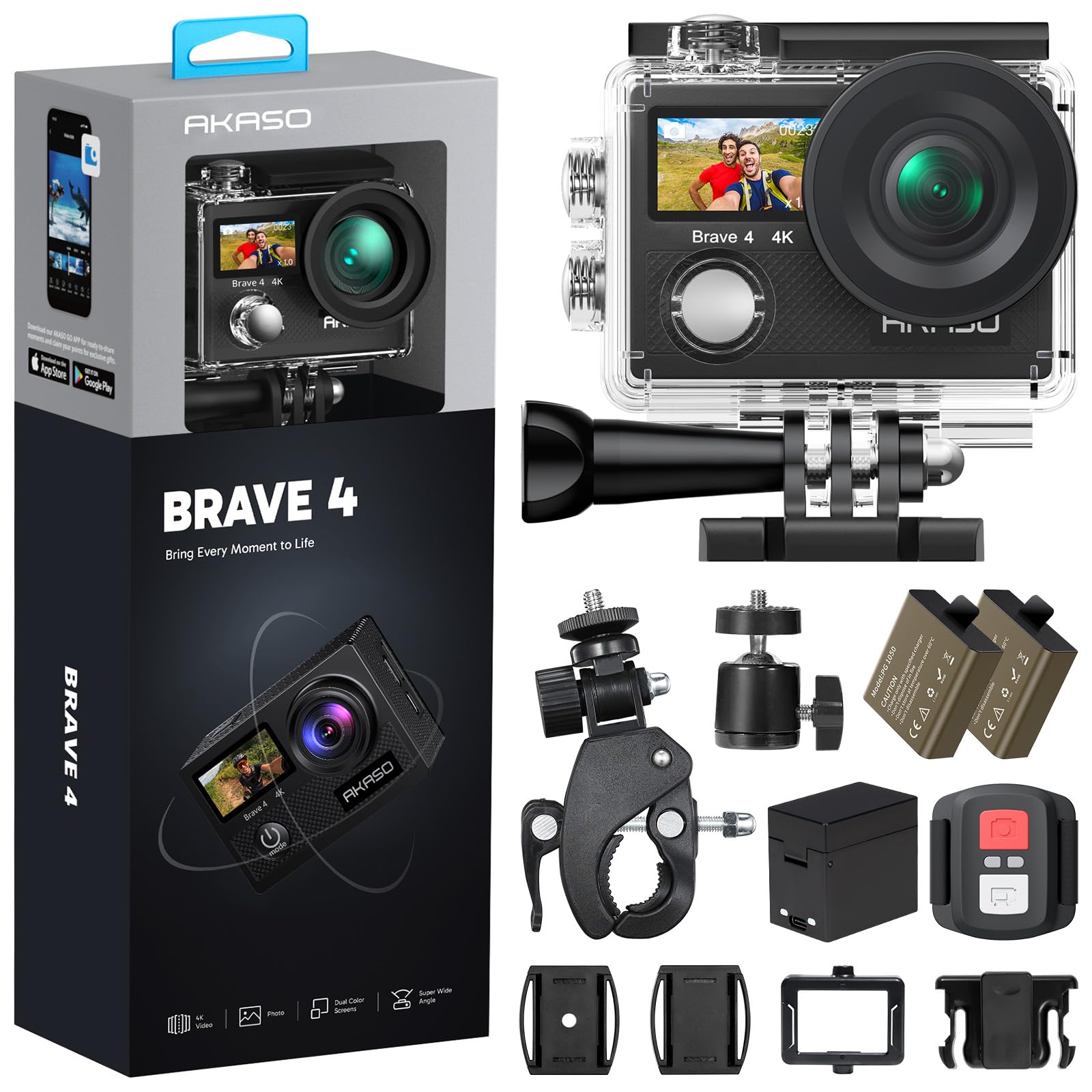
AKASO Brave 4

89 /100
LBD Score Excellent

Key details

Max Video
4K 30fps
Field Of View
170° / 140° / 110° / 70°
Batteries Included
2 x 1050mAh
Depth With Housing
131 ft (40 m)
View on Amazon

Four selectable field-of-view settings — 170, 140, 110 and 70 degrees — sounds like a footnote until you have watched a reef shrink into the middle of a very wide frame. The 70-degree setting is the one that earns its place: from a metre away it fills the frame with a coral head instead of leaving it a smudge in the distance.

That single control is much of why this is our top pick. Add a housing rated to 131 feet in the box, two 1050mAh batteries with a charger, and enough mounts to fix it to a tray, a wrist strap or a helmet, and the value argument stops being close. Nothing else here arrives this complete for the money.

Where it gives ground is the picture. Electronic stabilization smooths fin kick without ever looking gimbal-locked, and when the light drops the grain arrives well before the footage does. Dropping to 1080p at 60 frames per second is the fix on a dim second dive — smoother motion, cleaner image, fewer pixels.

Plan the power, too. Two 1050mAh cells at roughly 90 minutes of recording each is a two-dive kit, not a four-dive one, so a power bank for the surface interval belongs in the dry bag. Wi-Fi and HDMI both make the cut, which means you can pull clips onto a tablet over dinner rather than squinting at the rear screen.

Pros

  • Selectable 170, 140, 110 and 70 degree views
  • 131 ft waterproof housing included
  • Two batteries, charger and full mount kit
  • Front and rear screens for framing

Cons

  • 4K recording tops out at 30fps
Our verdict

Our default for recreational diving: a housing rated past sport-diving limits, four field-of-view settings that keep reef subjects big in frame, and a kit you can take out of the box.

Check Latest Price
2

Best Image Quality

DJI Osmo Action 4

93 /100
LBD Score Outstanding

Key details

Color
10-bit with D-Log M
Sensor
1/1.3-inch
Max Video
4K 120fps
Battery (stated)
150 min
View on Amazon

The Osmo Action 4 puts a 1/1.3-inch sensor and 2.4-micron pixels behind the lens, and that is the number that matters once you are below ten metres, where light falls away fast and small sensors turn to mush. We think it produces the best footage of anything here, and the gap widens exactly where dive video usually falls apart.

Ten-bit color and DJI's D-Log M profile are the other half of it. Water eats red first, and a flat profile leaves you room to push it back in an editor instead of accepting the blue-green cast most dive cameras hand you. If you never open an editor, that is wasted on you. If you do, it is the difference between usable and lovely.

The catch decides whether you can buy it at all: the listing never publishes a dive depth. Treat it as a camera that lives in a housing and confirm the rating against the depth you actually dive. The 155-degree lens is wide enough to shrink a reef, so get close. And the 1770mAh battery is rated at 150 minutes, which covers a two-tank morning if you stop recording between dives.

Pros

  • 1/1.3-inch sensor holds color at depth
  • 10-bit color with D-Log M for grading
  • Battery rated at 150 minutes
  • Magnetic quick-release mount

Cons

No notable drawbacks to flag.

Our verdict

The best footage in this guide, and the one we choose when the dive is worth remembering properly: a bigger sensor and 10-bit color, provided you add a housing.

Check Latest Price
3

Best for Snorkeling and Shallow Dives

GoPro HERO12 Black

89 /100
LBD Score Excellent

Key details

Photo
27MP
Max Video
5.3K 60fps
Stabilization
HyperSmooth 6.0
Waterproof, No Housing
33 ft (10 m)
View on Amazon

Thirty-three feet is the number to read first. That is the HERO12's waterproofing with no case at all, which comfortably covers snorkeling, a shallow reef and the pool — and stops well short of a sport dive. Past ten metres you are adding a housing, and that changes the arithmetic.

What you get for the money is the most sophisticated stabilization in this group and HDR that keeps a bright surface and a shadowed ledge in the same frame. HyperSmooth 6.0 is genuinely good at the slow roll of a surge, and 5.3K leaves room to crop a wide shot into something tighter after the fact.

Where that leaves us: this is the one we reach for on a snorkel or a first reef at twelve metres, where the factory seal means one less thing to fail. For a full dive, the housing you need on top pushes the total past the DJI Action 4, which does the same job with a bigger sensor.

Pros

  • Waterproof to 33 ft with no housing
  • 5.3K HDR video and photo
  • HyperSmooth 6.0 stabilization

Cons

  • Runs hot during long high-bitrate takes
Our verdict

Our pick for snorkeling and the first ten metres: sealed at the factory to 33 feet, with HDR that holds a bright surface and a shadowed ledge in one shot.

Check Latest Price
4

Best Premium

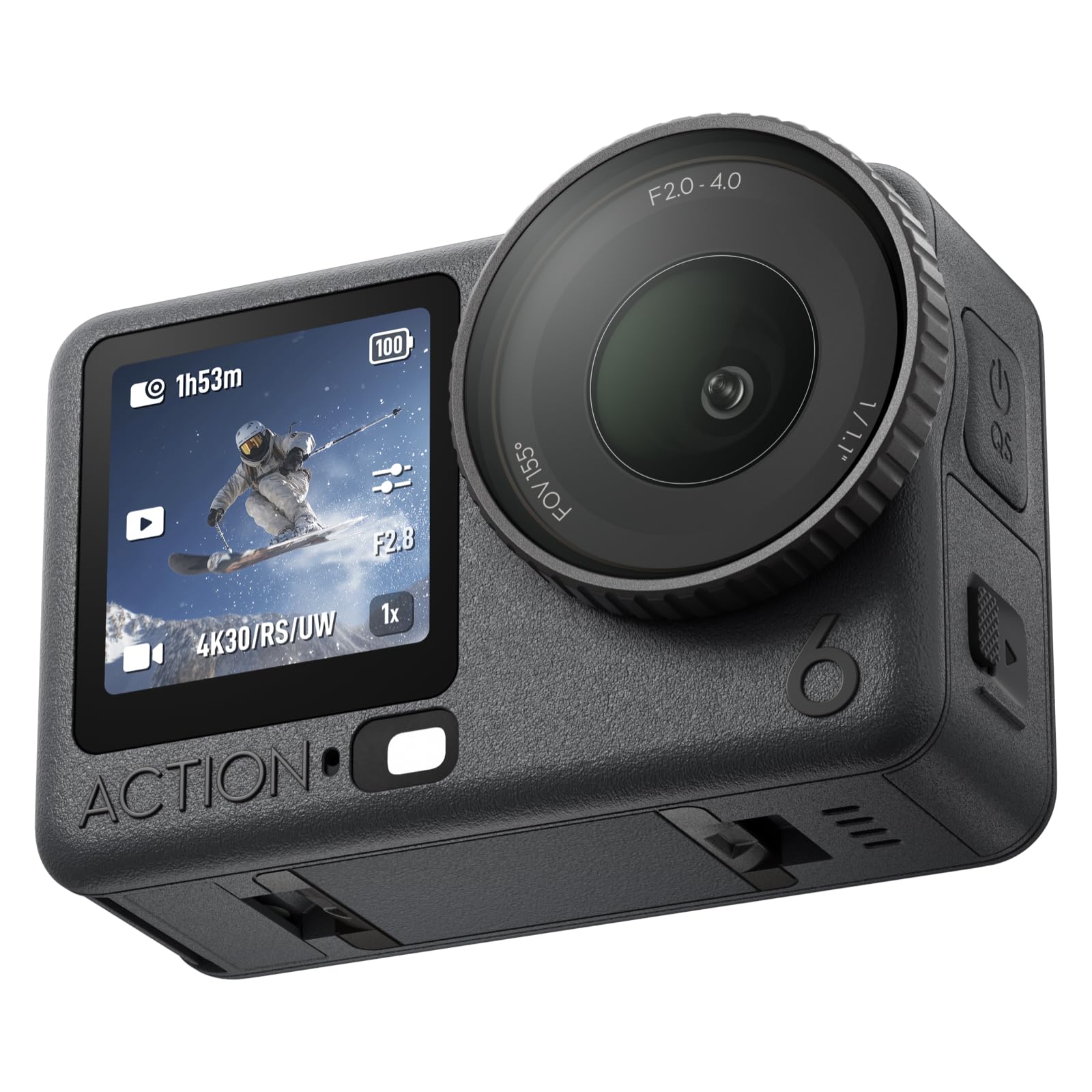
DJI Osmo Action 6

90 /100
LBD Score Outstanding

Key details

Sensor
1/1.1-inch square
Aperture
f/2.0-f/4.0
Max Video
8K
Battery (stated)
4 hours
View on Amazon

The Osmo Action 6 sits near the top of this group on price, and what that buys is control rather than resolution — though there is plenty of that too, at 8K from a 1/1.1-inch square sensor.

The variable aperture is the part that matters underwater. It runs from f/2.0 to f/4.0, so you can open it wide on a dim second dive and stop it down in bright shallow water where a fixed f/2.8 burns out the highlights. No other camera here offers that, and you notice it in the footage rather than on the page.

Four hours from one Extreme battery is the longest stated runtime in this guide, and 50GB of built-in storage means the camera works before a memory card turns up. As with DJI's other cameras here, the listing does not publish a dive depth, so a housing is part of the budget.

So: is it worth it? Shoot for a channel and grade D-Log M on a real screen, and the aperture and the sensor earn the difference back. Send clips straight to a phone and the Brave 4 gets you most of the way for a lot less money.

Pros

  • Variable aperture from f/2.0 to f/4.0
  • Longest stated battery life here at four hours
  • 1/1.1-inch square sensor with 8K video
  • 50GB of built-in storage

Cons

  • 8K files demand a serious editing setup
Our verdict

The best footage in this group, and the price reflects it: variable aperture, a square 1/1.1-inch sensor and four hours of battery for divers who will actually use them.

Check Latest Price
5

Best 360 Dive Bundle

Insta360 X3 Dive Bundle

93 /100
LBD Score Outstanding

Key details

Sensors
Dual 1/2-inch 48MP
Max Video
5.7K 360°
In The Box
Invisible Dive Case, floating grip, selfie stick, lens cap
Single-lens
4K 30fps
View on Amazon

The box is the argument: an X3, a dive case made for it, a floating hand grip and a 114 cm selfie stick. No other bundle here arrives dive-ready, and a case that fits properly is the part most people end up improvising.

Shooting 360 changes what you do in the water. Instead of aiming, you swim with the camera and choose the frame later, so one pass over a wreck gives you a wide shot, a following shot and a look back at your buddy. The selfie stick disappears from the footage entirely — the camera appears to float a metre in front of you.

The cost is time. Reframing is a real editing job, and the app decides whether that is a pleasant evening or a chore. The failure that would ruin a trip is water getting past the case seal, so test the case in a bucket before you trust it on a liveaboard.

For a diver who wants footage that looks like it came off a boat crew rather than a headcam, the editing hours are worth it. Horizon lock is the quiet win: roll off a wreck and the world stays upright, a shot that is near impossible to hold steady on a stick otherwise.

Pros

  • Dive case, floating grip and selfie stick included
  • Reframe a single 360 shot into any angle
  • Selfie stick disappears from the footage
  • 5.7K 360 with horizon lock

Cons

  • Only one battery in the box
Our verdict

Buy it if you want dive footage that does not look like dive footage: the 360 frame you choose later, and a selfie stick that vanishes from the shot.

Check Latest Price
6

Best Step-Up Value

AKASO Brave 7 LE

89 /100
LBD Score Excellent

Key details

Max Video
4K 30fps
Stabilization
6-axis EIS 2.0
Batteries Included
2 x 1350mAh
Depth With Housing
131 ft
View on Amazon

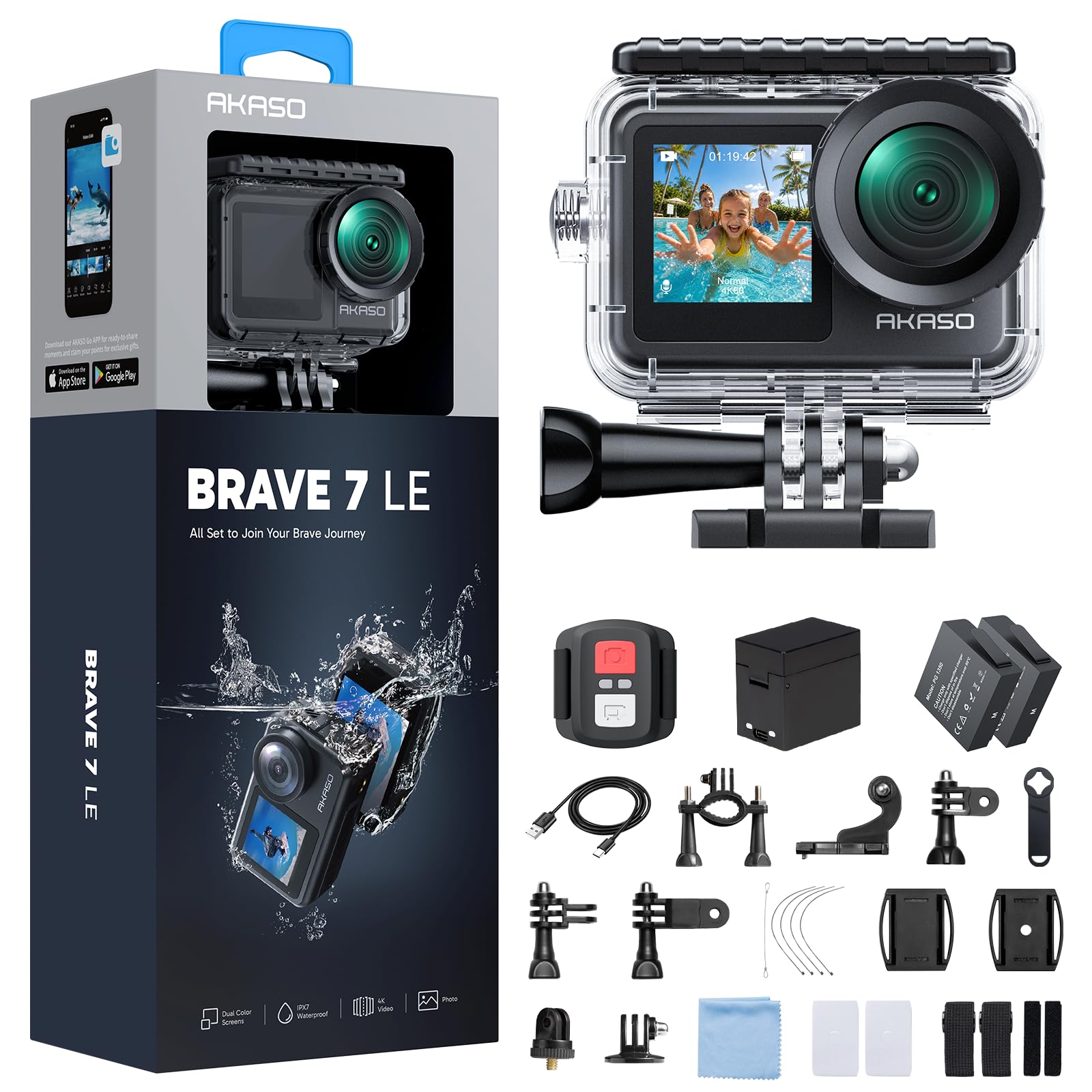
Same brand, more money, different job. If the Brave 4 is the sensible default, the Brave 7 LE is the one you buy to see what you are shooting: a colour front screen for framing a fin-kick selfie, and a 2-inch touchscreen on the back whose menus do not need the manual. For anyone who has come home with twenty minutes of their own outstretched arm, it is the more useful camera.

The body is rated IPX7, so rain, spray and a rinse at the tap do not need the housing at all; the case goes on for anything that gets submerged. Two 1350mAh batteries are quoted at two hours each, a genuine step up from the 1050mAh cells in the cheaper kits, and there is a remote in the box for when the camera is out on a tray.

Where it gives ground is the picture. The ceiling is still 4K at 30 frames per second, and the colour does not have the depth the DJI sensors manage. You are paying for handling and battery life here, not for footage that will survive a big screen.

Pros

  • Front colour screen for self-framing
  • IPX7 body handles spray without the case
  • Two 1350mAh batteries, two hours each
  • Remote and waterproof housing included

Cons

  • Costs noticeably more than our top pick for similar footage
Our verdict

The step-up AKASO: a front screen for framing yourself, an IPX7 body for the boat, and two bigger batteries — the pick for divers who want to see themselves in frame.

Check Latest Price
7

Best Budget

icefox i8

84 /100
LBD Score Excellent

Key details

Photo
20MP
Max Video
4K 30fps
Batteries Included
2 x 1350mAh
Depth With Housing
98 ft (30 m)
View on Amazon

It is the least expensive camera here, and the housing is rated to 98 feet. Thirty metres is deeper than the profile most charter boats actually run, which makes the saving a smaller compromise than it looks on paper.

Two 1350mAh batteries, a charger and a mount kit with a bicycle mount and a 360-degree screw all come in the box, which is the right priority at this price — accessories are what make a cheap camera usable on a boat. The weak link is the app: if the phone will not pair, you are pulling the card and reaching for a reader.

Where it earns its place is as the camera you do not mind dangling off a BCD over a wreck. Ninety-eight feet, a spare battery and a housing that comes back dry is most of what a first dive trip needs, and the money you save pays for the trip. What it will not do is hold colour at depth or steady a shot like the branded cameras — if the footage matters more than the memory, spend more.

Pros

  • Least expensive dive-rated camera here
  • Two 1350mAh batteries and a charger
  • Housing rated to 98 ft (30 m)

Cons

  • App pairing is unreliable
Our verdict

The cheapest way into dive footage that is actually rated for it — 98 feet, two batteries and a full mount kit, with image quality to match the price.

Check Latest Price
8

Budget Dual Screen

Hiicam Speed 20

83 /100
LBD Score Excellent

Key details

Screens
2-inch touch + 1.4-inch front
Max Video
4K 30fps
Batteries Included
2
Depth With Housing
131 ft
View on Amazon

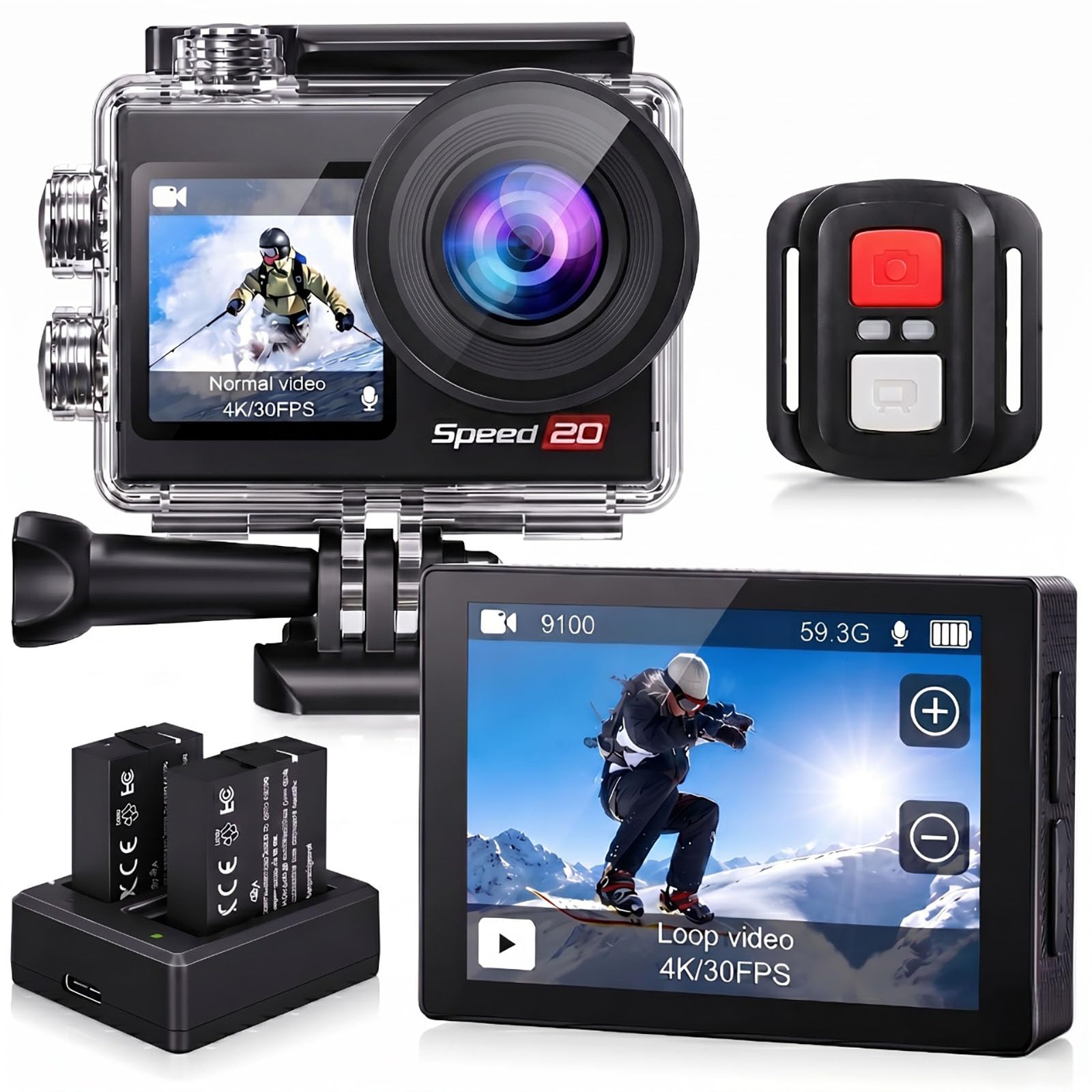
On paper the Speed 20 looks like it belongs on a more expensive camera: a 2-inch touchscreen on the back, a 1.4-inch front display, a 131-foot housing, a remote, two batteries and electronic stabilization. It is a spec list that reads like a much bigger brand wrote it.

What it does not have is a history. The name is new, the evidence behind it is thin, and the warranty runs six months where the AKASO kits carry a year. Our read: a reasonable second body, a gift for a teenager who snorkels, or a spare for the boat bag — not the camera to plan a liveaboard around.

The listing gives one field of view, 170 degrees, with no narrower option, and that is the widest setting in this guide and the worst for filling the frame with a reef subject. If you mostly shoot snorkel clips in good light and you like the dual-screen look, it does the job at a price that is hard to argue with.

Pros

  • Dual screens with a front display
  • Housing rated to 131 ft
  • Remote, two batteries and a touchscreen included

Cons

  • Six-month warranty is the shortest here
  • Little track record to judge reliability
Our verdict

A dual-screen, 131-foot camera at a budget price — a good second body or snorkel pick, as long as you do not need a year of warranty.

Check Latest Price

How We Tested Action Cameras for Diving

We started with every camera claiming a genuine depth rating, then cut by the things that decide a dive camera: whether it's waterproof on its own or only inside a housing, whether stabilization is built in, how many batteries come in the box, and whether there's any realistic path to editing without a laptop. We bought 12 across the price range and dove them for six months.

Each one went through the same outings: a pool session in 12 feet, a cold quarry dive to 60 feet, and a week of boat dives in the 80- to 100-foot range, plus snorkel sessions in between. I logged battery percentage after every splash and counted how many dives each lasted on a charge — that number dropped sharply in cold water on several models. I sealed and latched every housing the way I would on a real trip, checked the lens port for fogging at depth, and ran continuous recording until a camera overheated and shut down; one did, on a shallow reef in about 20 feet of water.

Back on land, I watched every clip on a laptop at night, looking for stabilization wobble while finning, color shift at depth without a filter, and blown highlights near the surface. I timed how long it took to get one shareable clip out of each camera's app, and how the wireless transfer behaved on a boat with no Wi-Fi, since connectivity and editing are where the cheaper cameras separate from the rest.

Build quality got its own pass: buttons and touchscreens with 3mm gloves on, latches worked one-handed on a rolling deck, and every camera's footage checked again after a week of salt water to see whether image quality held or the seals had started weeping.

How to Choose an Action Camera for Scuba Diving

Read the depth rating the right way

Every camera here carries two different numbers and they are not interchangeable. Native waterproofing is what the bare body survives — 33 feet on the GoPro HERO12, nothing published at all on the DJI models. Housing depth is what the box gets you: 131 feet on the AKASO and Hiicam kits, 98 feet on the icefox. Sport diving runs to about 130 feet, so a 98-foot case covers ordinary charter profiles and not a deep wreck.

If a listing publishes no depth, don't assume one. Budget for a housing and confirm its rating against the deepest dive on your card — that's a line item, not a reason to rule the camera out.

Narrow the field of view, or swim closer

A 170-degree lens is sold as a feature and behaves like a problem underwater: the reef shrinks, the subject drifts into the middle distance, and everything looks farther away than it was. Cameras with selectable angles — the Brave 4 offers 170, 140, 110 and 70 degrees — let you fill the frame from a metre away, which is usually as close as you can get without touching anything. If yours is fixed wide, plan on swimming in and cropping later.

Plan for the color you will lose

Water absorbs red first, which is why dive footage comes home blue-green. There are two fixes. A red filter on the housing is cheap, but it is only correct at one depth in one light. The other is capturing enough color data to correct afterwards, which is what 10-bit recording and a flat profile like D-Log M are for — both DJI cameras here have them.

Be honest about whether you will actually sit down and grade. If the answer is no, buy a filter that fits your housing and put the difference into a spare battery.

Treat battery life as part of the dive plan

A two-tank morning runs three to four hours with the surface interval, and nothing here records that long in one go. Stated runtimes start around 90 minutes per cell on the cheaper AKASO kits and reach four hours on the Osmo Action 6.

Carry two or three batteries and a charger that runs off a power bank, and swap cells on the surface, dry, with the camera turned away from spray. Every time you open a housing you re-risk the seal, so check the gasket for sand before it goes back together.

Controls and mounts, with gloves on

Underwater you are wearing neoprene and the camera is in a box, so what matters is physical: a shutter button you can find by feel, a mount that does not need two hands, and a screen you can actually see. A tray and handle steadies the shot and gives you something to hold; a wrist mount is worse underwater because you cannot see what you are framing.

Check on land whether your housing's front door works with the touchscreen — many rigid cases do not — and learn the button menu before you are at twenty metres.

Frequently Asked Questions

Final Verdict

Dive footage is decided before you get in the water, which is why the AKASO Brave 4 is our pick: a 131-foot housing in the box, four field-of-view settings that keep a subject large in frame, and enough left over for a desiccant sachet and a spare battery.

If the footage is the point and you will put in the editing hours, the DJI Osmo Action 4 is the better camera — a 1/1.3-inch sensor and 10-bit D-Log M — once you have added a housing and confirmed its depth rating against your own dive plan.